Ashy Ruba A, Jalal Rewaa S, Sonbol Hana S, Alqahtani Mashael D, Sefrji Fatmah O, Alshareef Sahar A, Alshehrei Fatimah M, Abuauf Haneen W, Baz Lina, Tashkandi Manal A, Hakeem Israa J, Refai Mohammed Y, Abulfaraj Aala A
Department of Biology, College of Science, University of Jeddah, Jeddah, Saudi Arabia.
Department of Biology, College of Sciences, Princess Nourah bint Abdulrahman University, Riyadh, Saudi Arabia.
Front Microbiol. 2023 May 16;14:1166148. doi: 10.3389/fmicb.2023.1166148. eCollection 2023.
The study aims to describe phageome of soil rhizosphere of in terms of the genes encoding CAZymes and other KEGG enzymes.
Genes of the rhizospheric virome of the wild plant species were investigated for their ability to encode useful CAZymes and other KEGG (Kyoto Encyclopedia of Genes and Genomes) enzymes and to resist antibiotic resistance genes (ARGs) in the soil.
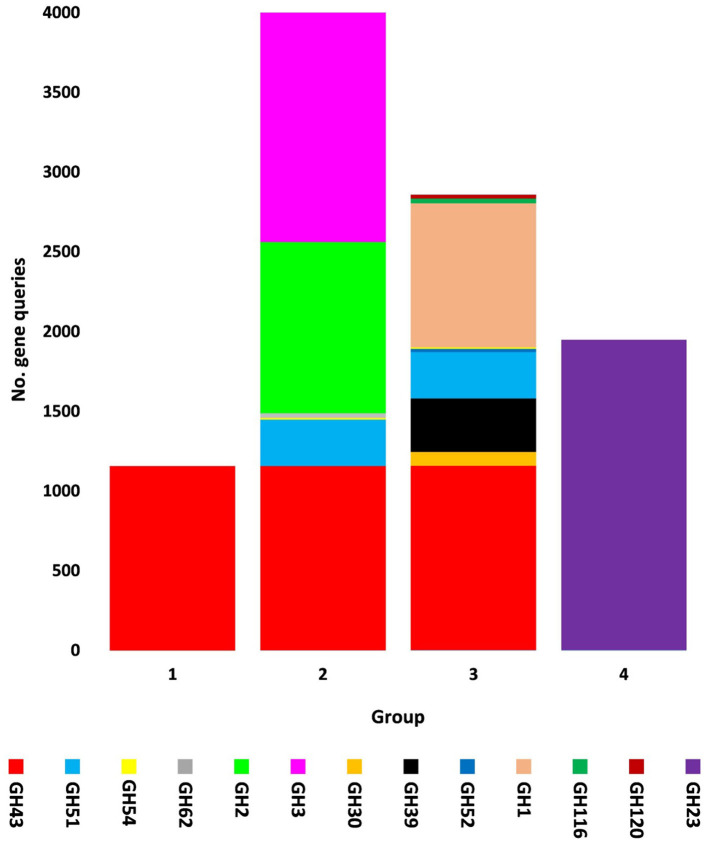
Abundance of these genes was higher in the rhizospheric microbiome than in the bulk soil. Detected viral families include the plant viral family Potyviridae as well as the tailed bacteriophages of class Caudoviricetes that are mainly associated with bacterial genera and . Viral CAZymes in this soil mainly belong to glycoside hydrolase (GH) families GH43 and GH23. Some of these CAZymes participate in a KEGG pathway with actions included debranching and degradation of hemicellulose. Other actions include biosynthesizing biopolymer of the bacterial cell wall and the layered cell wall structure of peptidoglycan. Other CAZymes promote plant physiological activities such as cell-cell recognition, embryogenesis and programmed cell death (PCD). Enzymes of other pathways help reduce the level of soil HO and participate in the biosynthesis of glycine, malate, isoprenoids, as well as isoprene that protects plant from heat stress. Other enzymes act in promoting both the permeability of bacterial peroxisome membrane and carbon fixation in plants. Some enzymes participate in a balanced supply of dNTPs, successful DNA replication and mismatch repair during bacterial cell division. They also catalyze the release of signal peptides from bacterial membrane prolipoproteins. Phages with the most highly abundant antibiotic resistance genes (ARGs) transduce species of bacterial genera , and . Abundant mechanisms of antibiotic resistance in the rhizosphere include "antibiotic efflux pump" for ARGs , and , "antibiotic target alteration" for , and "antibiotic inactivation" for .
These ARGs can act synergistically to inhibit several antibiotics including tetracycline, penam, cephalosporin, rifamycins, aminocoumarin, and oleandomycin. The study highlighted the issue of horizontal transfer of ARGs to clinical isolates and human gut microbiome.
本研究旨在从编码碳水化合物活性酶(CAZymes)和其他京都基因与基因组百科全书(KEGG)酶的基因方面描述土壤根际噬菌体组。
对野生植物物种根际病毒组的基因进行研究,以了解其编码有用的CAZymes和其他KEGG酶以及抵抗土壤中抗生素抗性基因(ARGs)的能力。
这些基因在根际微生物组中的丰度高于在 bulk 土壤中的丰度。检测到的病毒科包括植物病毒科马铃薯Y病毒科以及有尾噬菌体目,主要与细菌属和相关。该土壤中的病毒CAZymes主要属于糖苷水解酶(GH)家族GH43和GH23。其中一些CAZymes参与KEGG途径,其作用包括半纤维素的去分支和降解。其他作用包括细菌细胞壁生物聚合物和肽聚糖层状细胞壁结构的生物合成。其他CAZymes促进植物生理活动,如细胞间识别、胚胎发生和程序性细胞死亡(PCD)。其他途径的酶有助于降低土壤HO水平,并参与甘氨酸、苹果酸、类异戊二烯以及保护植物免受热应激的异戊二烯的生物合成。其他酶在促进细菌过氧化物酶体膜的通透性和植物中的碳固定方面发挥作用。一些酶参与细菌细胞分裂过程中dNTPs的平衡供应、成功的DNA复制和错配修复。它们还催化细菌膜前脂蛋白信号肽的释放。具有最高丰度抗生素抗性基因(ARGs)的噬菌体转导细菌属、和的物种。根际中丰富的抗生素抗性机制包括针对ARGs的“抗生素外排泵”、针对的“抗生素靶点改变”和针对的“抗生素失活”。
这些ARGs可协同作用抑制多种抗生素,包括四环素、青霉烷、头孢菌素、利福霉素、氨基香豆素和竹桃霉素。该研究突出了ARGs向临床分离株和人类肠道微生物组水平转移的问题。