
自然放养恒河猴群体的眼部特征的年龄相关性差异。
Age-Related Differences in Ocular Features of a Naturalistic Free-Ranging Population of Rhesus Macaques.
机构信息
Department of Anthropology and Archaeology, University of Calgary, Calgary, Alberta, Canada.
Department of Ophthalmology, New York University Langone Health, New York, New York, United States.
出版信息
Invest Ophthalmol Vis Sci. 2023 Jun 1;64(7):3. doi: 10.1167/iovs.64.7.3.
PURPOSE
Rhesus macaques (Macaca mulatta) are the premier nonhuman primate model for studying human health and disease. We investigated if age was associated with clinically relevant ocular features in a large cohort of free-ranging rhesus macaques from Cayo Santiago, Puerto Rico.
METHODS
We evaluated 120 rhesus macaques (73 males, 47 females) from 0 to 29 years old (mean ± SD: 12.6 ± 6.4) from September to December 2021. The ophthalmic evaluation included intraocular pressure (IOP) assessment, corneal pachymetry, biomicroscopy, A-scan biometry, automated refraction, and fundus photography after pupil dilation. The associations of age with the outcomes were investigated through multilevel mixed-effects models adjusted for sex and weight.
RESULTS
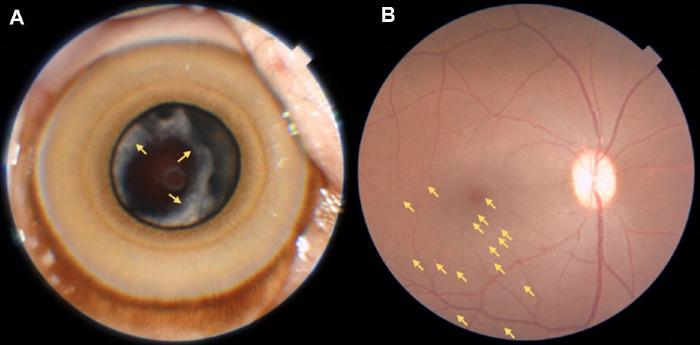
On average, IOP, pachymetry, axial length, and automated refraction spherical equivalent were 18.37 ± 4.68 mmHg, 474.43 ± 32.21 µm, 19.49 ± 1.24 mm, and 0.30 ± 1.70 diopters (D), respectively. Age was significantly associated with pachymetry (β coefficient = -1.20; 95% confidence interval [CI], -2.27 to -0.14; P = 0.026), axial length (β coefficient = 0.03; 95% CI, 0.01 to 0.05; P = 0.002), and spherical equivalent (β coefficient = -0.12; 95% CI, -0.22 to -0.02; P = 0.015). No association was detected between age and IOP. The prevalence of cataracts in either eye was 10.83% (95% CI, 6.34-17.89) and was significantly associated with age (odds ratio [OR] = 1.20; 95% CI, 1.06-1.36; P = 0.004). Retinal drusen in either eye was observed in 15.00% (95% CI, 9.60-22.68) of animals, which was also significantly associated with age (OR = 1.14; 95% CI, 1.02-1.27; P = 0.020).
CONCLUSIONS
Rhesus macaques exhibit age-related ocular associations similar to those observed in human aging, including decreased corneal thickness, increased axial length, myopic shift, and higher prevalence of cataract and retinal drusen.
目的
恒河猴(Macaca mulatta)是研究人类健康和疾病的首要非人类灵长类动物模型。我们研究了在波多黎各的圣地亚哥岛的一个大型自由放养恒河猴队列中,年龄是否与临床相关的眼部特征相关。
方法
我们评估了 120 只年龄在 0 至 29 岁之间的恒河猴(73 只雄性,47 只雌性;平均±SD:12.6±6.4),时间为 2021 年 9 月至 12 月。眼科评估包括眼压(IOP)评估、角膜厚度测量、生物显微镜检查、A 扫描生物测量、自动折射和瞳孔扩张后的眼底照相。通过多水平混合效应模型调整性别和体重,研究年龄与结果的关联。
结果
平均而言,IOP、角膜厚度、眼轴长度和自动折射等效球镜度数分别为 18.37±4.68mmHg、474.43±32.21µm、19.49±1.24mm 和 0.30±1.70 屈光度(D)。年龄与角膜厚度(β系数=-1.20;95%置信区间[CI],-2.27 至-0.14;P=0.026)、眼轴长度(β系数=0.03;95%CI,0.01 至 0.05;P=0.002)和等效球镜度数(β系数=-0.12;95%CI,-0.22 至-0.02;P=0.015)显著相关。年龄与 IOP 之间未发现关联。双眼白内障的患病率为 10.83%(95%CI,6.34-17.89),与年龄显著相关(优势比[OR] = 1.20;95%CI,1.06-1.36;P=0.004)。双眼视网膜硬性渗出的发生率为 15.00%(95%CI,9.60-22.68),也与年龄显著相关(OR=1.14;95%CI,1.02-1.27;P=0.020)。
结论
恒河猴表现出与人类衰老相似的年龄相关的眼部关联,包括角膜厚度变薄、眼轴长度增加、近视漂移以及白内障和视网膜硬性渗出的患病率增加。


 Zotero 插件