Department of Biochemistry, Faculty of Science, Chulalongkorn University, Bangkok, Thailand.
Institute of Molecular Biosciences, Mahidol University, Nakhon Pathom, Thailand.
Sci Rep. 2023 Jun 1;13(1):8921. doi: 10.1038/s41598-023-36034-2.
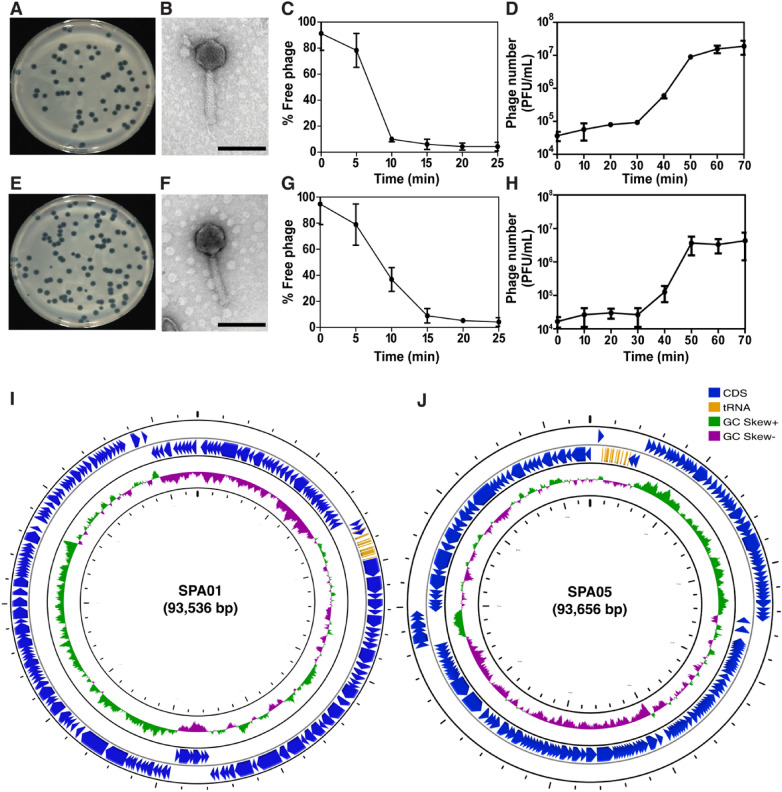
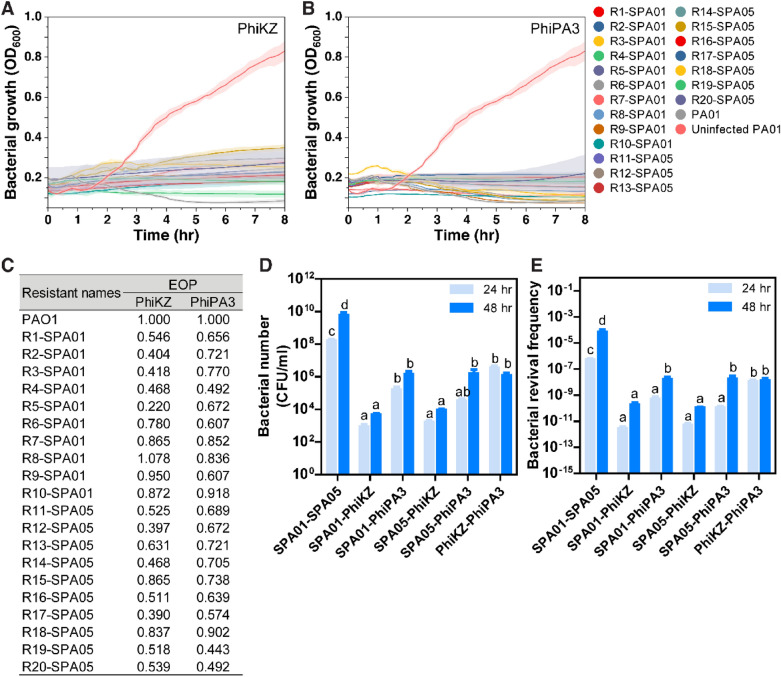
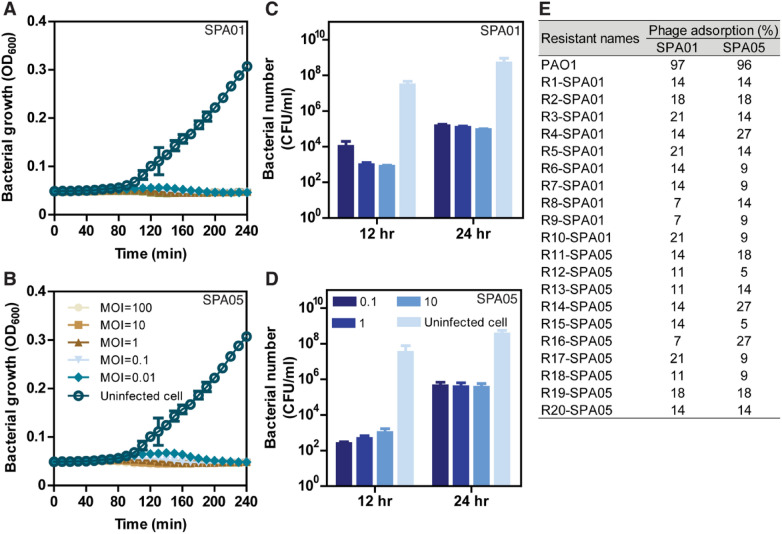
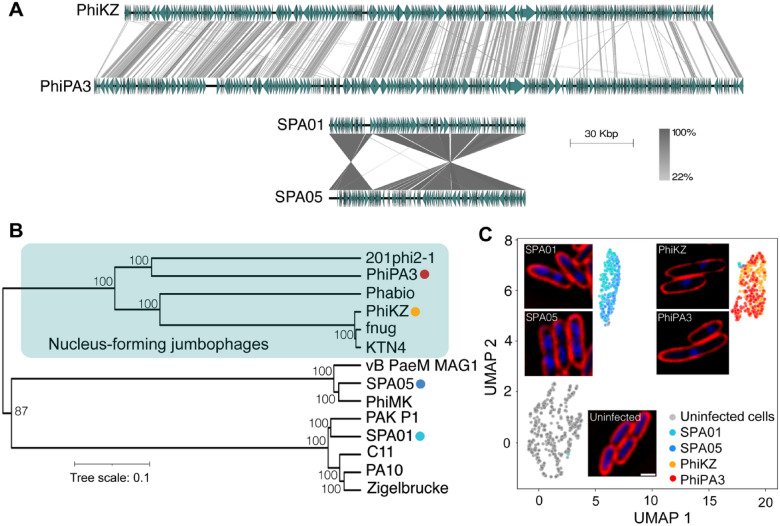
Phage treatment has been used as an alternative to antibiotics since the early 1900s. However, bacteria may acquire phage resistance quickly, limiting the use of phage treatment. The combination of genetically diverse phages displaying distinct replication machinery in phage cocktails has therefore become a novel strategy to improve therapeutic outcomes. Here, we isolated and studied lytic phages (SPA01 and SPA05) that infect a wide range of clinical Pseudomonas aeruginosa isolates. These relatively small myophages have around 93 kbp genomes with no undesirable genes, have a 30-min latent period, and reproduce a relatively high number of progenies, ranging from 218 to 240 PFU per infected cell. Even though both phages lyse their hosts within 4 h, phage-resistant bacteria emerge during the treatment. Considering SPA01-resistant bacteria cross-resist phage SPA05 and vice versa, combining SPA01 and SPA05 for a cocktail would be ineffective. According to the decreased adsorption rate of the phages in the resistant isolates, one of the anti-phage mechanisms may occur through modification of phage receptors on the target cells. All resistant isolates, however, are susceptible to nucleus-forming jumbophages (PhiKZ and PhiPA3), which are genetically distinct from phages SPA01 and SPA05, suggesting that the jumbophages recognize a different receptor during phage entry. The combination of these phages with the jumbophage PhiKZ outperforms other tested combinations in terms of bactericidal activity and effectively suppresses the emergence of phage resistance. This finding reveals the effectiveness of the diverse phage-composed cocktail for reducing bacterial growth and prolonging the evolution of phage resistance.
噬菌体制剂治疗自 20 世纪初以来一直被用作抗生素的替代品。然而,细菌可能会迅速获得噬菌体抗性,从而限制了噬菌体治疗的应用。因此,将具有不同复制机制的遗传多样化噬菌体组合在噬菌体鸡尾酒中已成为改善治疗效果的一种新策略。在这里,我们分离并研究了感染广泛临床铜绿假单胞菌分离株的裂解噬菌体(SPA01 和 SPA05)。这些相对较小的肌尾噬菌体具有约 93 kbp 的基因组,没有不良基因,潜伏期为 30 分钟,繁殖的后代数量相对较高,每个受感染细胞的数量在 218 到 240 个 PFU 之间。尽管两种噬菌体在 4 小时内即可裂解宿主,但在治疗过程中仍会出现噬菌体抗性细菌。考虑到 SPA01 抗性细菌交叉抵抗噬菌体 SPA05,反之亦然,因此将 SPA01 和 SPA05 组合成鸡尾酒将无效。根据噬菌体在抗性分离株中的吸附率降低,其中一种抗噬菌体机制可能是通过修饰靶细胞上的噬菌体受体。然而,所有抗性分离株均易受核形成巨型噬菌体(PhiKZ 和 PhiPA3)的影响,这些噬菌体在遗传上与噬菌体 SPA01 和 SPA05 不同,表明巨型噬菌体在噬菌体进入时识别不同的受体。这些噬菌体与巨型噬菌体 PhiKZ 的组合在杀菌活性方面优于其他测试组合,并且有效地抑制了噬菌体抗性的出现。这一发现揭示了多样化噬菌体组成的鸡尾酒在减少细菌生长和延长噬菌体抗性进化方面的有效性。