Department of Medicine, City of Hope Comprehensive Cancer Center, Duarte, CA, 91010, USA.
Stanford Cardiovascular Institute, Stanford, CA, 94305, USA.
Curr Oncol Rep. 2023 Sep;25(9):965-977. doi: 10.1007/s11912-023-01424-2. Epub 2023 Jun 5.
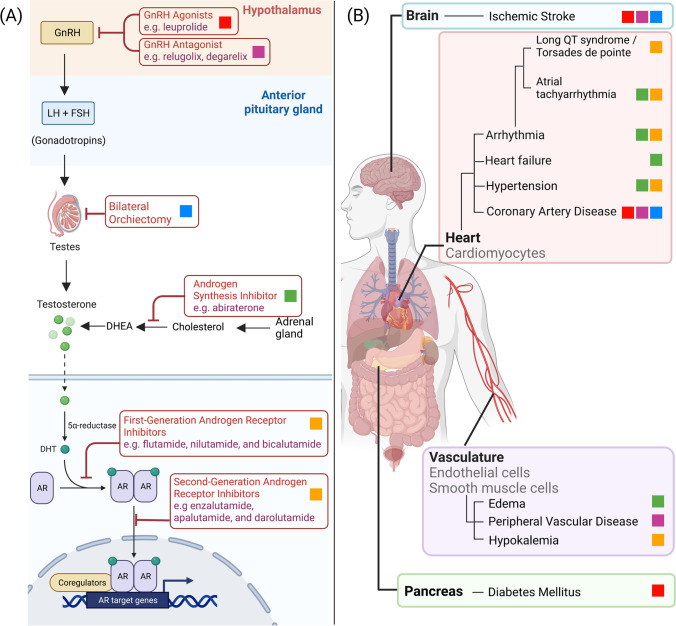
There have been increasing reports of cardiovascular complications of androgen deprivation therapy (ADT) leading to worse outcomes among patients with prostate cancer. While this may result from the direct effects of androgen suppression in the cardiovascular systems, there are ADT-type-specific distinct cardiovascular complications suggestive of mechanisms beyond androgen-mediated. Thus, it is critical to understand the biological and clinical impact of ADT on the cardiovascular system.
Gonadotropin-releasing hormone (GnRH) agonists cause increased cardiovascular events compared to GnRH antagonists. Androgen receptor antagonists are linked to an increased risk of long QT syndrome, torsades de pointes, and sudden cardiac death. Androgen synthesis inhibitors are associated with increased rates of hypertension, atrial tachyarrhythmia, and, in rare incidences, heart failure. ADT increases the risk of cardiovascular disease. The risk among ADT drugs differs and must be evaluated to develop a medically optimal plan for prostate cancer patients.
越来越多的报告表明,雄激素剥夺疗法 (ADT) 会导致前列腺癌患者的心血管并发症,从而导致预后更差。虽然这可能是由于雄激素抑制在心血管系统中的直接作用所致,但 ADT 有其特定的心血管并发症,提示存在雄激素介导以外的机制。因此,了解 ADT 对心血管系统的生物学和临床影响至关重要。
促性腺激素释放激素 (GnRH) 激动剂比 GnRH 拮抗剂引起更多的心血管事件。雄激素受体拮抗剂与长 QT 综合征、尖端扭转型室性心动过速和心脏性猝死的风险增加有关。雄激素合成抑制剂与高血压、房性快速性心律失常的发生率增加有关,在极少数情况下还会导致心力衰竭。ADT 会增加心血管疾病的风险。ADT 药物的风险不同,必须进行评估,以便为前列腺癌患者制定最佳的医疗计划。