Department of Cardiology, School of Medicine, Inha University Hospital, Inha University, Incheon, Korea.
School of Medicine, Inha University, Incheon, Korea.
BMC Cardiovasc Disord. 2023 Jun 7;23(1):287. doi: 10.1186/s12872-023-03326-4.
Information on electrocardiogram (ECG) has not been quantified in obstructive coronary artery disease (ObCAD), despite the deep learning (DL) algorithm being proposed as an effective diagnostic tool for acute myocardial infarction (AMI). Therefore, this study adopted a DL algorithm to suggest the screening of ObCAD from ECG.
ECG voltage-time traces within a week from coronary angiography (CAG) were extracted for the patients who received CAG for suspected CAD in a single tertiary hospital from 2008 to 2020. After separating the AMI group, those were classified into ObCAD and non-ObCAD groups based on the CAG results. A DL-based model adopting ResNet was built to extract information from ECG data in the patients with ObCAD relative to those with non-ObCAD, and compared the performance with AMI. Moreover, subgroup analysis was conducted using ECG patterns of computer-assisted ECG interpretation.
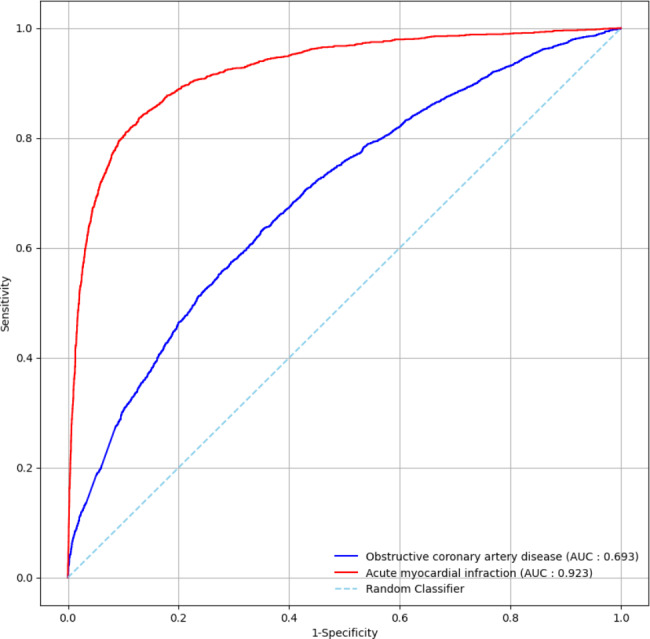
The DL model demonstrated modest performance in suggesting the probability of ObCAD but excellent performance in detecting AMI. The AUC of the ObCAD model adopting 1D ResNet was 0.693 and 0.923 in detecting AMI. The accuracy, sensitivity, specificity, and F1 score of the DL model for screening ObCAD were 0.638, 0.639, 0.636, and 0.634, respectively, while the figures were up to 0.885, 0.769, 0.921, and 0.758 for detecting AMI, respectively. Subgroup analysis showed that the difference between normal and abnormal/borderline ECG groups was not notable.
ECG-based DL model showed fair performance for assessing ObCAD and it may serve as an adjunct to the pre-test probability in patients with suspected ObCAD during the initial evaluation. With further refinement and evaluation, ECG coupled with the DL algorithm may provide potential front-line screening support in the resource-intensive diagnostic pathways.
尽管深度学习(DL)算法已被提议作为急性心肌梗死(AMI)的有效诊断工具,但阻塞性冠状动脉疾病(ObCAD)的心电图(ECG)信息尚未得到量化。因此,本研究采用 DL 算法建议从 ECG 中筛选 ObCAD。
从 2008 年至 2020 年,在一家三级医院接受冠状动脉造影(CAG)检查疑似 CAD 的患者,在 CAG 后一周内提取 ECG 电压时间轨迹。在将 AMI 组分离后,根据 CAG 结果将其分为 ObCAD 和非 ObCAD 组。建立了基于 ResNet 的 DL 模型,从 ObCAD 患者和非 ObCAD 患者的 ECG 数据中提取信息,并与 AMI 进行比较。此外,还使用计算机辅助心电图解释的心电图模式进行了亚组分析。
DL 模型在提示 ObCAD 概率方面表现出中等性能,但在检测 AMI 方面表现出色。采用 1D ResNet 的 ObCAD 模型的 AUC 在检测 AMI 时分别为 0.693 和 0.923。DL 模型筛查 ObCAD 的准确率、敏感度、特异度和 F1 评分分别为 0.638、0.639、0.636 和 0.634,而检测 AMI 时分别高达 0.885、0.769、0.921 和 0.758。亚组分析显示,正常和异常/临界 ECG 组之间的差异不明显。
基于 ECG 的 DL 模型在评估 ObCAD 方面表现出良好的性能,它可能成为疑似 ObCAD 患者初始评估中预测试概率的辅助手段。随着进一步的改进和评估,ECG 结合 DL 算法可能为资源密集型诊断途径提供潜在的一线筛查支持。