Huang Pang-Shuo, Tseng Yu-Heng, Tsai Chin-Feng, Chen Jien-Jiun, Yang Shao-Chi, Chiu Fu-Chun, Chen Zheng-Wei, Hwang Juey-Jen, Chuang Eric Y, Wang Yi-Chih, Tsai Chia-Ti
Division of Cardiology, Department of Internal Medicine, National Taiwan University Hospital Yun-Lin Branch, Yunlin County 640, Taiwan.
Cardiovascular Center, National Taiwan University Hospital, Taipei 100, Taiwan.
Biomedicines. 2022 Feb 7;10(2):394. doi: 10.3390/biomedicines10020394.
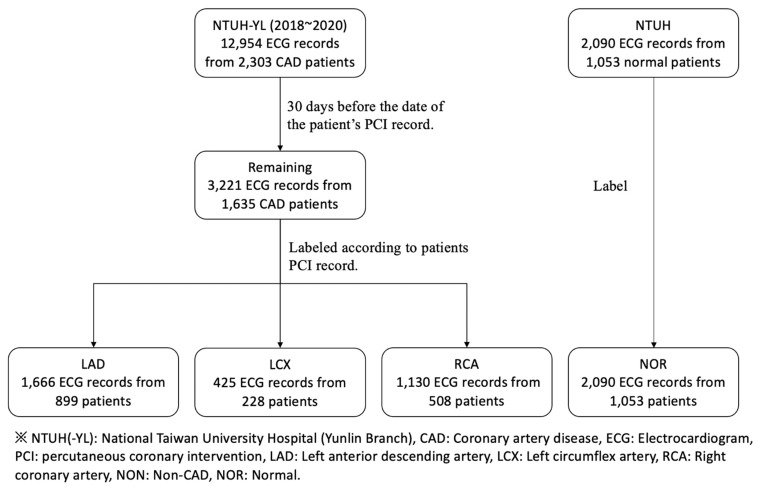
(1) Background: The role of using artificial intelligence (AI) with electrocardiograms (ECGs) for the diagnosis of significant coronary artery disease (CAD) is unknown. We first tested the hypothesis that using AI to read ECG could identify significant CAD and determine which vessel was obstructed. (2) Methods: We collected ECG data from a multi-center retrospective cohort with patients of significant CAD documented by invasive coronary angiography and control patients in Taiwan from 1 January 2018 to 31 December 2020. (3) Results: We trained convolutional neural networks (CNN) models to identify patients with significant CAD (>70% stenosis), using the 12,954 ECG from 2303 patients with CAD and 2090 ECG from 1053 patients without CAD. The Marco-average area under the ROC curve (AUC) for detecting CAD was 0.869 for image input CNN model. For detecting individual coronary artery obstruction, the AUC was 0.885 for left anterior descending artery, 0.776 for right coronary artery, and 0.816 for left circumflex artery obstruction, and 1.0 for no coronary artery obstruction. Marco-average AUC increased up to 0.973 if ECG had features of myocardial ischemia. (4) Conclusions: We for the first time show that using the AI-enhanced CNN model to read standard 12-lead ECG permits ECG to serve as a powerful screening tool to identify significant CAD and localize the coronary obstruction. It could be easily implemented in health check-ups with asymptomatic patients and identifying high-risk patients for future coronary events.
(1) 背景:利用人工智能(AI)结合心电图(ECG)诊断严重冠状动脉疾病(CAD)的作用尚不清楚。我们首先检验了这样一个假设,即使用人工智能解读心电图可以识别严重CAD并确定阻塞的血管。(2) 方法:我们收集了2018年1月1日至2020年12月31日期间台湾地区一个多中心回顾性队列的心电图数据,该队列中有经侵入性冠状动脉造影记录的严重CAD患者以及对照患者。(3) 结果:我们使用来自2303例CAD患者的12954份心电图和来自1053例无CAD患者的2090份心电图,训练卷积神经网络(CNN)模型以识别严重CAD(狭窄>70%)患者。对于图像输入的CNN模型,检测CAD的ROC曲线下的宏平均面积(AUC)为0.869。对于检测单个冠状动脉阻塞,左前降支动脉阻塞的AUC为0.885,右冠状动脉阻塞的AUC为0.776,左旋支动脉阻塞的AUC为0.816,无冠状动脉阻塞的AUC为1.0。如果心电图具有心肌缺血特征,宏平均AUC可提高至0.973。(4) 结论:我们首次表明,使用人工智能增强的CNN模型解读标准12导联心电图可使心电图成为识别严重CAD并定位冠状动脉阻塞的强大筛查工具。它可以很容易地应用于无症状患者的健康检查,并识别未来冠状动脉事件的高危患者。