Department of Molecular Biophysics and Biochemistry, Yale University, New Haven, CT, USA.
Department of Laboratory Medicine, Yale School of Medicine, New Haven, CT, USA.
Nat Commun. 2023 Jun 9;14(1):3426. doi: 10.1038/s41467-023-38623-1.
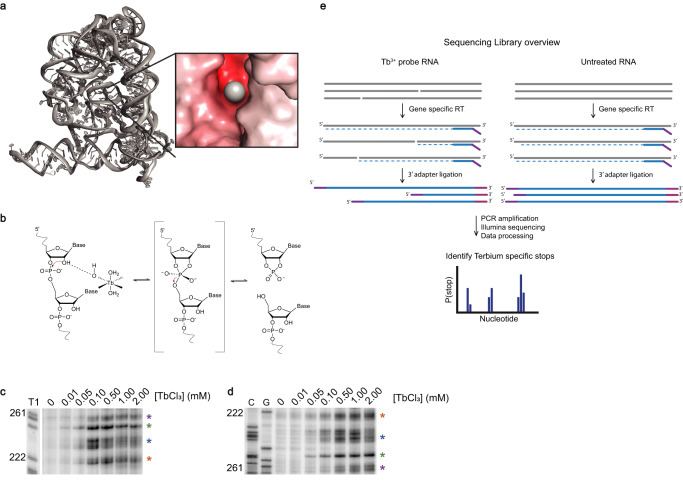
Compact RNA structural motifs control many aspects of gene expression, but we lack methods for finding these structures in the vast expanse of multi-kilobase RNAs. To adopt specific 3-D shapes, many RNA modules must compress their RNA backbones together, bringing negatively charged phosphates into close proximity. This is often accomplished by recruiting multivalent cations (usually Mg), which stabilize these sites and neutralize regions of local negative charge. Coordinated lanthanide ions, such as terbium (III) (Tb), can also be recruited to these sites, where they induce efficient RNA cleavage, thereby revealing compact RNA 3-D modules. Until now, Tb cleavage sites were monitored via low-throughput biochemical methods only applicable to small RNAs. Here we present Tb-seq, a high-throughput sequencing method for detecting compact tertiary structures in large RNAs. Tb-seq detects sharp backbone turns found in RNA tertiary structures and RNP interfaces, providing a way to scan transcriptomes for stable structural modules and potential riboregulatory motifs.
紧凑的 RNA 结构基元控制着基因表达的许多方面,但我们缺乏在数千碱基长的 RNA 中发现这些结构的方法。为了采用特定的 3-D 形状,许多 RNA 模块必须将它们的 RNA 骨架压缩在一起,使带负电荷的磷酸根彼此靠近。这通常通过招募多价阳离子(通常是 Mg)来实现,多价阳离子可以稳定这些位点并中和局部负电荷区域。配位镧系离子,如铽 (III)(Tb),也可以被招募到这些位点,在这些位点上它们诱导有效的 RNA 切割,从而揭示紧凑的 RNA 3-D 模块。到目前为止,Tb 切割位点仅通过适用于小 RNA 的高通量生化方法进行监测。在这里,我们提出了 Tb-seq,这是一种用于检测大型 RNA 中紧凑三级结构的高通量测序方法。Tb-seq 检测到在 RNA 三级结构和 RNP 界面中发现的尖锐骨架转弯,为在转录组中扫描稳定的结构模块和潜在的核糖调控基序提供了一种方法。