Key Laboratory of OptoElectronic Science and Technology for Medicine of Ministry of Education, Fujian Provincial Key Laboratory of Photonics Technology, College of Photonic and Electronic Engineering, Fujian Normal University, Fuzhou, 350117, China.
College of Life Science, Fujian Normal University, Fuzhou, 350117, China.
BMC Cancer. 2023 Jun 9;23(1):530. doi: 10.1186/s12885-023-10943-x.
Tumor necrosis (TN) was associated with poor prognosis. However, the traditional classification of TN ignored spatial intratumor heterogeneity, which may be associated with important prognosis. The purpose of this study was to propose a new method to reveal the hidden prognostic value of spatial heterogeneity of TN in invasive breast cancer (IBC).
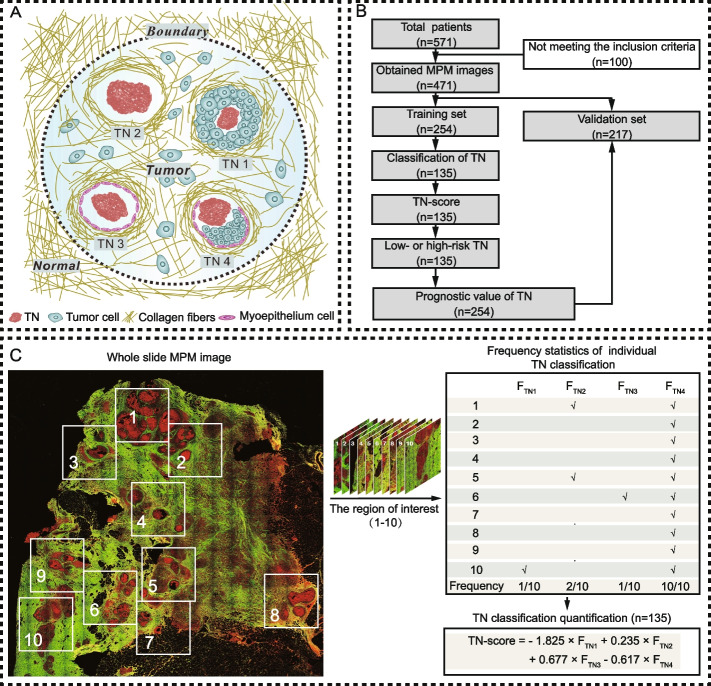
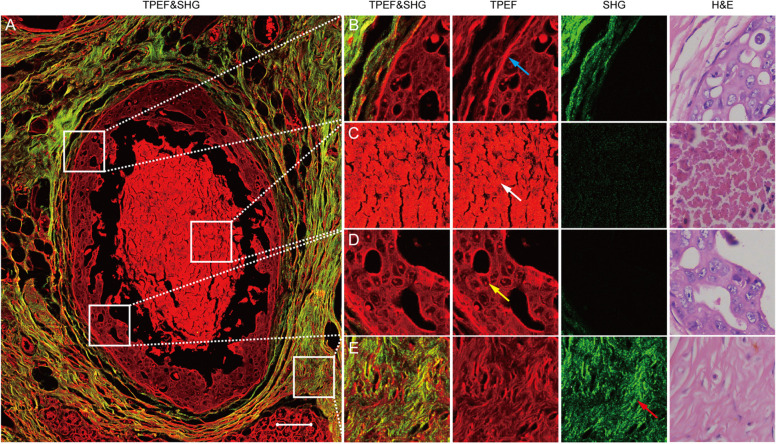
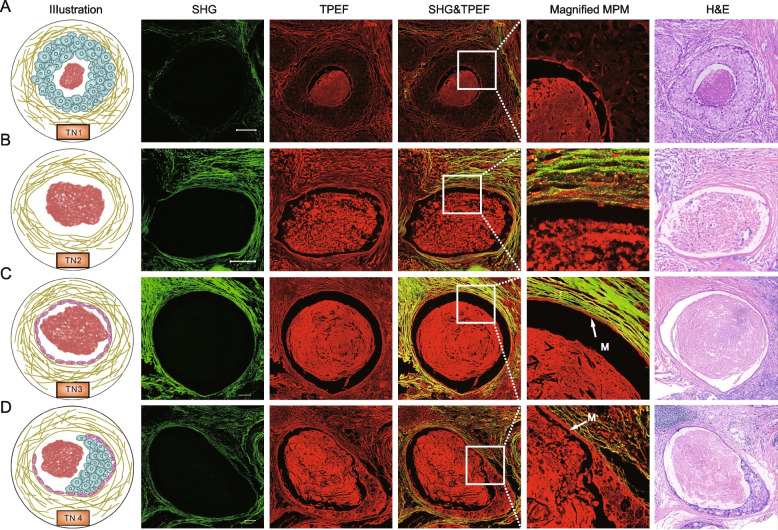
Multiphoton microscopy (MPM) was used to obtain multiphoton images from 471 patients. According to the relative spatial positions of TN, tumor cells, collagen fibers and myoepithelium, four spatial heterogeneities of TN (TN1-4) were defined. Based on the frequency of individual TN, TN-score was obtained to investigate the prognostic value of TN.
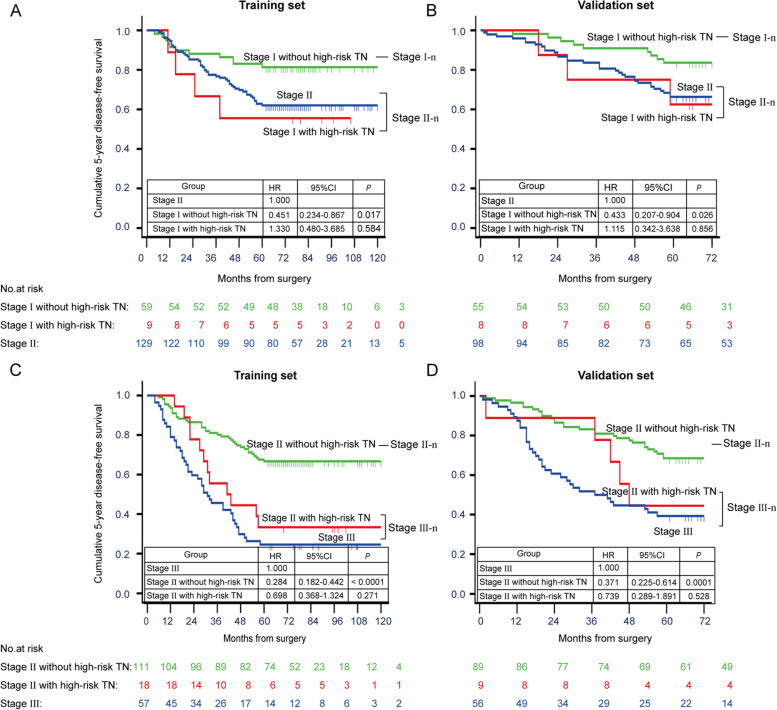
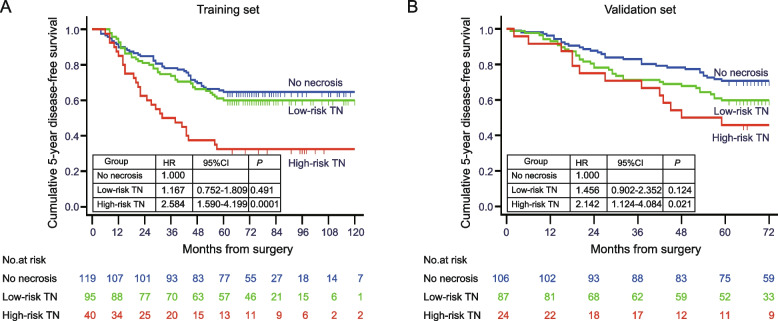
Patients with high-risk TN had worse 5-year disease-free survival (DFS) than patients with no necrosis (32.5% vs. 64.7%; P < 0.0001 in training set; 45.8% vs. 70.8%; P = 0.017 in validation set), while patients with low-risk TN had a 5-year DFS comparable to patients with no necrosis (60.0% vs. 64.7%; P = 0.497 in training set; 59.8% vs. 70.8%; P = 0.121 in validation set). Furthermore, high-risk TN "up-staged" the patients with IBC. Patients with high-risk TN and stage I tumors had a 5-year DFS comparable to patients with stage II tumors (55.6% vs. 62.0%; P = 0.565 in training set; 62.5% vs. 66.3%; P = 0.856 in validation set), as well as patients with high-risk TN and stage II tumors had a 5-year DFS comparable to patients with stage III tumors (33.3% vs. 24.6%; P = 0.271 in training set; 44.4% vs. 39.3%; P = 0.519 in validation set).
TN-score was an independent prognostic factor for 5-year DFS. Only high-risk TN was associated with poor prognosis. High-risk TN "up-staged" the patients with IBC. Incorporating TN-score into staging category could improve its performance to stratify patients.
肿瘤坏死(TN)与预后不良相关。然而,传统的 TN 分类忽略了肿瘤内的空间异质性,这种异质性可能与重要的预后有关。本研究旨在提出一种新的方法来揭示浸润性乳腺癌(IBC)中 TN 空间异质性的潜在预后价值。
多光子显微镜(MPM)从 471 名患者中获得多光子图像。根据 TN、肿瘤细胞、胶原纤维和肌上皮的相对空间位置,定义了 4 种 TN 空间异质性(TN1-4)。基于个体 TN 的频率,获得 TN 评分以研究 TN 的预后价值。
高危 TN 患者的 5 年无病生存率(DFS)明显低于无坏死患者(训练集:32.5% vs. 64.7%;P<0.0001;验证集:45.8% vs. 70.8%;P=0.017),而低危 TN 患者的 5 年 DFS 与无坏死患者相当(训练集:60.0% vs. 64.7%;P=0.497;验证集:59.8% vs. 70.8%;P=0.121)。此外,高危 TN“升级”了 IBC 患者的分期。高危 TN 合并 I 期肿瘤患者的 5 年 DFS 与 II 期肿瘤患者相当(训练集:55.6% vs. 62.0%;P=0.565;验证集:62.5% vs. 66.3%;P=0.856),高危 TN 合并 II 期肿瘤患者的 5 年 DFS 与 III 期肿瘤患者相当(训练集:33.3% vs. 24.6%;P=0.271;验证集:44.4% vs. 39.3%;P=0.519)。
TN 评分是 5 年 DFS 的独立预后因素。只有高危 TN 与预后不良相关。高危 TN“升级”了 IBC 患者的分期。将 TN 评分纳入分期类别可以提高其性能,从而更好地分层患者。