
物理线索与机械敏感离子通道在癌症转移中的相互作用。
The interplay between physical cues and mechanosensitive ion channels in cancer metastasis.
作者信息
Bera Kaustav, Kiepas Alexander, Zhang Yuqi, Sun Sean X, Konstantopoulos Konstantinos
机构信息
Department of Chemical and Biomolecular Engineering, The Johns Hopkins University, Baltimore, MD, United States.
Johns Hopkins Institute for NanoBioTechnology, The Johns Hopkins University, Baltimore, MD, United States.
出版信息
Front Cell Dev Biol. 2022 Sep 7;10:954099. doi: 10.3389/fcell.2022.954099. eCollection 2022.
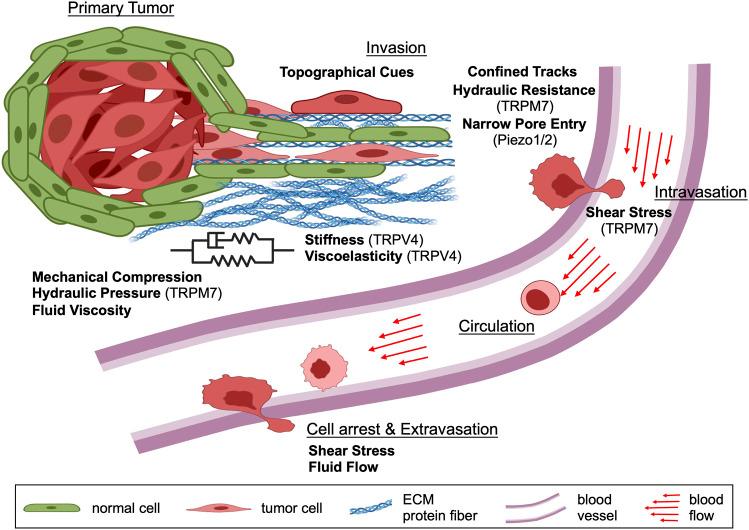
Physical cues have emerged as critical influencers of cell function during physiological processes, like development and organogenesis, and throughout pathological abnormalities, including cancer progression and fibrosis. While ion channels have been implicated in maintaining cellular homeostasis, their cell surface localization often places them among the first few molecules to sense external cues. Mechanosensitive ion channels (MICs) are especially important transducers of physical stimuli into biochemical signals. In this review, we describe how physical cues in the tumor microenvironment are sensed by MICs and contribute to cancer metastasis. First, we highlight mechanical perturbations, by both solid and fluid surroundings typically found in the tumor microenvironment and during critical stages of cancer cell dissemination from the primary tumor. Next, we describe how Piezo1/2 and transient receptor potential (TRP) channels respond to these physical cues to regulate cancer cell behavior during different stages of metastasis. We conclude by proposing alternative mechanisms of MIC activation that work in tandem with cytoskeletal components and other ion channels to bestow cells with the capacity to sense, respond and navigate through the surrounding microenvironment. Collectively, this review provides a perspective for devising treatment strategies against cancer by targeting MICs that sense aberrant physical characteristics during metastasis, the most lethal aspect of cancer.
物理信号已成为生理过程(如发育和器官发生)以及整个病理异常过程(包括癌症进展和纤维化)中细胞功能的关键影响因素。虽然离子通道与维持细胞内稳态有关,但其细胞表面定位常常使它们成为最早感知外部信号的分子之一。机械敏感离子通道(MIC)是将物理刺激转化为生化信号的特别重要的转换器。在本综述中,我们描述了肿瘤微环境中的物理信号如何被MIC感知并促进癌症转移。首先,我们强调了肿瘤微环境中通常存在的固体和流体环境以及癌细胞从原发性肿瘤扩散的关键阶段所产生的机械扰动。接下来,我们描述了Piezo1/2和瞬时受体电位(TRP)通道如何响应这些物理信号,以在转移的不同阶段调节癌细胞行为。我们通过提出MIC激活的替代机制来结束本文,这些机制与细胞骨架成分和其他离子通道协同作用,赋予细胞感知、响应并在周围微环境中导航的能力。总的来说,本综述为通过靶向在转移过程中感知异常物理特征的MIC来设计抗癌治疗策略提供了一个视角,而转移是癌症最致命的方面。
 Zotero 插件