Khalaf Kareem, Terrin Maria, Jovani Manol, Rizkala Tommy, Spadaccini Marco, Pawlak Katarzyna M, Colombo Matteo, Andreozzi Marta, Fugazza Alessandro, Facciorusso Antonio, Grizzi Fabio, Hassan Cesare, Repici Alessandro, Carrara Silvia
Division of Gastroenterology, St. Michael's Hospital, University of Toronto, Toronto, ON M5S 1A1, Canada.
Division of Gastroenterology and Digestive Endoscopy, Humanitas Research Hospital IRCCS, Rozzano, 20089 Milan, Italy.
J Clin Med. 2023 May 30;12(11):3757. doi: 10.3390/jcm12113757.
Endoscopic Ultrasound (EUS) is widely used for the diagnosis of bilio-pancreatic and gastrointestinal (GI) tract diseases, for the evaluation of subepithelial lesions, and for sampling of lymph nodes and solid masses located next to the GI tract. The role of Artificial Intelligence in healthcare in growing. This review aimed to provide an overview of the current state of AI in EUS from imaging to pathological diagnosis and training.
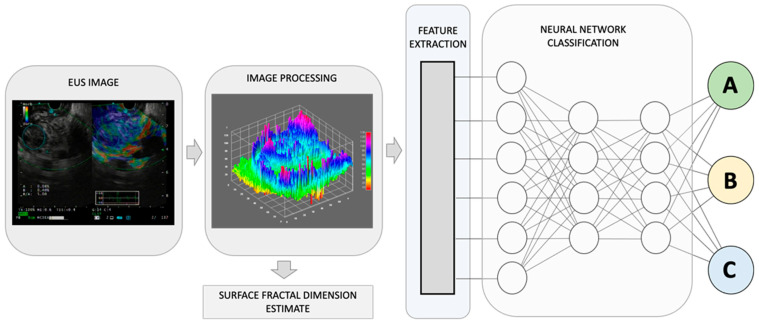
AI algorithms can assist in lesion detection and characterization in EUS by analyzing EUS images and identifying suspicious areas that may require further clinical evaluation or biopsy sampling. Deep learning techniques, such as convolutional neural networks (CNNs), have shown great potential for tumor identification and subepithelial lesion (SEL) evaluation by extracting important features from EUS images and using them to classify or segment the images.
AI models with new features can increase the accuracy of diagnoses, provide faster diagnoses, identify subtle differences in disease presentation that may be missed by human eyes, and provide more information and insights into disease pathology.
The integration of AI in EUS images and biopsies has the potential to improve the diagnostic accuracy, leading to better patient outcomes and to a reduction in repeated procedures in case of non-diagnostic biopsies.
内镜超声(EUS)广泛用于诊断胆胰和胃肠道(GI)疾病、评估上皮下病变以及对胃肠道旁的淋巴结和实体肿块进行采样。人工智能在医疗保健领域的作用正在不断扩大。本综述旨在概述人工智能在EUS中从成像到病理诊断及培训的当前状态。
人工智能算法可通过分析EUS图像并识别可能需要进一步临床评估或活检采样的可疑区域,辅助EUS中的病变检测和特征描述。深度学习技术,如卷积神经网络(CNN),通过从EUS图像中提取重要特征并用于图像分类或分割,在肿瘤识别和上皮下病变(SEL)评估方面显示出巨大潜力。
具有新特性的人工智能模型可提高诊断准确性,提供更快的诊断,识别肉眼可能遗漏的疾病表现细微差异,并提供有关疾病病理的更多信息和见解。
将人工智能整合到EUS图像和活检中有可能提高诊断准确性,从而改善患者预后,并减少非诊断性活检时的重复操作。