School of Public Health, University of Alberta, Edmonton, AB T6G 2R3, Canada.
Department of Pediatrics, Division of Neurology, Faculty of Medicine and Dentistry, University of Alberta, Edmonton, AB T6G 2R7, Canada.
Molecules. 2023 May 23;28(11):4266. doi: 10.3390/molecules28114266.
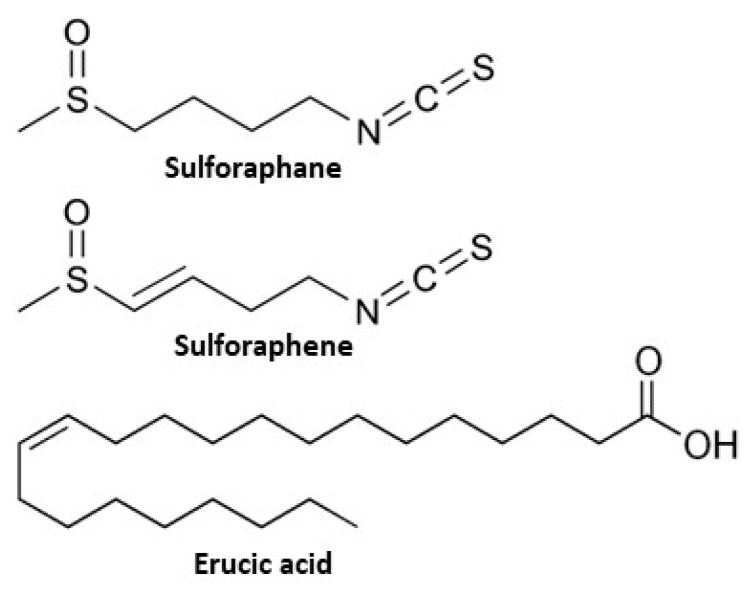
Our research group previously found that broccoli sprouts possess neuroprotective effects during pregnancy. The active compound has been identified as sulforaphane (SFA), obtained from glucosinolate and glucoraphanin, which are also present in other crucifers, including kale. Sulforaphene (SFE), obtained from glucoraphenin in radish, also has numerous biological benefits, some of which supersede those of sulforaphane. It is likely that other components, such as phenolics, contribute to the biological activity of cruciferous vegetables. Notwithstanding their beneficial phytochemicals, crucifers are known to contain erucic acid, an antinutritional fatty acid. The aim of this research was to phytochemically examine broccoli, kale, and radish sprouts to determine good sources of SFA and SFE to inform future studies of the neuroprotective activity of cruciferous sprouts on the fetal brain, as well as product development. Three broccoli: Johnny's Sprouting Broccoli (JSB), Gypsy F1 (GYP), and Mumm's Sprouting Broccoli (MUM), one kale: Johnny's Toscano Kale (JTK), and three radish cultivars: Black Spanish Round (BSR), Miyashige (MIY), and Nero Tunda (NT), were analyzed. We first quantified the glucosinolate, isothiocyanate, phenolics, and DPPH free radical scavenging activity (AOC) of one-day-old dark- and light-grown sprouts by HPLC. Radish cultivars generally had the highest glucosinolate and isothiocyanate contents, and kale had higher glucoraphanin and significantly higher sulforaphane content than the broccoli cultivars. Lighting conditions did not significantly affect the phytochemistry of the one-day-old sprouts. Based on phytochemistry and economic factors, JSB, JTK, and BSR were chosen for further sprouting for three, five, and seven days and subsequently analyzed. The three-day-old JTK and radish cultivars were identified to be the best sources of SFA and SFE, respectively, both yielding the highest levels of the respective compound while retaining high levels of phenolics and AOC and markedly lower erucic acid levels compared to one-day-old sprouts.
我们的研究小组之前发现,西兰花芽在怀孕期间具有神经保护作用。活性化合物已被确定为萝卜硫素(SFA),它来源于芥子油苷和葡萄糖苷,也存在于其他十字花科蔬菜中,包括羽衣甘蓝。萝卜硫素(SFE),来自萝卜中的葡萄糖苷,也具有许多生物学益处,其中一些超过了萝卜硫素。可能还有其他成分,如酚类,对十字花科蔬菜的生物活性有贡献。尽管十字花科蔬菜含有有益的植物化学物质,但已知它们含有反营养脂肪酸芥酸。本研究的目的是对西兰花、羽衣甘蓝和萝卜芽进行植物化学分析,以确定 SFA 和 SFE 的良好来源,为未来研究十字花科芽对胎儿大脑的神经保护活性以及产品开发提供信息。分析了三个西兰花品种:Johnny's Sprouting Broccoli(JSB)、Gypsy F1(GYP)和 Mumm's Sprouting Broccoli(MUM),一个羽衣甘蓝品种:Johnny's Toscano Kale(JTK)和三个萝卜品种:Black Spanish Round(BSR)、Miyashige(MIY)和 Nero Tunda(NT)。我们首先通过 HPLC 定量分析了一天龄暗培养和光培养芽中的芥子油苷、异硫氰酸酯、酚类和 DPPH 自由基清除活性(AOC)。萝卜品种通常具有最高的芥子油苷和异硫氰酸酯含量,羽衣甘蓝的葡萄糖苷含量较高,萝卜硫素含量明显高于西兰花品种。光照条件对一天龄芽的植物化学物质没有显著影响。基于植物化学和经济因素,选择 JSB、JTK 和 BSR 进一步进行为期三天、五天和七天的发芽,并随后进行分析。结果表明,三天龄的 JTK 和萝卜品种分别是 SFA 和 SFE 的最佳来源,它们分别产生了最高水平的相应化合物,同时保持了高水平的酚类和 AOC,与一天龄芽相比,芥酸水平明显降低。