BC Children's Hospital Research Institute, Vancouver, British Columbia, Canada.
Department of Pediatrics, The University of British Columbia Faculty of Medicine, Vancouver, British Columbia, Canada.
BMJ Open. 2023 Jun 12;13(6):e071228. doi: 10.1136/bmjopen-2022-071228.
To determine the SARS-CoV-2 seroprevalence among school workers within the Greater Vancouver area, British Columbia, Canada, after the first Omicron wave.
Cross-sectional study by online questionnaire, with blood serology testing.
Three main school districts (Vancouver, Richmond and Delta) in the Vancouver metropolitan area.
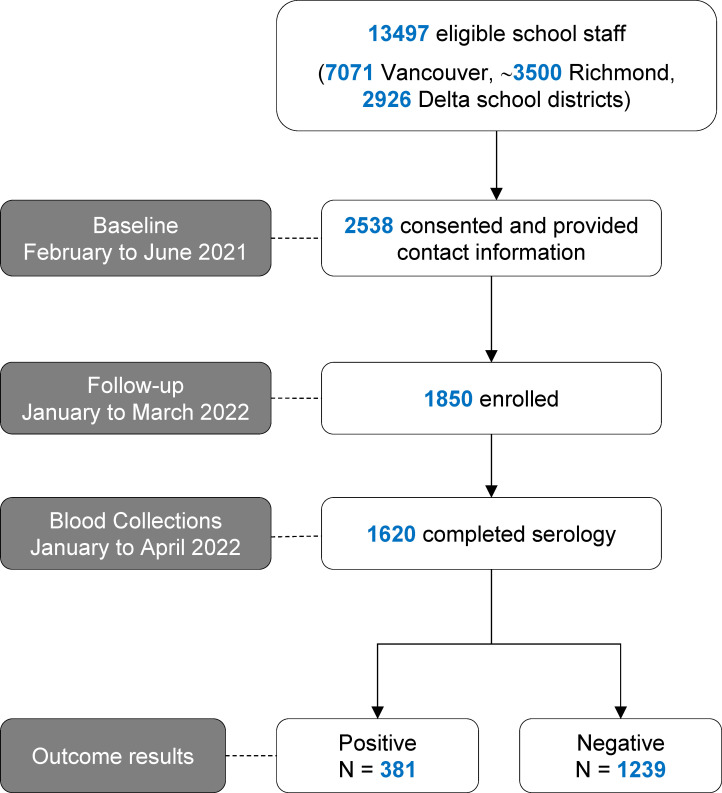
Active school staff enrolled from January to April 2022, with serology testing between 27 January and 8 April 2022. Seroprevalence estimates were compared with data obtained from Canadian blood donors weighted over the same sampling period, age, sex and postal code distribution.
SARS-CoV-2 nucleocapsid antibody testing results adjusted for test sensitivity and specificity, and regional variation across school districts using Bayesian models.
Of 1850 school staff enrolled, 65.8% (1214/1845) reported close contact with a COVID-19 case outside the household. Of those close contacts, 51.5% (625/1214) were a student and 54.9% (666/1214) were a coworker. Cumulative incidence of COVID-19 positive testing by self-reported nucleic acid or rapid antigen testing since the beginning of the pandemic was 15.8% (291/1845). In a representative sample of 1620 school staff who completed serology testing (87.6%), the adjusted seroprevalence was 26.5% (95% CrI 23.9% to 29.3%), compared with 32.4% (95% CrI 30.6% to 34.5%) among 7164 blood donors.
Despite frequent COVID-19 exposures reported, SARS-CoV-2 seroprevalence among school staff in this setting remained no greater than the community reference group. Results are consistent with the premise that many infections were acquired outside the school setting, even with Omicron.
在加拿大不列颠哥伦比亚省大温哥华地区首次奥密克戎浪潮后,确定学校工作人员中的 SARS-CoV-2 血清流行率。
通过在线问卷调查进行的横断面研究,并进行血液血清学检测。
温哥华大都市区的三个主要学区(温哥华、列治文和三角洲)。
2022 年 1 月至 4 月期间招募的在职学校工作人员,2022 年 1 月 27 日至 4 月 8 日进行血清学检测。血清流行率估计值与同一采样期、年龄、性别和邮政编码分布的加拿大献血者数据进行加权比较。
使用贝叶斯模型,根据测试灵敏度和特异性以及学区之间的区域差异,对 SARS-CoV-2 核衣壳抗体检测结果进行调整。
在 1850 名登记的学校工作人员中,65.8%(1214/1845)报告与家庭外的 COVID-19 病例有密切接触。在这些密切接触者中,51.5%(625/1214)是学生,54.9%(666/1214)是同事。自大流行开始以来,通过自我报告的核酸或快速抗原检测 COVID-19 阳性检测的累积发病率为 15.8%(291/1845)。在完成血清学检测的 1620 名学校工作人员的代表性样本中(87.6%),调整后的血清流行率为 26.5%(95%置信区间 23.9%至 29.3%),而在 7164 名献血者中为 32.4%(95%置信区间 30.6%至 34.5%)。
尽管报告了频繁的 COVID-19 暴露,但在这种情况下,学校工作人员中的 SARS-CoV-2 血清流行率并未高于社区参考组。结果与许多感染发生在学校环境之外的前提一致,即使是在奥密克戎时期。