Velasco Nicolás, Bustamante Ramiro, Smit Christian
Conservation Ecology Group, Groningen Institute for Evolutionary Life Sciences, University of Groningen, Groningen, the Netherlands.
Departamento de Ciencias Ecológicas, Instituto de Ecología y Biodiversidad, Facultad de Ciencias, Universidad de Chile, Chile.
Heliyon. 2023 Jun 9;9(6):e17171. doi: 10.1016/j.heliyon.2023.e17171. eCollection 2023 Jun.
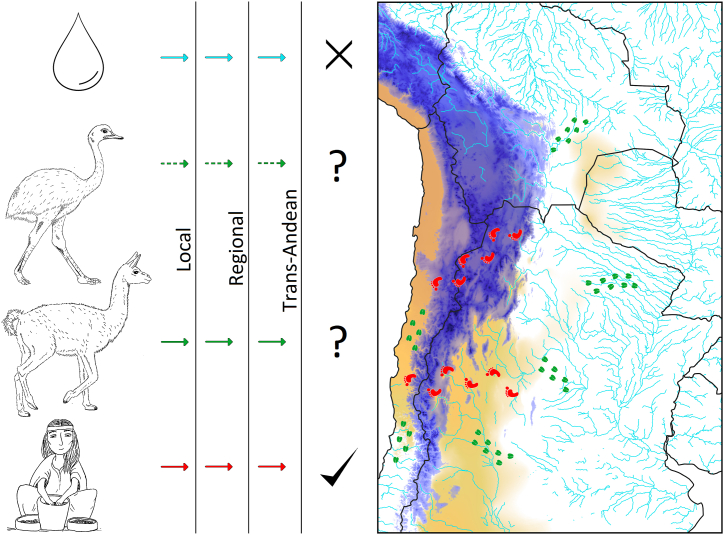
has a disjunct distribution at the southern cone of South America, occupying two major ranges: west of Andes (Central Chile) and east of them (mainly the South American Gran Chaco). For decades, the species has been subject to various ecological and natural history studies across its distribution, but questions concerning its origin in the western range remain unresolved. Thus far, it is unclear whether was always a natural component of the Chilean forests, and "how" and "when" the species arrived in the country. In this study, we revised the dispersal syndromes of the species and contrast the two main hypotheses of dispersion to the west of Andes that have been proposed in the 90's, namely animal versus human-mediated dispersal. For this, we reviewed all scientific literature on the species and explored the available information on morphology, genetics, fossil records and distribution patterns of closely related species. Here we illustrate how the collected evidence provides support for the human-mediated dispersal hypothesis, by including a conceptual synthesis that summarizes the outcomes of different dispersal scenarios. Lastly, and regarding the positive ecological effects this species has in the introduced area, we suggest reconsidering the (underappreciated) historical impacts of archaeophytes and rethinking the role that indigenous human tribes may have had in the dispersion of different plants in South America.
在南美洲的南端呈间断分布,占据两个主要区域:安第斯山脉以西(智利中部)和以东(主要是南美洲大查科地区)。几十年来,该物种在其分布范围内一直是各种生态和自然历史研究的对象,但关于其在西部区域起源的问题仍未得到解决。到目前为止,尚不清楚它是否一直是智利森林的自然组成部分,以及该物种是“如何”和“何时”抵达该国的。在本研究中,我们修订了该物种的传播综合征,并对比了20世纪90年代提出的关于安第斯山脉以西传播的两个主要假设,即动物传播与人类介导传播。为此,我们查阅了关于该物种的所有科学文献,并探索了有关形态学、遗传学、化石记录以及近缘物种分布模式的现有信息。在此,我们通过纳入一个总结不同传播情景结果的概念性综合内容,来说明所收集的证据如何为人类介导传播假设提供支持。最后,鉴于该物种在引入地区所产生的积极生态影响,我们建议重新考虑古植物(未得到充分重视)的历史影响,并重新思考本土人类部落可能在南美洲不同植物传播中所起的作用。