Zhang Tong, Sun Yanan, Wei Jing, Zhao Guoqiang, Hao Wenqi, Lv Zhihai, Chen Xiaohang, Liu Yanan, Wei Fengxiang
Longgang District Maternity and Child Healthcare Hospital, Shenzhen, China.
Department of Maternal, Child and Adolescent Health, School of Public Health, Anhui Medical University, Hefei, China.
Front Psychiatry. 2023 Jun 2;14:1209638. doi: 10.3389/fpsyt.2023.1209638. eCollection 2023.
Autism spectrum disorder (ASD) is a highly heterogeneous neurodevelopmental disorder caused by a complex interaction between genetic and environmental risk factors. The balance between antioxidant capacity and oxidative stress (OS) induced free radicals may be crucial during the pathophysiological development of ASD.
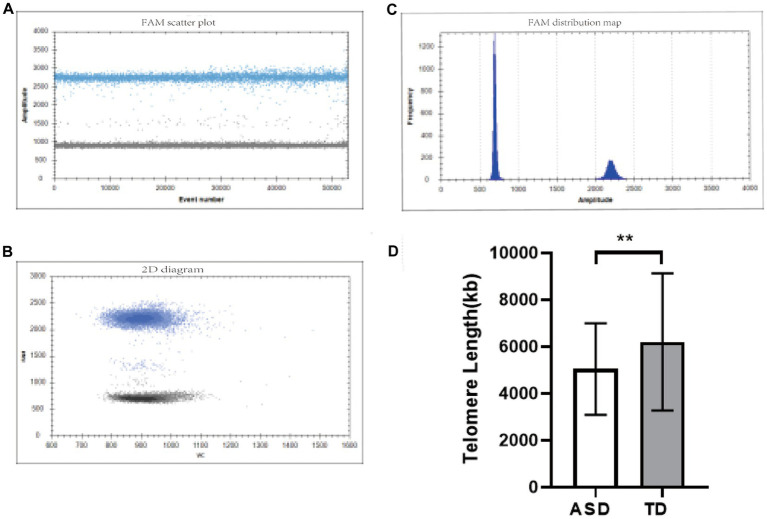
In this study, 96 children with ASD who met the diagnostic and statistical manual of mental disorders were collected, and the number of children in the typical development (TD) group was matched by 1:1. Digital PCR (dPCR) for telomere length (TL) expression in ASD in peripheral blood leukocytes. Urine levels of 8-hydroxy-2-deoxyguanosine (8-OHdG) content were measured by tandem triple quadrupole mass spectrometry and corrected by urinary creatinine levels. The levels of superoxide dismutase (SOD), catalase (CAT), and capacity (AOC) were detected by kits.
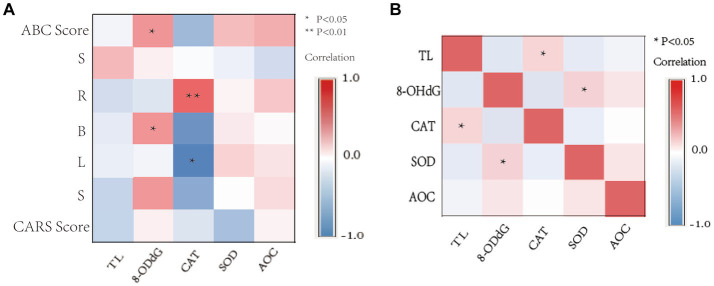
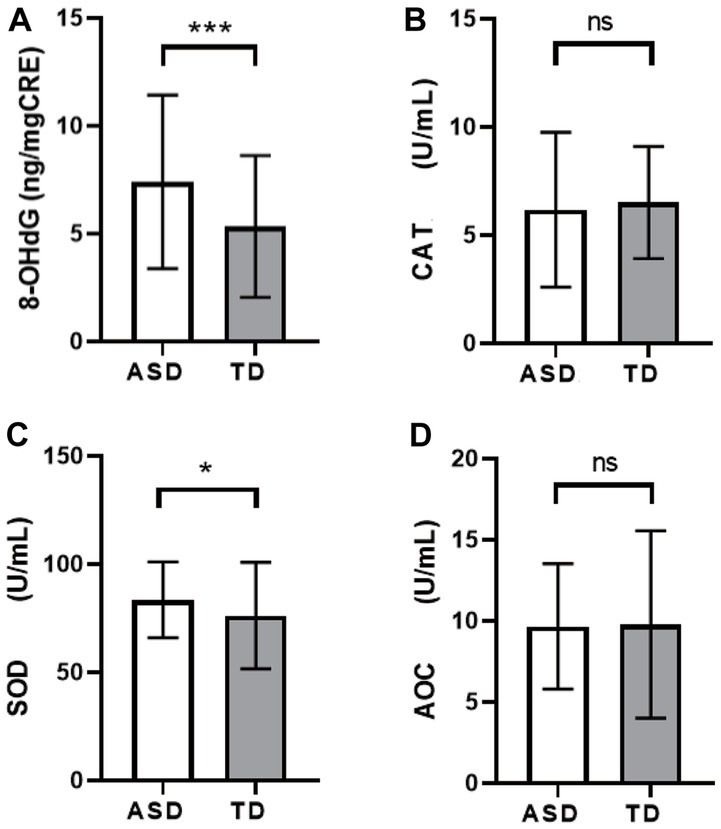
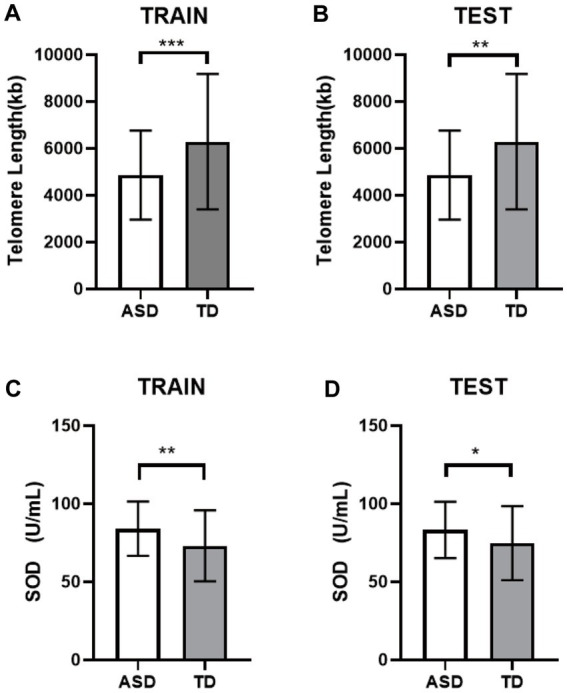
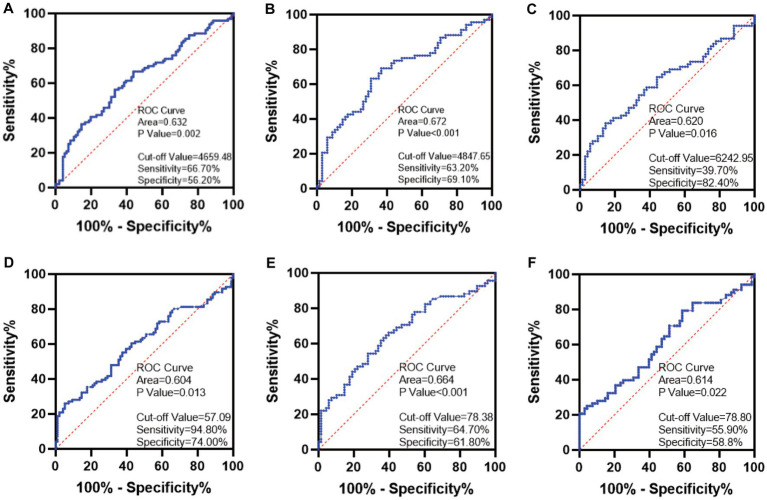
The TL of the ASD group was shorter than the TD group ( < 0.01) and had some accurate predictive significance for the identification of ASD (AUC = 0.632, 95% CI: 0.533-0.710, = 0.002). Both 8-OHdG content and SOD activity in the ASD group were significantly higher than those in the TD group ( < 0.05). Shortened TL (Monofactor: 2.20 (1.22, 3.96), = 0.009; Multifactor: 2.22 (1.22, 4.00), = 0.008) and reduced CAT activity (Monofactor: 2.31 (1.28, 4.17), = 0.006; Multifactor: 2.31 (1.28, 4.18), = 0.006) are risk factors for the development of ASD, while reduced 8-OHdG content (Monofactor: 0.29 (0.14, 0.60), = 0.001; Multifactor: 0.27 (0.13, 0.57), = 0.001) and reduced SOD activity (Monofactor: 0.55 (0.31, 0.98), = 0.042; Multifactor: 0.54 (0.30, 0.98), = 0.042) are protective factors for the development of ASD.
In this study, TL and OS were significantly different between the ASD group and the TD group. As guanine-rich telomere sequences were likely damaged by oxygen free radicals, creating OS, which is a factor in the incidence and progression of ASDs. In conclusion, oxidative damage occurs in the bodies of children with ASD, which may lead to sustained disease progression and severe clinical manifestations. We assume that timely supplementation of antioxidants is very likely to be a potential treatment for early intervention in children with ASD. Identification and detection of OS-related biomarkers may contribute to early diagnosis and timely interventions in young patients with ASD.
自闭症谱系障碍(ASD)是一种高度异质性的神经发育障碍,由遗传和环境风险因素之间的复杂相互作用引起。在ASD的病理生理发展过程中,抗氧化能力与氧化应激(OS)诱导的自由基之间的平衡可能至关重要。
本研究收集了96例符合精神障碍诊断与统计手册的ASD儿童,并按1:1匹配典型发育(TD)组儿童数量。采用数字PCR(dPCR)检测外周血白细胞中ASD的端粒长度(TL)表达。采用串联三重四极杆质谱法测定尿中8-羟基-2-脱氧鸟苷(8-OHdG)含量,并以尿肌酐水平进行校正。采用试剂盒检测超氧化物歧化酶(SOD)、过氧化氢酶(CAT)水平及抗氧化能力(AOC)。
ASD组的TL短于TD组(<0.01),对ASD的识别具有一定的准确预测意义(AUC = 0.632,95%CI:0.533 - 0.710,= 0.002)。ASD组的8-OHdG含量和SOD活性均显著高于TD组(<0.05)。TL缩短(单因素:2.20(1.22,3.96),= 0.009;多因素:2.22(1.22,4.00),= 0.008)和CAT活性降低(单因素:2.31(1.28,4.17),= 0.006;多因素:2.31(1.28,4.18),= 0.006)是ASD发生发展的危险因素,而8-OHdG含量降低(单因素:0.29(0.14,0.60),= 0.001;多因素:0.27(0.13,0.57),= 0.001)和SOD活性降低(单因素:0.55(0.31,0.98),= 0.042;多因素:0.54(0.30,0.98),= 0.042)是ASD发生发展的保护因素。
本研究中,ASD组与TD组的TL和OS存在显著差异。富含鸟嘌呤的端粒序列可能被氧自由基破坏,产生OS,这是ASD发病和进展的一个因素。总之,ASD患儿体内发生氧化损伤,这可能导致疾病持续进展和严重的临床表现。我们推测及时补充抗氧化剂很可能是ASD患儿早期干预的一种潜在治疗方法。识别和检测与OS相关的生物标志物可能有助于ASD年轻患者的早期诊断和及时干预。