Unit of Psychiatry, Department of Public Health and Medicinal Administration, Institute of Translational Medicine, Faculty of Health Sciences, University of Macau, Macao SAR, China; Centre for Cognitive and Brain Sciences, University of Macau, Macao SAR, China; Institute of Advanced Studies in Humanities and Social Sciences, University of Macau, Macao SAR, China.
The National Clinical Research Center for Mental Disorders, Beijing Key Laboratory of Mental Disorders Beijing Anding Hospital, the Advanced Innovation Center for Human Brain Protection, Capital Medical University, School of Mental Health, Beijing, China.
J Affect Disord. 2022 Aug 15;311:181-188. doi: 10.1016/j.jad.2022.05.061. Epub 2022 May 17.
Although the Coronavirus Disease 2019 (COVID-19) has greatly impacted individuals' mental health and quality of life, network analysis studies of associations between symptoms of common syndromes during the pandemic are lacking, particularly among Macau residents. This study investigated the network structure of insomnia, anxiety, and depression and explored their associations with quality of life in this population.
This online survey was conducted in Macau between August 18 and November 9, 2020. Insomnia, anxiety, depressive symptoms, and quality of life were assessed with the Insomnia Severity Index, Generalized Anxiety Disorder Scale, Patient Health Questionnaire, and World Health Organization Quality of Life-brief version, respectively. Analyses were performed to identify central symptoms and bridge symptoms of this network and their links to quality of life.
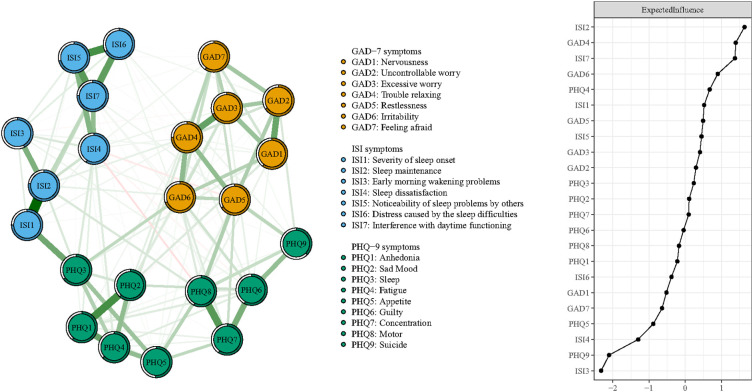
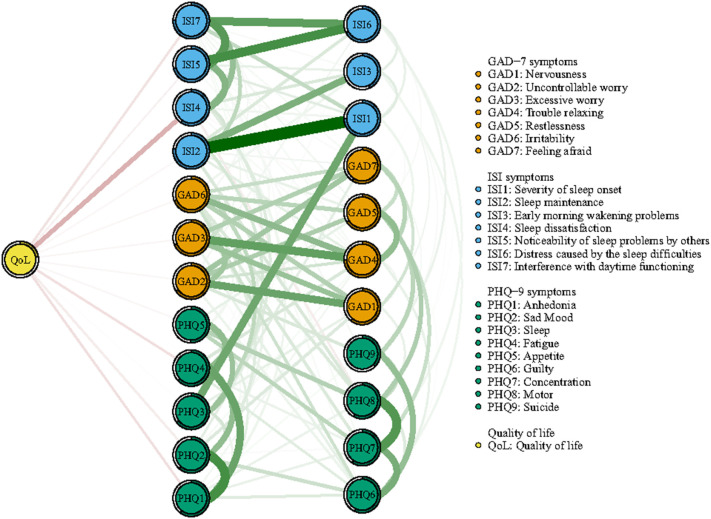
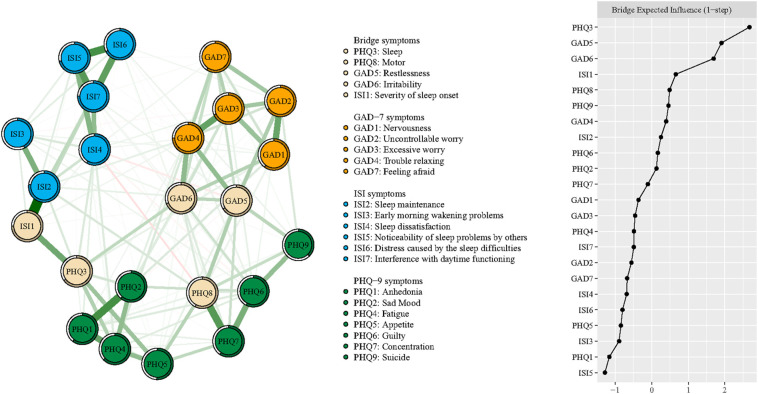
975 participants enrolled in this survey. The prevalence of depressive, anxiety and insomnia symptoms were 38.5% (95% confidence interval (CI): 35.5%-41.5%), 28.8% (95%CI: 26.0%-31.7%), and 27.6% (95% CI: 24.8%-30.4%), respectively. "Sleep maintenance" had the highest expected influence centrality, followed by "Trouble relaxing", "Interference with daytime functioning", "Irritability", and "Fatigue". Five bridge symptoms were identified: "Sleep problems", "Restlessness", "Irritability", "Severity of sleep onset", and "Motor activity". The insomnia symptom, "Sleep dissatisfaction", had the strongest direct relation to quality of life.
Insomnia symptoms played a critical role in the distress symptom network regarding node and bridge centrality as well as associations with quality of life among Macau residents. Close attention to these symptoms may be critical to reducing risk and preventing exacerbations in common forms of distress in this population.
尽管 2019 年冠状病毒病(COVID-19)极大地影响了个体的心理健康和生活质量,但在澳门居民中,缺乏对大流行期间常见综合征症状之间关联的网络分析研究。本研究调查了失眠、焦虑和抑郁症状的网络结构,并探讨了它们与该人群生活质量的关系。
这项在线调查于 2020 年 8 月 18 日至 11 月 9 日在澳门进行。失眠、焦虑、抑郁症状和生活质量分别用失眠严重程度指数、广泛性焦虑症量表、患者健康问卷和世界卫生组织生活质量简表评估。进行分析以确定该网络的中心症状和桥接症状及其与生活质量的联系。
共有 975 名参与者参加了这项调查。抑郁、焦虑和失眠症状的患病率分别为 38.5%(95%置信区间:35.5%-41.5%)、28.8%(95%CI:26.0%-31.7%)和 27.6%(95%CI:24.8%-30.4%)。“睡眠维持”具有最高的预期影响中心性,其次是“放松困难”、“日间功能障碍”、“易怒”和“疲劳”。确定了五个桥接症状:“睡眠问题”、“不安宁”、“易怒”、“入睡困难严重程度”和“运动活动”。失眠症状“睡眠不满”与生活质量的直接关系最强。
在澳门居民中,失眠症状在节点和桥接中心性以及与生活质量的关系方面在困扰症状网络中起着关键作用。密切关注这些症状对于降低该人群中常见形式的困扰的风险和预防恶化可能至关重要。