Kasralainy Faculty of Medicine, Cairo University, Cairo, Egypt.
Public Health Faculty of Medicine, Zagazig University State Country, Zagazig, Egypt.
BMC Public Health. 2023 Jun 19;23(1):1178. doi: 10.1186/s12889-023-15791-9.
Knowing what to eat and realizing the significance of healthful eating habits are among the important steps to promoting eating behavior. The current study aims to assess the nutrition knowledge (NK) among a convenient sample in four different countries, determine the association between different demographic factors and NK, and investigate the need for future interventions on nutrition in the four selected countries.
A cross-sectional multi-national survey study among a convenient sample of 8,191 subjects from Egypt, Syria, Saudi Arabia, and Jordan who undertook surveys between January 2019 and January 2020. A pre-tested interview questionnaire was utilized for data collection from study participants. It included three sections: i) Sociodemographic characteristics:. ii). Section two included twenty-one questions related to NK.. iii). Section three included one question about NK sources.
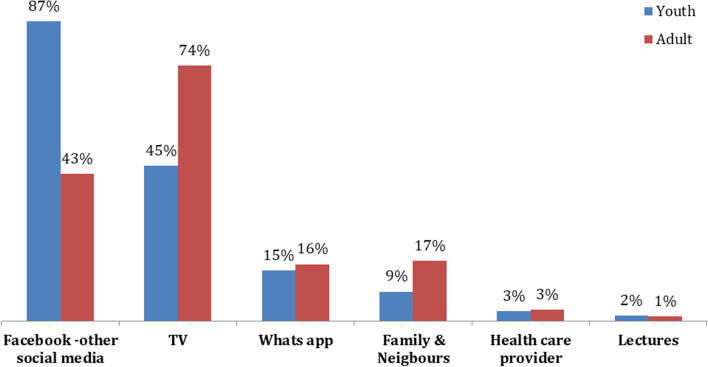
About three-quarters showed inadequate nutrition knowledge (73.1%). Youth (15-24 yrs.) were more dependent on social media, with 87% using it as a primary source of NK, while adults (≥ 25 yrs.) demonstrated that 43% of them used social media. In contrast, TV was more prominent among them, with participants' characteristics such as living with parents, body mass index, and country of residence showing no association with NK. However, female sex, education, and reading nutrition articles are significantly correlated with adequate knowledge (p < 0.001). Significant predictors of satisfactory knowledge were age, sex, education, living with parents, and reading nutrition articles.
The study revealed low levels of NK indicating an urgent need to implement educational programs to promote nutrition knowledge. As NK is a modifiable determinant of diet intake and can positively impact the need for developing strategies in counselling and raising awareness among the general population to improve their health status.
了解饮食内容并认识到健康饮食习惯的重要性是促进饮食行为的重要步骤之一。本研究旨在评估四个不同国家中便利样本的营养知识 (NK),确定不同人口统计学因素与 NK 之间的关系,并调查四个选定国家未来进行营养干预的必要性。
这是一项在埃及、叙利亚、沙特阿拉伯和约旦四个国家的便利样本中进行的横断面多国调查研究,共有 8191 名参与者于 2019 年 1 月至 2020 年 1 月期间完成了调查。研究采用了经过预测试的访谈问卷来收集参与者的数据。问卷分为三个部分:i)社会人口统计学特征;ii)第二部分包括 21 个与 NK 相关的问题;iii)第三部分包括一个关于 NK 来源的问题。
约四分之三的人表现出 NK 不足(73.1%)。15-24 岁的年轻人(15-24 岁)更依赖社交媒体,87%的人将其作为 NK 的主要来源,而成年人(≥25 岁)则表明 43%的人使用社交媒体。相比之下,电视在他们中更为突出,参与者的特征,如与父母同住、体重指数和居住国家与 NK 无关。然而,女性性别、教育程度和阅读营养文章与 NK 显著相关(p<0.001)。与满意的知识水平相关的显著预测因素是年龄、性别、教育程度、与父母同住和阅读营养文章。
本研究显示 NK 水平较低,表明急需实施教育计划以提高营养知识。由于 NK 是饮食摄入的可改变决定因素,并且可以积极影响在普通人群中制定咨询和提高认识的策略,以改善他们的健康状况。