Sahin Elif, Sanlier Nevin
Department of Nutrition and Dietetics, School of Health Sciences, Ankara Medipol University, Altındağ, Ankara, 06050, Turkey.
Department of Nutrition and Dietetics, School of Health Sciences, Gedik University, Kartal, Istanbul, 34870, Turkey.
BMC Public Health. 2025 May 9;25(1):1711. doi: 10.1186/s12889-025-22689-1.
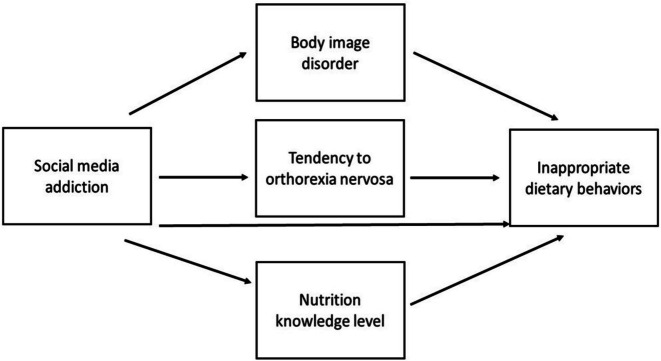
This study examined the relationships among female's nutrition knowledge levels, diet practices, healthy eating obsessions, body perceptions, and social media usage.
The study included 613 voluntarily participating females aged 18-60 years. Data including demographic information, anthropometric measurements, whether they follow a diet or not, and ORTO-R, Body Shape Questionnaire (BSQ-34), Bergen Social Media Addiction Scale (BSMAS), and General and Sport Nutrition Knowledge (GeSNK) Scale scores were collected.
The participants' mean age was 28.47 ± 9.38 years. Mean scores were 17.5 ± 5.1 for the ORTO-R scale, 89.2 ± 40.2 for the BSQ-34, 38.6 ± 12.5 for the GeSNK, and 17.3 ± 6.1 for the BSMAS. Statistically significant differences were found among the participants' total ORTO-R, BSQ-34, and GeSNK scores according to body mass index (BMI) and education level. Statistically significant relationships were also found among total ORTO-R, BSMAS, BSQ-34, and GeSNK scores. ORTO-R scores were positively correlated with BSMAS (r = 0.475, p < 0.05) and BSQ-34 (r = 0.685, p < 0.05) scores, while they were negatively correlated with GeSNK scores (r = -0.117, p < 0.05). There was a positive correlation between BMI and BSQ-34 scores (r = 0.380, p < 0.001) and between BMI and ORTO-R scores (r = 0.130, p < 0.001), while there was a negative correlation (r = -0.176, p < 0.001) between BMI and GeSNK scores.
Social media is a fast, important, and effective tool for the sharing of information. Thus, social media may be effective in strengthening individuals' nutrition knowledge, nutrition obsessions, body perceptions. Therefore, it would be beneficial to provide training for individuals to use social media consciously and providing nutritional literacy will be effective.
本研究探讨了女性的营养知识水平、饮食习惯、健康饮食痴迷程度、身体认知以及社交媒体使用之间的关系。
该研究纳入了613名年龄在18至60岁之间自愿参与的女性。收集的数据包括人口统计学信息、人体测量数据、她们是否遵循某种饮食、ORTO-R量表、身体形状问卷(BSQ-34)、卑尔根社交媒体成瘾量表(BSMAS)以及一般和运动营养知识(GeSNK)量表得分。
参与者的平均年龄为28.47±9.38岁。ORTO-R量表的平均得分为17.5±5.1,BSQ-34的平均得分为89.2±40.2,GeSNK的平均得分为38.6±12.5,BSMAS的平均得分为17.3±6.1。根据体重指数(BMI)和教育水平,参与者的ORTO-R、BSQ-34和GeSNK总分存在统计学显著差异。ORTO-R、BSMAS、BSQ-34和GeSNK总分之间也存在统计学显著关系。ORTO-R得分与BSMAS得分(r = 0.475,p < 0.05)和BSQ-34得分(r = 0.685,p < 0.05)呈正相关,而与GeSNK得分呈负相关(r = -0.117,p < 0.05)。BMI与BSQ-34得分(r = 0.380,p < 0.001)以及BMI与ORTO-R得分(r = 0.130,p < 0.001)之间呈正相关,而BMI与GeSNK得分之间呈负相关(r = -0.176,p < 0.001)。
社交媒体是一个快速、重要且有效的信息分享工具。因此,社交媒体可能在增强个体的营养知识、营养痴迷程度和身体认知方面有效。所以,为个体提供有意识使用社交媒体的培训将是有益的,并且提供营养素养教育也将是有效的。