Department of Brain & Neuroscience, Tokyo Metropolitan Institute of Medical Science, Japan.
Laboratory of Neuropathology and Neuroscience, Graduate School of Pharmaceutical Sciences, The University of Tokyo, Japan.
FEBS Open Bio. 2023 Aug;13(8):1394-1404. doi: 10.1002/2211-5463.13657. Epub 2023 Jul 7.
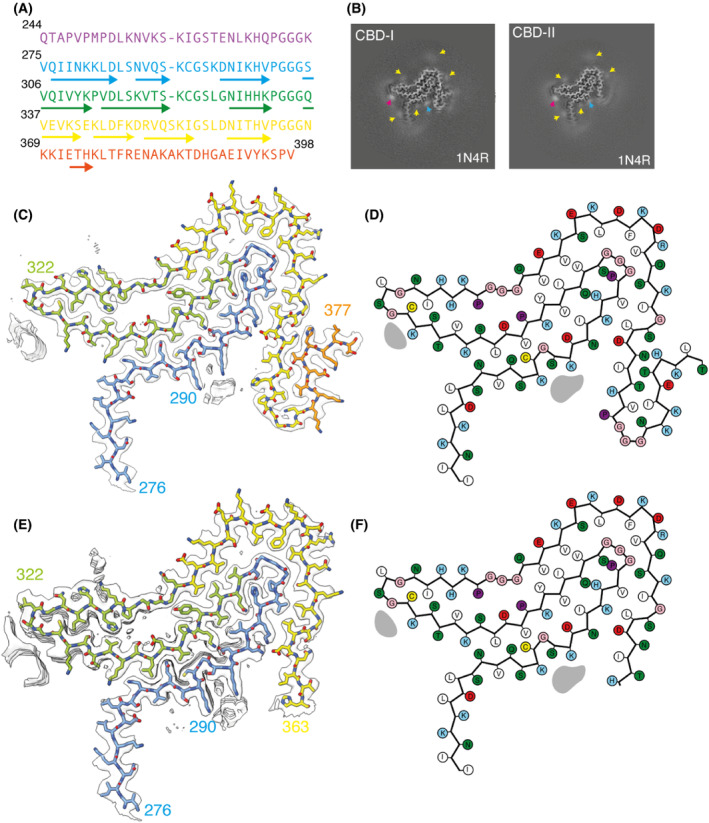
The formation of amyloid filaments through templated seeding is believed to underlie the propagation of pathology in most human neurodegenerative diseases. A widely used model system to study this process is to seed amyloid filament formation in cultured cells using human brain extracts. Here, we report the electron cryo-microscopy structures of tau filaments from undifferentiated seeded SH-SY5Y cells that transiently expressed N-terminally HA-tagged 1N3R or 1N4R human tau, using brain extracts from individuals with Alzheimer's disease or corticobasal degeneration. Although the resulting filament structures differed from those of the brain seeds, some degrees of structural templating were observed. Studying templated seeding in cultured cells, and determining the structures of the resulting filaments, can thus provide insights into the cellular aspects underlying neurodegenerative diseases.
通过模板引发形成淀粉样纤维被认为是大多数人类神经退行性疾病中病理学传播的基础。研究这一过程的一个广泛使用的模型系统是使用人脑提取物在培养的细胞中引发淀粉样纤维的形成。在这里,我们报告了使用来自阿尔茨海默病或皮质基底变性患者的脑提取物,瞬时表达 N 端 HA 标记的 1N3R 或 1N4R 人 tau 的未分化接种 SH-SY5Y 细胞中的 tau 纤维的电子低温显微镜结构。尽管得到的纤维结构与脑种子的不同,但观察到了一定程度的结构模板。因此,研究培养细胞中的模板引发以及确定所得纤维的结构,可以为神经退行性疾病的细胞方面提供深入了解。