Kim Soyeon, Belfry Kimberly D, Crawford Jennifer, MacDougall Arlene, Kolla Nathan J
Waypoint Centre for Mental Health Care, Waypoint Research Institute, Penetanguishene, ON, Canada.
Psychiatry and Behavioural Neurosciences, McMaster University, Hamilton, ON, Canada.
Front Psychiatry. 2023 Jun 5;14:1029082. doi: 10.3389/fpsyt.2023.1029082. eCollection 2023.
Current literature indicates that safety measures, including lockdowns during the COVID-19 pandemic, severely disrupted our lifestyle, marked by increased screen time. The increased screen time is mostly associated with exacerbated physical and mental wellbeing. However, the studies that examine the relationship between specific types of screen time and COVID-19-related anxiety among youth are limited.
We examined the usage of passive watching, social media, video games, and educational screen time and COVID-19-related anxiety at the 5-time points (Early-Spring 2021, Late-Spring 2021, Fall 2021, Winter 2022, and Spring 2022) among youth in Southern Ontario, Canada ( = 117, mean age = 16.82, male = 22%, non-White = 21%) and investigated the role of 4 types of screen time in COVID-19 related anxiety. COVID-related anxiety was measured using the Coronavirus Anxiety Scale (CAS). Descriptive statistics examined the binary relationships between demographic factors, screen time, and COVID-related anxiety. Also, partially adjusted and fully adjusted binary logistic regression analyses were conducted to examine the association between the types of screen time and COVID-19-related anxiety.
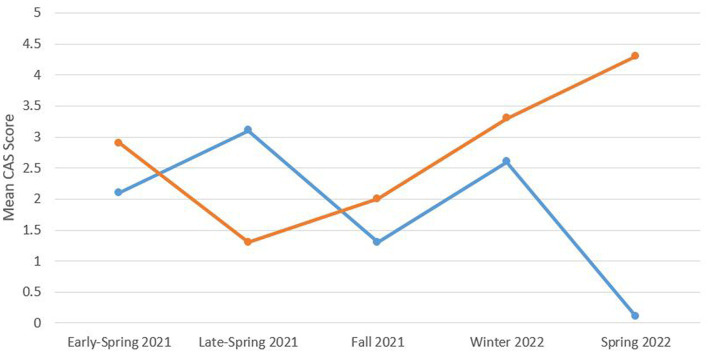
During the late Spring of 2021, when the provincial safety restrictions were most stringent, screen time was the highest among the 5 data collection time points. Further, adolescents experienced the highest COVID-19-related anxiety during this period. On the other hand, young adults experienced the highest COVID-19-related anxiety during Spring 2022. In a partially adjusted model (accounting for other types of screen time), engaging in 1-5 h per day on social media increased the likelihood of experiencing COVID-19-related anxiety compared to those who spend less than 1 h per day (OR = 3.50, 95%CI = 1.14-10.72, < 0.05). Other types of screen time was not significantly associated with COVID-19-related anxiety. In a fully adjusted model (accounting for age, sex and ethnicity besides four types on screen time), 1-5 h per day of social media remained significantly associated with COVID-19-related anxiety (OR = 4.08, 95%CI = 1.22-13.62, < 0.05).
Our findings suggest that COVID-19-related anxiety is associated with youth engagement in social media during the COVID-19 pandemic. Clinicians, parents, and educators should work collaboratively to provide developmentally appropriate approaches to reduce the negative social media impact on COVID-19-related anxiety and promote/foster resiliency in our community during the recovery period.
当前文献表明,包括新冠疫情期间封锁措施在内的安全措施严重扰乱了我们的生活方式,其特征是屏幕使用时间增加。屏幕使用时间增加大多与身心健康恶化相关。然而,研究特定类型屏幕使用时间与青少年新冠相关焦虑之间关系的研究有限。
我们调查了加拿大安大略省南部青少年在5个时间点(2021年早春、2021年晚春、2021年秋季、2022年冬季和2022年春季)被动观看、社交媒体、电子游戏和教育性屏幕使用时间情况以及与新冠相关的焦虑状况(n = 117,平均年龄 = 16.82岁,男性 = 22%,非白人 = 21%),并研究了4种屏幕使用时间类型在新冠相关焦虑中的作用。使用冠状病毒焦虑量表(CAS)测量新冠相关焦虑。描述性统计分析了人口统计学因素、屏幕使用时间和新冠相关焦虑之间的二元关系。此外,进行了部分调整和完全调整的二元逻辑回归分析,以检验屏幕使用时间类型与新冠相关焦虑之间的关联。
在2021年晚春,当省级安全限制最为严格时,屏幕使用时间在5个数据收集时间点中最高。此外,青少年在此期间经历了最高的新冠相关焦虑。另一方面,年轻人在2022年春季经历了最高的新冠相关焦虑。在部分调整模型(考虑其他类型屏幕使用时间)中,与每天花费少于1小时的人相比,每天在社交媒体上花费1 - 5小时会增加经历新冠相关焦虑的可能性(OR = 3.50,95%CI = 1.14 - 10.72,P < 0.05)。其他类型的屏幕使用时间与新冠相关焦虑无显著关联。在完全调整模型(除屏幕使用时间的四种类型外还考虑年龄、性别和种族)中,每天1 - 5小时的社交媒体使用仍与新冠相关焦虑显著相关(OR = 4.08,95%CI = 1.22 - 13.62,P < 0.05)。
我们的研究结果表明,新冠相关焦虑与新冠疫情期间青少年参与社交媒体有关。临床医生、家长和教育工作者应共同努力,提供适合青少年发展阶段的方法,以减少社交媒体对新冠相关焦虑的负面影响,并在恢复期促进/培养我们社区的恢复力。