Ministry of Education-Shanghai Key Laboratory of Children's Environmental Health, School of Public Health, Shanghai Jiao Tong University School of Medicine, Chongqing road n.227, Shanghai, 200025, China.
School of Public Health, Shanghai Jiao Tong University School of Medicine, Chongqing road n.227, Shanghai, 200025, China.
Int J Behav Nutr Phys Act. 2022 Jul 26;19(1):92. doi: 10.1186/s12966-022-01327-8.
We examined the prospective associations of changes in lifestyle behaviors before/during the COVID-19 pandemic, namely physical activity and screen time, with mental health. Furthermore, the impacts of physical activity and screen time on mental health during the pandemic were examined cross-sectionally.
A two-wave longitudinal study was conducted among 2423 children and adolescents in Shanghai, China. Lifestyle behavior variables (physical activity and screen time) and psychological variables (depressive symptoms, anxiety, and stress) were measured using a self-reported questionnaire in January and March 2020. A series of multivariable logistic regressions were performed to examine the associations between changes in lifestyle behaviors in two waves and psychological problems. The combined associations of physical activity and screen time with psychological problems were also explored using the second wave data.
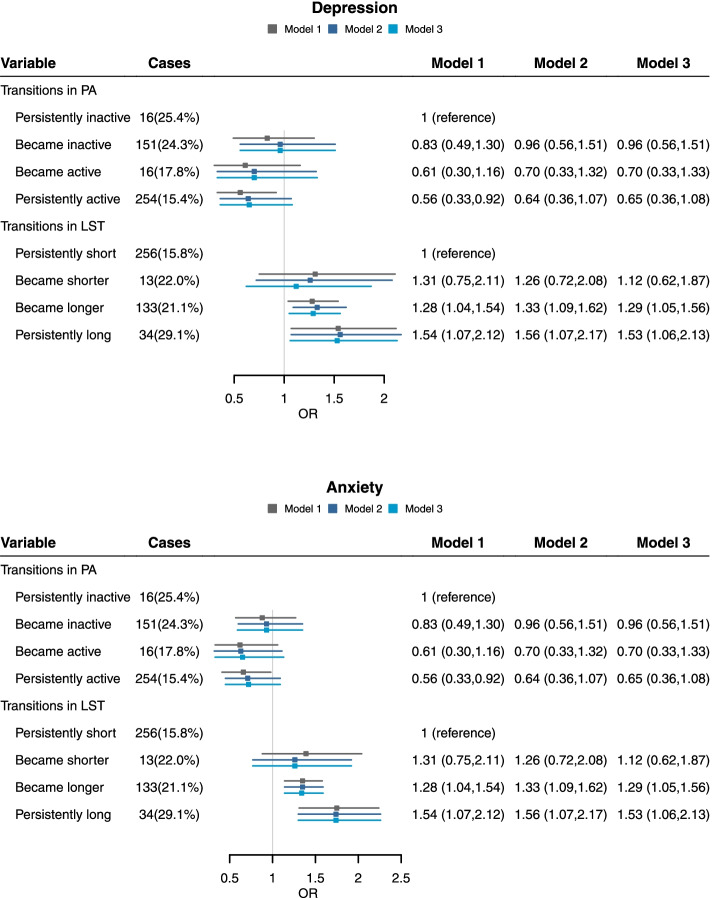
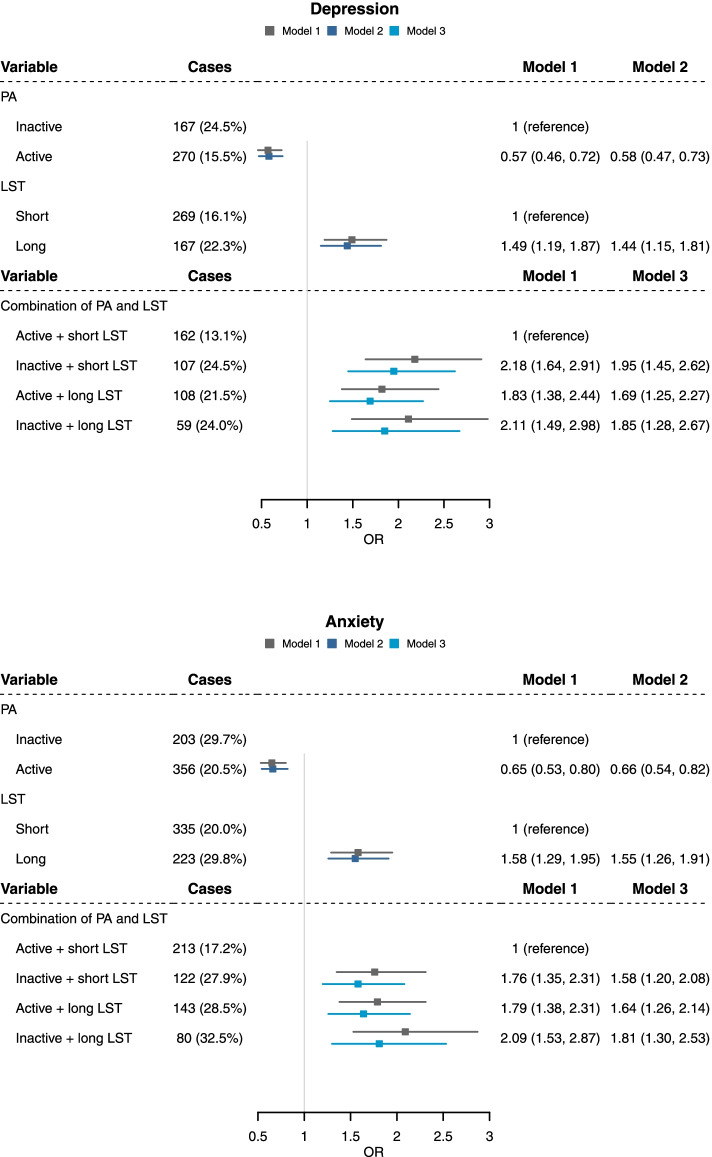
Compared to students with persistently short screen time before and during the COVID-19 pandemic, those with prolonged screen time (OR = 1·36 for depression, OR = 1·48 for anxiety) and those with persistently long screen time (OR = 1·70 for depression, OR = 2·13 for anxiety) reported a higher risk of psychological symptoms. The association between changes in physical activity and psychological symptoms was not statistically significant after adjustment for demographic factors, socioeconomic status, and screen time. During the COVID-19 pandemic, engaging in longer screen time (OR = 1·44 for depression, OR = 1·55 for anxiety) was associated with worsened psychological conditions, while engaging in increased physical activity (OR = 0·58 for depression, OR = 0·66 for anxiety) was associated with better psychological conditions.
Our study suggests that promoting physical activity and limiting leisure screen time during the COVID-19 pandemic are important to prevent and mitigate psychological problems in children and adolescents. Therefore, effective interventions targeting lifestyle behaviors are needed to protect children and adolescents' physical and mental health.
本研究旨在探讨 COVID-19 大流行前后生活方式行为(体力活动和屏幕时间)的变化与心理健康之间的前瞻性关联。此外,还考察了大流行期间体力活动和屏幕时间对心理健康的横断面影响。
在中国上海,对 2423 名儿童和青少年进行了两波纵向研究。使用自我报告问卷于 2020 年 1 月和 3 月测量生活方式行为变量(体力活动和屏幕时间)和心理变量(抑郁症状、焦虑和压力)。采用一系列多变量逻辑回归分析来检验两波之间生活方式行为变化与心理问题之间的关联。还使用第二波数据探讨了体力活动和屏幕时间与心理问题的综合关联。
与 COVID-19 大流行前后屏幕时间持续较短的学生相比,屏幕时间延长(抑郁的 OR=1.36,焦虑的 OR=1.48)和屏幕时间持续较长(抑郁的 OR=1.70,焦虑的 OR=2.13)的学生报告出现心理症状的风险更高。调整人口统计学因素、社会经济地位和屏幕时间后,体力活动变化与心理症状之间的关联无统计学意义。在 COVID-19 大流行期间,较长的屏幕时间(抑郁的 OR=1.44,焦虑的 OR=1.55)与心理健康状况恶化相关,而增加体力活动(抑郁的 OR=0.58,焦虑的 OR=0.66)与心理健康状况改善相关。
本研究表明,在 COVID-19 大流行期间,促进体力活动和限制休闲屏幕时间对于预防和减轻儿童和青少年的心理问题至关重要。因此,需要针对生活方式行为的有效干预措施来保护儿童和青少年的身心健康。