Department of Psychology, University of Campania Luigi Vanvitelli, 81100, Caserta, Italy.
Department of Neuroscience, Karolinska Institute, Stockholm, Sweden.
Sci Rep. 2023 Jun 21;13(1):10064. doi: 10.1038/s41598-023-36173-6.
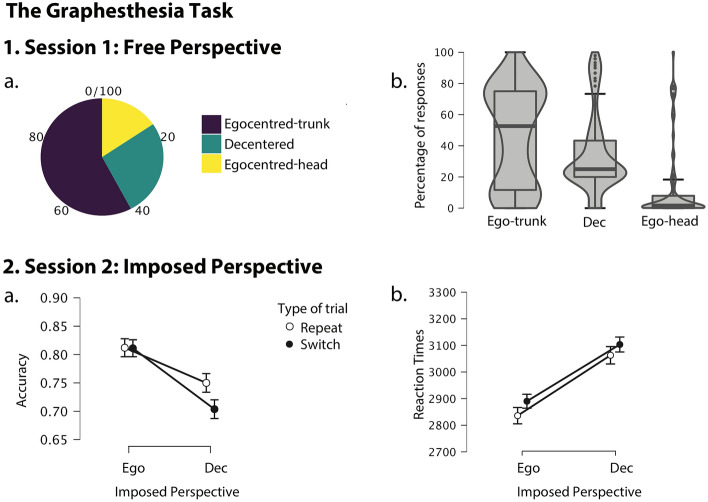
Information can be perceived from a multiplicity of spatial perspectives, which is central to effectively understanding and interacting with our environment and other people. Interoception, the sense of the physiological state of our body, is also a fundamental component contributing to our perception. However, whether the perception of our inner body signals influences our ability to adopt and flexibly change between different spatial perspectives remains poorly understood. To investigate this, 90 participants completed tasks assessing multiple dimensions of interoception (interoceptive sensibility, cardiac interoceptive accuracy and awareness) and the Graphesthesia task to assess tactile spatial perspective-taking and its flexibility. The results revealed that higher cardiac interoceptive awareness is associated with greater consistency in adopting a perspective decentred from the self. Second, higher cardiac interoceptive accuracy was associated with slower and less accurate performance in switching from a decentred to an egocentred perspective. These results show that interoceptive abilities facilitate decentred spatial perspective-taking, likely reflecting stronger perceived boundaries between internal states and the external world.
信息可以从多种空间视角感知,这对于有效理解和与我们的环境和他人互动至关重要。内感受,即对我们身体生理状态的感知,也是对我们的感知做出贡献的基本组成部分。然而,我们对内在身体信号的感知是否会影响我们采用和灵活改变不同空间视角的能力,仍知之甚少。为了研究这一点,90 名参与者完成了多项内感受任务(内感受敏感性、心脏内感受准确性和意识)和触觉空间视角任务,以评估触觉空间视角的采用及其灵活性。结果表明,更高的心脏内感受意识与更一致地采用自我去中心化的视角相关。其次,更高的心脏内感受准确性与从去中心化到以自我为中心的视角转换时更慢和更不准确的表现相关。这些结果表明,内感受能力促进了去中心化的空间视角采用,这可能反映了内部状态和外部世界之间更强的感知边界。