Department of Orthopedics, The Fifth Affiliated Hospital of Sun Yat-sen University, Zhuhai, Guangdong Province, China.
Department of Rehabilitation, The Fifth Affiliated Hospital of Sun Yat-sen University, Zhuhai, 519000, Guangdong Province, China.
Sci Rep. 2023 Jun 21;13(1):10054. doi: 10.1038/s41598-023-35742-z.
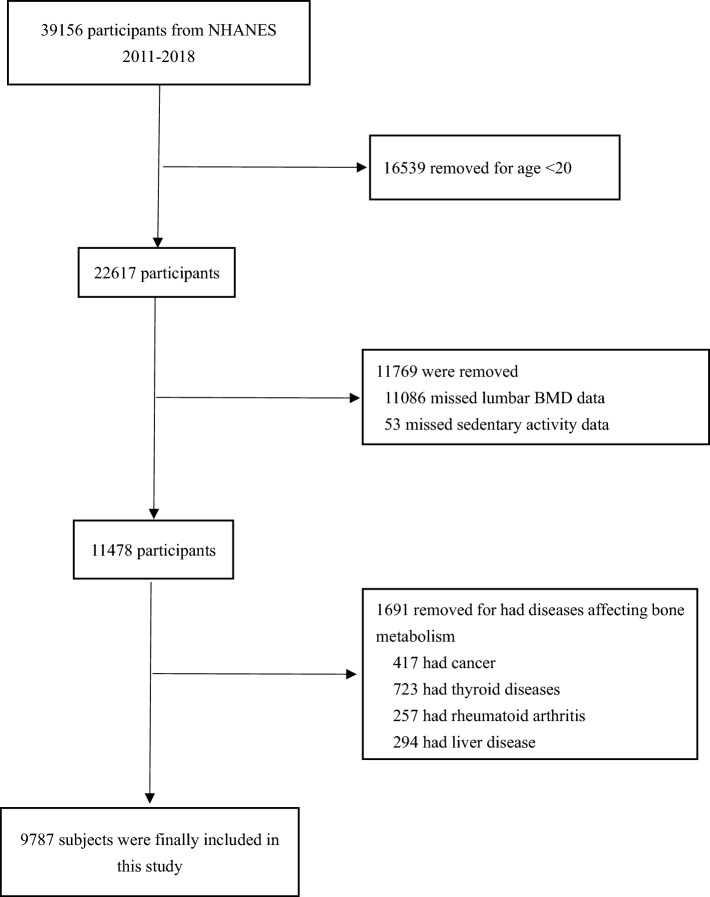
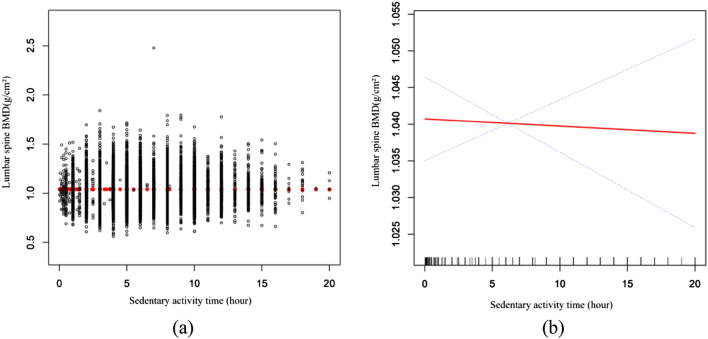
We compared the relationship between sedentary activity (SA) and physical activity (PA) with bone mineral density (BMD) and body fat percentage in the United States and found a negative association between SA and BMD and a positive association with body fat percentage. A positive association between PA and BMD and a negative association with body fat percentage. SA and PA are associated with changes in skeletal parameters and body fat percentage, and we aimed to investigate and compare the relationship between SA, PA and bone mineral density (BMD) and body fat percentage in men and women. We assessed the relationship between SA, PA and BMD and body fat percentage in 9787 Americans aged 20-59 years (mean age 38.28 ± 11.39 years) from NHANES 2011-2018. BMD and body fat percentage were measured by dual-energy X-ray bone densitometry (DXA). We used multiple linear regression models to examine the relationships between SA, PA and lumbar spine BMD and total body fat percentage, adjusted for a large number of confounding factors. After adjusting for race/ethnicity, age, alcohol and smoking behavior, body mass index (BMI), total protein, blood calcium, blood uric acid, cholesterol, blood phosphorus, vitamin D, and blood urea nitrogen, SA was negatively associated with lumbar spine BMD (β = - 0.0011 95% CI - 0.0020 to - 0.0002, P = 0.022), and SA was positively associated with total fat percentage (β = PA was positively associated with lumbar BMD (β = 0.0046 95% CI 0.0010 to 0.0082, P = 0.012) and there was a negative association between PA and body fat percentage (β = - 1.177 95% CI - 1.326 to -1.027, P < 0.001). Our results show that physical activity is a key component of maintaining bone health in both men and women and is strongly associated with lower body fat percentages. Sedentary activity is negatively correlated with bone density and is strongly associated with an increase in body fat percentage. Healthcare policy makers should consider reducing sedentary activity and increasing physical activity when preventing osteoporosis and obesity.
我们比较了美国久坐活动(SA)和体力活动(PA)与骨密度(BMD)和体脂百分比的关系,发现 SA 与 BMD 呈负相关,与体脂百分比呈正相关。PA 与 BMD 呈正相关,与体脂百分比呈负相关。SA 和 PA 与骨骼参数和体脂百分比的变化有关,我们旨在调查和比较 SA、PA 与男性和女性骨密度(BMD)和体脂百分比的关系。我们评估了 20-59 岁的 9787 名美国成年人(平均年龄 38.28 ± 11.39 岁)的 SA、PA 与 BMD 和全身脂肪百分比之间的关系,这些人来自 NHANES 2011-2018 年。BMD 和体脂百分比通过双能 X 射线骨密度仪(DXA)测量。我们使用多线性回归模型来检查 SA、PA 与腰椎 BMD 和全身脂肪百分比之间的关系,同时调整了大量混杂因素。在调整了种族/民族、年龄、酒精和吸烟行为、体重指数(BMI)、总蛋白、血钙、血尿酸、胆固醇、血磷、维生素 D 和血尿素氮后,SA 与腰椎 BMD 呈负相关(β=-0.0011 95%CI-0.0020 至-0.0002,P=0.022),SA 与总脂肪百分比呈正相关(β=0.0046 95%CI 0.0010 至 0.0082,P=0.012),PA 与腰椎 BMD 呈正相关(β=0.0046 95%CI 0.0010 至 0.0082,P=0.012),PA 与体脂百分比呈负相关(β=-1.177 95%CI-1.326 至-1.027,P<0.001)。我们的结果表明,体力活动是维持男性和女性骨骼健康的关键组成部分,与较低的体脂百分比密切相关。久坐活动与骨密度呈负相关,与体脂百分比增加密切相关。医疗保健政策制定者在预防骨质疏松症和肥胖症时,应考虑减少久坐活动和增加体力活动。