University of Minnesota Minneapolis MN USA.
Hennepin County Medical Center Minneapolis MN USA.
J Am Heart Assoc. 2023 Jul 4;12(13):e027273. doi: 10.1161/JAHA.122.027273. Epub 2023 Jun 22.
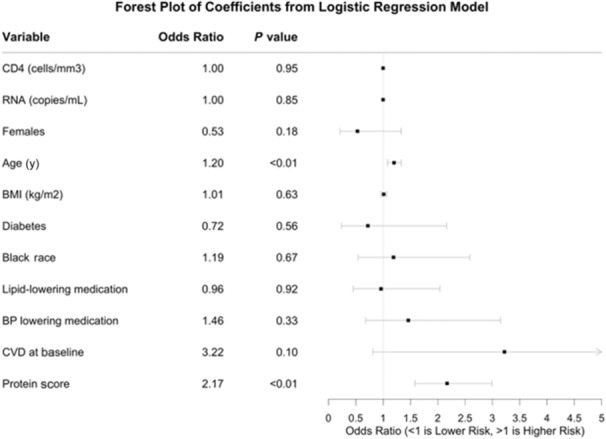
Background Cardiovascular disease risk prediction models underestimate CVD risk in people living with HIV (PLWH). Our goal is to derive a risk score based on protein biomarkers that could be used to predict CVD in PLWH. Methods and Results In a matched case-control study, we analyzed normalized protein expression data for participants enrolled in 1 of 4 trials conducted by INSIGHT (International Network for Strategic Initiatives in Global HIV Trials). We used dimension reduction, variable selection and resampling methods, and multivariable conditional logistic regression models to determine candidate protein biomarkers and to generate a protein score for predicting CVD in PLWH. We internally validated our findings using bootstrap. A protein score that was derived from 8 proteins (including HGF [hepatocyte growth factor] and interleukin-6) was found to be associated with an increased risk of CVD after adjustment for CVD and HIV factors (odds ratio: 2.17 [95% CI: 1.58-2.99]). The protein score improved CVD prediction when compared with predicting CVD risk using the individual proteins that comprised the protein score. Individuals with a protein score above the median score were 3.10 (95% CI, 1.83-5.41) times more likely to develop CVD than those with a protein score below the median score. Conclusions A panel of blood biomarkers may help identify PLWH at a high risk for developing CVD. If validated, such a score could be used in conjunction with established factors to identify CVD at-risk individuals who might benefit from aggressive risk reduction, ultimately shedding light on CVD pathogenesis in PLWH.
背景 心血管疾病风险预测模型低估了 HIV 感染者(PLWH)的 CVD 风险。我们的目标是基于蛋白质生物标志物开发一种风险评分,用于预测 PLWH 的 CVD。
方法和结果 在一项匹配的病例对照研究中,我们分析了参与由 INSIGHT(国际 HIV 临床试验战略倡议网络)进行的 4 项试验之一的参与者的标准化蛋白质表达数据。我们使用降维、变量选择和重采样方法以及多变量条件逻辑回归模型来确定候选蛋白质生物标志物,并生成预测 PLWH 中 CVD 的蛋白质评分。我们使用自举法对内部分数进行了验证。在调整 CVD 和 HIV 因素后,我们发现源自 8 种蛋白质(包括 HGF [肝细胞生长因子]和白细胞介素-6)的蛋白质评分与 CVD 风险增加相关(优势比:2.17 [95%CI:1.58-2.99])。与使用组成蛋白质评分的单个蛋白质预测 CVD 风险相比,蛋白质评分可提高 CVD 预测能力。蛋白质评分高于中位数的个体发生 CVD 的可能性是蛋白质评分低于中位数的个体的 3.10 倍(95%CI,1.83-5.41)。
结论 一组血液生物标志物可帮助识别发生 CVD 风险较高的 PLWH。如果得到验证,这样的评分可以与既定因素结合使用,以识别可能受益于积极降低风险的 CVD 高危个体,最终阐明 PLWH 中 CVD 的发病机制。