Vagal Afferent Research Group, School of Biomedicine, University of Adelaide, Adelaide, SA, Australia.
Nutrition, Diabetes & Gut Health, Lifelong Health Theme, South Australian Health and Medical Research Institute (SAHMRI), Adelaide, SA, Australia.
Eur J Nutr. 2023 Oct;62(7):2723-2737. doi: 10.1007/s00394-023-03191-z. Epub 2023 Jun 22.
To our knowledge, no studies have examined the association of diet quality and plant-based diets (PBD) with inflammatory-related mortality in obesity. Therefore, this study aimed to determine the joint associations of Healthy Eating Index-2015 (HEI-2015), plant-based dietary index (PDI), healthy PDI (hPDI), unhealthy PDI (uPDI), pro-vegetarian dietary index (PVD), and systemic inflammation with all-cause, cardiovascular disease (CVD), and cancer mortality risks by obesity status.
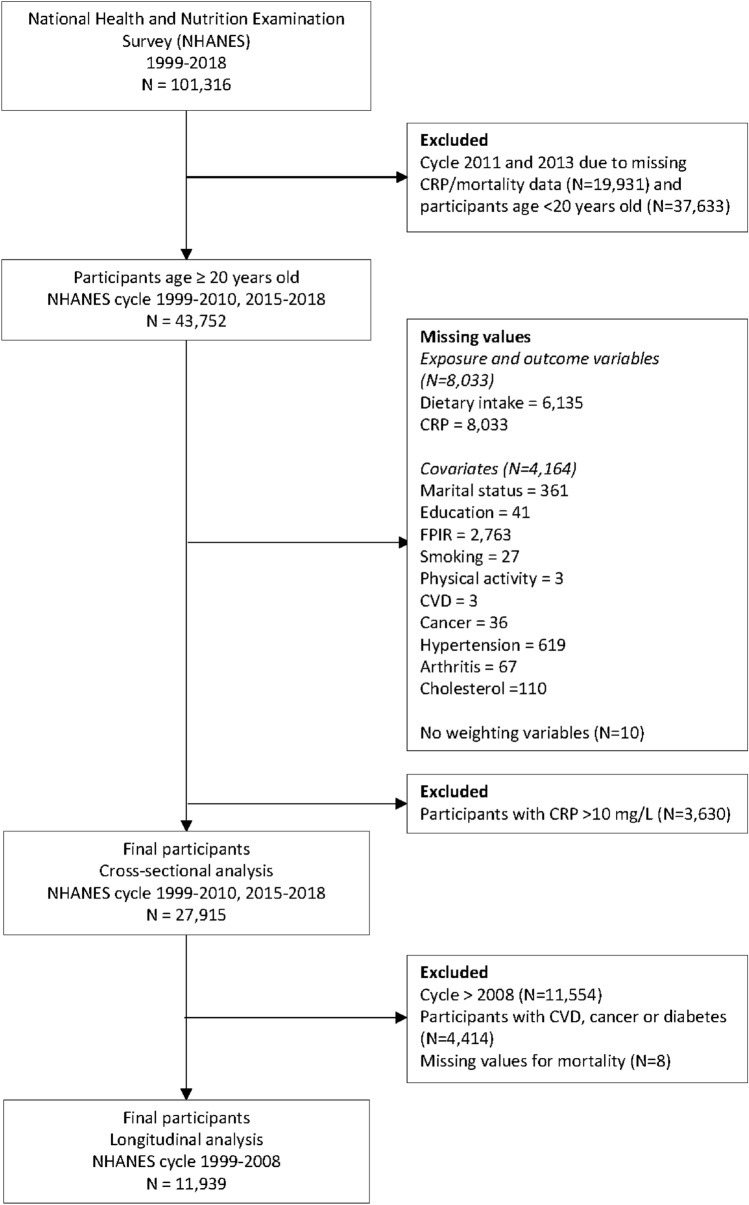
Participants from NHANES were included in cross-sectional (N = 27,915, cycle 1999-2010, 2015-2018) and longitudinal analysis (N = 11,939, cycle 1999-2008). HEI-2015, PDI, hPDI, uPDI, and PVD were constructed based on the 24-h recall dietary interview. The grade of inflammation (low, moderate, and high) was determined based on C-reactive protein (CRP) values and multivariable ordinal logistic regression was used to determine the association. Cox proportional hazard models were used to determine the joint associations of diet and inflammation with mortality.
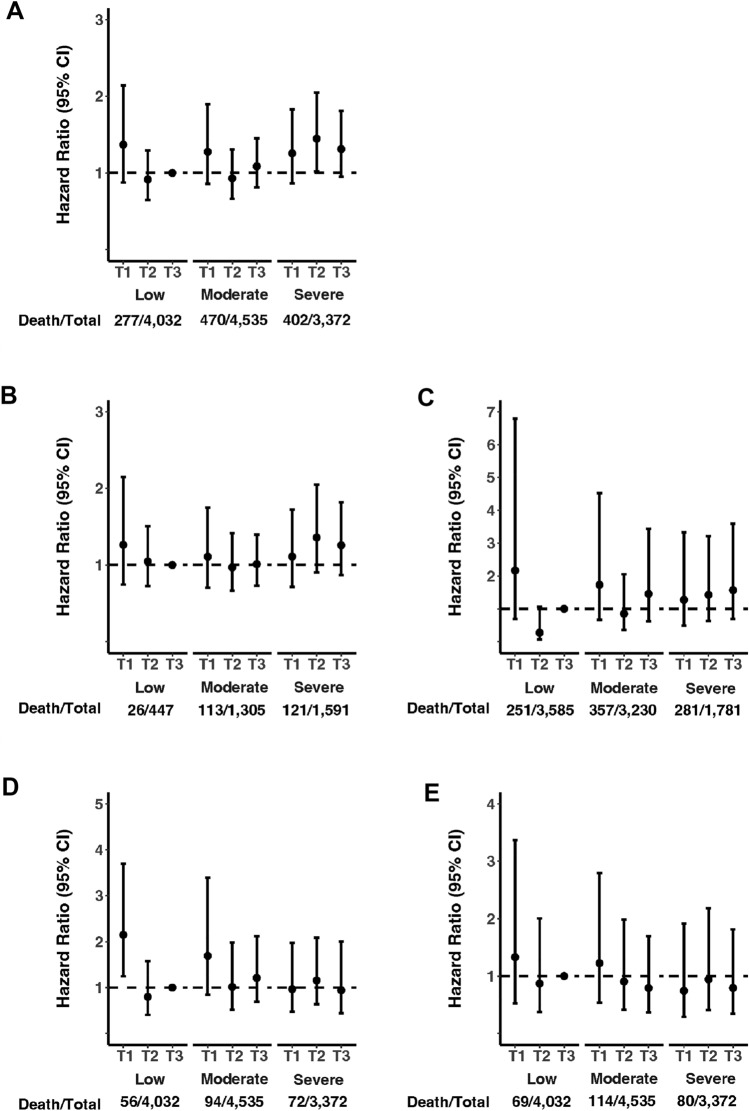
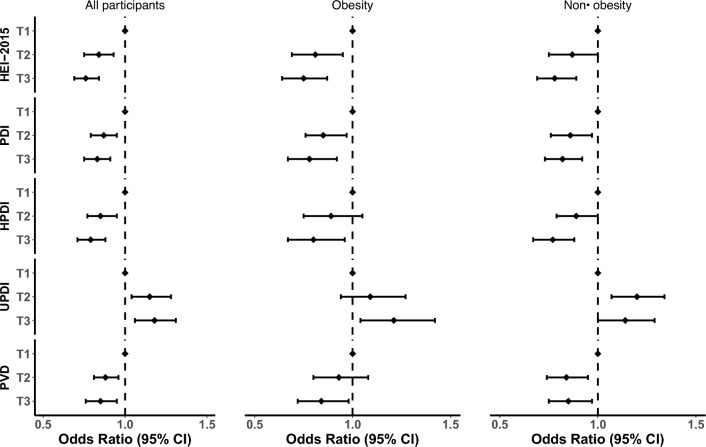
In the fully adjusted model, HEI-2015 (OR = 0.76, 95% CI 0.69-0.84; p-trend = < 0.001), PDI (OR = 0.83, 95% CI 0.75-0.91; p trend = < 0.001), hPDI (OR = 0.79, 95% CI 0.71-0.88; p trend = < 0.001), and PVD (OR = 0.85, 95% CI 0.75-0.97; p trend = 0.02) were associated with lower systemic inflammation. In contrast, uPDI was associated with higher systemic inflammation (OR = 1.18, 95% CI 1.06-1.31; p-trend = 0.03). Severe inflammation was associated with a 25% increase in all-cause mortality (OR = 1.25, 95% CI 1.03-1.53, p trend = 0.02). No association was found between PDI, hPDI, uPDI, and PVD with mortality. The joint association, between HEI-2015, levels of systemic inflammation, and all-cause, CVD and cancer mortality, was not significant. However, a greater reduction in mortality risk with an increase in HEI-2015 scores was observed in individuals with low and moderate inflammation, especially those with obesity.
Higher scores of HEI-2015 and increased intake of a healthy plant-based diet were associated with lower inflammation, while an unhealthy plant-based diet was associated with higher inflammation. A greater adherence to the 2015 dietary guidelines may reduce the risk of mortality associated with inflammation and may also benefit individuals with obesity who had low and moderate inflammation.
据我们所知,目前尚无研究探讨饮食质量和植物性饮食(PBD)与肥胖相关炎症死亡率之间的关系。因此,本研究旨在确定健康饮食指数-2015(HEI-2015)、植物性饮食指数(PDI)、健康 PDI(hPDI)、不健康 PDI(uPDI)、亲素食饮食指数(PVD)和全身炎症与肥胖状态下全因、心血管疾病(CVD)和癌症死亡率的联合关联。
纳入来自 NHANES 的横断面(N=27915,周期 1999-2010 年,2015-2018 年)和纵向分析(N=11939,周期 1999-2008 年)参与者。根据 24 小时膳食回顾性访谈构建 HEI-2015、PDI、hPDI、uPDI 和 PVD。根据 C 反应蛋白(CRP)值确定炎症程度(低、中、高),并使用多变量有序逻辑回归确定相关性。使用 Cox 比例风险模型确定饮食和炎症与死亡率的联合关联。
在完全调整模型中,HEI-2015(OR=0.76,95%CI 0.69-0.84;p 趋势<0.001)、PDI(OR=0.83,95%CI 0.75-0.91;p 趋势<0.001)、hPDI(OR=0.79,95%CI 0.71-0.88;p 趋势<0.001)和 PVD(OR=0.85,95%CI 0.75-0.97;p 趋势=0.02)与全身炎症程度较低有关。相比之下,uPDI 与全身炎症程度较高有关(OR=1.18,95%CI 1.06-1.31;p 趋势=0.03)。严重炎症与全因死亡率增加 25%有关(OR=1.25,95%CI 1.03-1.53,p 趋势=0.02)。PDI、hPDI、uPDI 和 PVD 与死亡率之间没有关联。HEI-2015、全身炎症水平与全因、CVD 和癌症死亡率之间的联合关联并不显著。然而,在炎症程度较低和中度的个体中,随着 HEI-2015 评分的增加,死亡率风险降低幅度更大,尤其是肥胖者。
较高的 HEI-2015 评分和增加健康的植物性饮食摄入与较低的炎症水平有关,而不健康的植物性饮食与较高的炎症水平有关。更好地遵循 2015 年饮食指南可能会降低与炎症相关的死亡率风险,并且可能对炎症程度较低和中度的肥胖者也有益。