Bakri Sophie J, Delyfer Marie-Noelle, Grauslund Jakob, Andersen Steffen, Karcher Helene
Department of Ophthalmology, Mayo Clinic, 200 First St SW, Rochester, MN, 55902, USA.
University of Bordeaux, Team "Lifelong Exposures, Health and Aging" (LEHA), Inserm U1219, Bordeaux Population Health Research Center, Bordeaux, France.
Ophthalmol Ther. 2023 Oct;12(5):2465-2477. doi: 10.1007/s40123-023-00750-9. Epub 2023 Jun 22.
There is little understanding of long-term treatment persistence in patients receiving anti-vascular endothelial growth factor (anti-VEGF) injections for diabetic macular edema (DME), particularly relating to treatment intervals. The aim of this study was to investigate the association between treatment interval and discontinuation rate after 24 months of unilateral anti-VEGF treatment in patients with DME under routine clinical care in the USA.
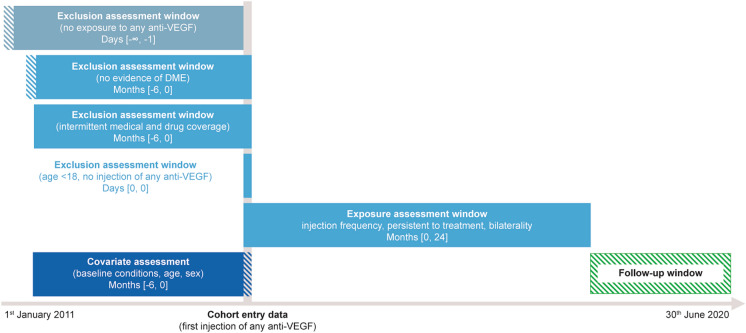
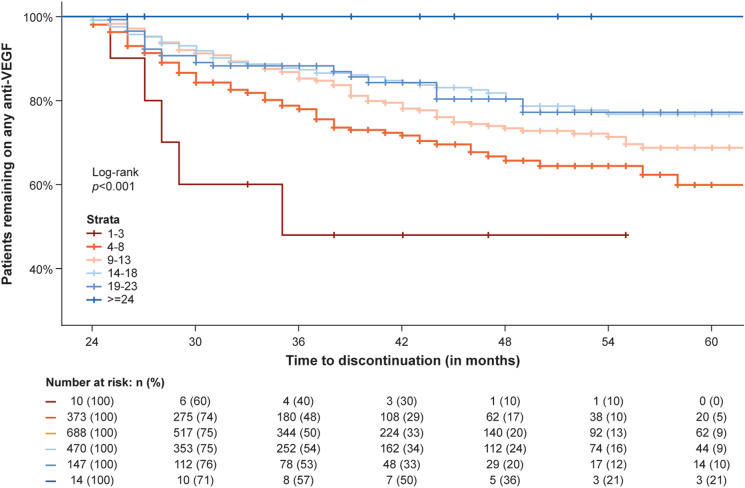
This was a non-interventional, retrospective cohort study to review the health insurance claims of adults with DME linked with the IBM MarketScan Commercial and Medicare Supplemental databases, who were continuously enrolled in a health plan for at least 6 months prior to their first anti-VEGF treatment and for a duration of at least 24 months between July 2011 and June 2017. Patients were grouped on the basis of the injection interval they achieved at 24 months of treatment. Discontinuation rate beyond 24 months and its association with treatment intervals at 24 months was estimated using the Kaplan-Meier method and Cox proportional hazards models.
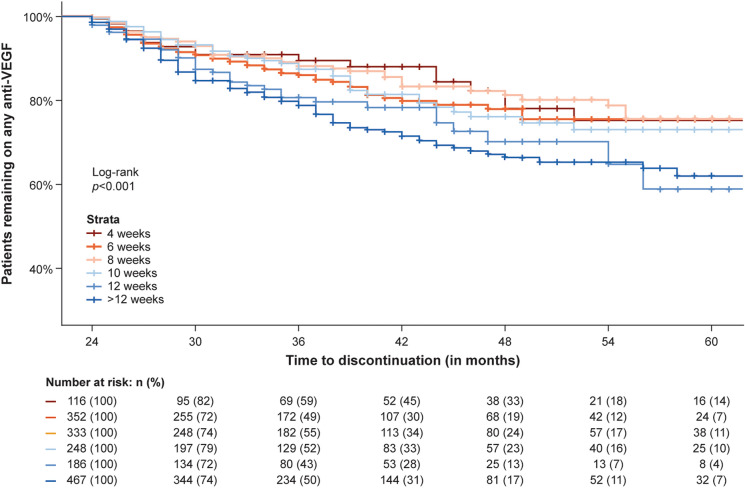
The overall discontinuation rate among the 1702 eligible patients from 24 to 60 months after treatment initiation was 30%. At 60 months, patients were more likely to remain on treatment in shorter (75.3% [4-week interval group]) versus longer treatment interval groups (62.1% [> 12-week interval group], difference = 13.2%, [95% confidence interval (CI) 1.06, 2.06], p = 0.01). Patients on a > 12-week interval were twice as likely to discontinue treatment compared with those on an 8-week interval (hazard ratio = 2.01 [95% CI 1.43, 2.82], p < 0.001).
Patients with DME on longer anti-VEGF treatment intervals at 24 months consistently had higher discontinuation rates in the following years than those on shorter treatment intervals.
对于接受抗血管内皮生长因子(anti-VEGF)注射治疗糖尿病性黄斑水肿(DME)的患者的长期治疗依从性,尤其是与治疗间隔相关的情况,人们了解甚少。本研究的目的是调查在美国常规临床护理下,DME患者单侧抗VEGF治疗24个月后治疗间隔与停药率之间的关联。
这是一项非干预性回顾性队列研究,旨在审查与IBM MarketScan商业数据库和医疗保险补充数据库相关联的DME成年患者的健康保险理赔记录,这些患者在首次接受抗VEGF治疗前至少连续参加健康计划6个月,且在2011年7月至2017年6月期间持续至少24个月。患者根据治疗2个月时达到的注射间隔进行分组。使用Kaplan-Meier方法和Cox比例风险模型估计24个月后的停药率及其与24个月时治疗间隔的关联。
1702例符合条件的患者在治疗开始后24至60个月的总体停药率为30%。在60个月时,与较长治疗间隔组(62.1%[间隔>12周组])相比,较短治疗间隔组(75.3%[4周间隔组])的患者更有可能继续接受治疗,差异为13.2%,[95%置信区间(CI)1.06,2.06],p = 0.01。与8周间隔组相比,间隔>12周的患者停药可能性是其两倍(风险比=2.01[95%CI 1.43,2.82],p < 0.001)。
接受抗VEGF治疗间隔较长的DME患者在随后几年的停药率始终高于治疗间隔较短的患者。