Clinic of Neurology and Neurosurgery, Institute of Clinical Medicine, Faculty of Medicine, Vilnius University, Vilnius, Lithuania.
J Alzheimers Dis. 2023;94(3):1169-1178. doi: 10.3233/JAD-230077.
Olfactory dysfunction is an early symptom of Alzheimer's disease (AD). However, olfactory tests are rarely performed in clinical practice because their diagnostic efficacy in detecting early AD is unclear.
To investigate odor discrimination in patients with early AD and the efficacy of olfactory discrimination tests in differentiating these patients from subjects with normal cognition (CN).
Thirty patients each with mild dementia due to AD (MD-AD) and mild cognitive impairment due to AD (MCI-AD) and 30 older subjects with CN were enrolled. All participants underwent cognitive examinations (CDR, MMSE, ADAS-Cog 13, and verbal fluency) and odor discrimination tests (Sniffin' Sticks test, Burghart®, Germany).
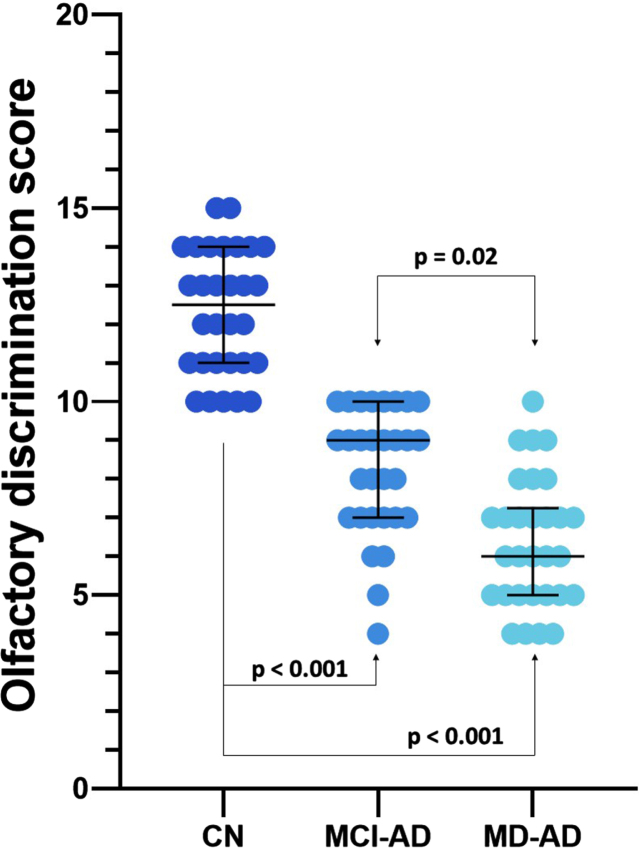
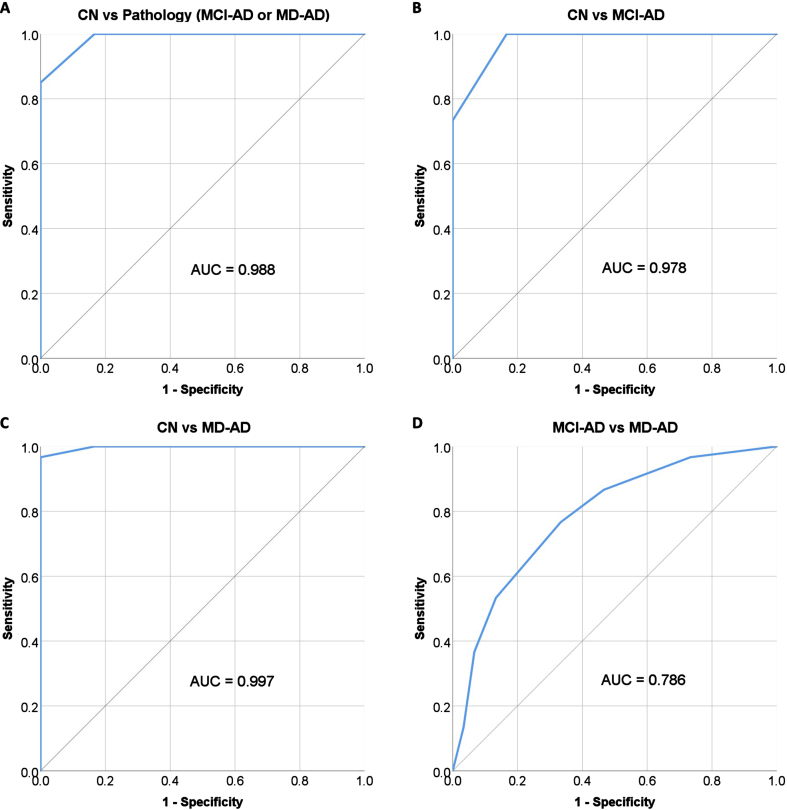
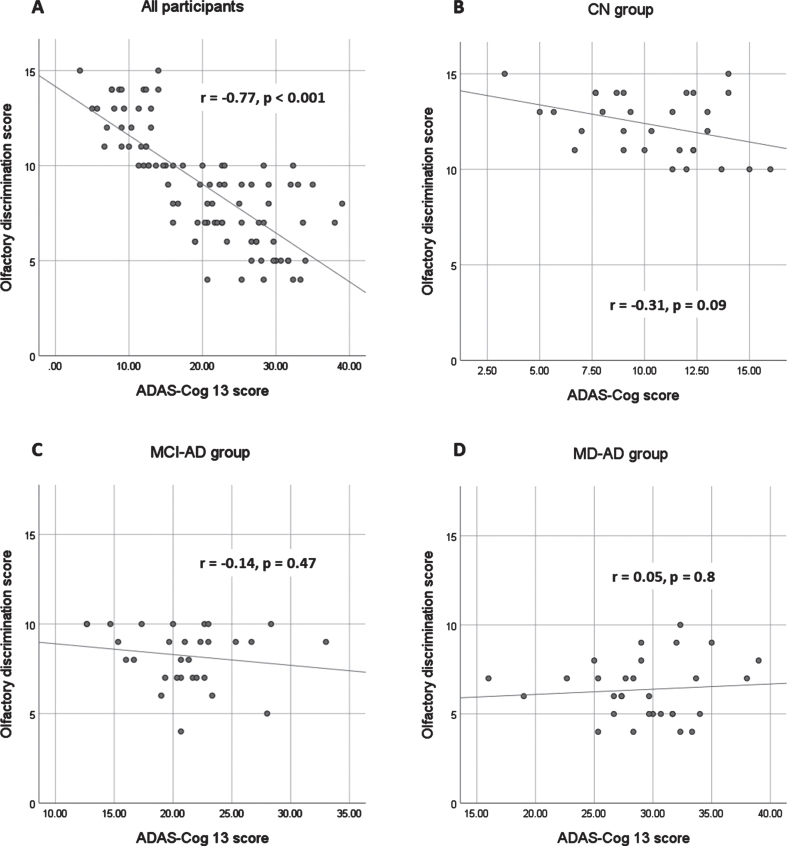
The MD-AD group achieved significantly worse scores on the olfactory discrimination test than the MCI-AD group, and the MCI-AD group achieved significantly worse results than the CN group (p < 0.05). A cut-off score of≤10 had a diagnostic accuracy of 94.44% (95% CI, 87.51-98.17%) in differentiating patients with MCI-AD/MD-AD from subjects with CN and of 91.67% (95% CI, 81.61-97.24%) in differentiating those with MCI-AD from subjects with CN. Our multinomial logistic regression model with demographic data and ADAS-Cog 13 scores as predictor variables correctly classified 82.2% of the cases (CN, 93.3%; MC-AD, 70%; MD-AD, 83.3%); on adding the olfactory discrimination score to the model, the percentage increased to 92.2% (CN, 96.7%; MCI-AD, 86.7%; MD-AD, 93.3%).
Odor discrimination is impaired in cases of early AD and continues to deteriorate as the disease progresses. The olfactory discrimination test showed good diagnostic efficacy in detecting early AD.
嗅觉功能障碍是阿尔茨海默病(AD)的早期症状。然而,由于其在早期 AD 中的诊断效果尚不清楚,因此在临床实践中很少进行嗅觉测试。
探讨早期 AD 患者的气味辨别能力,以及嗅觉辨别测试区分这些患者与认知正常(CN)受试者的效果。
纳入 30 例轻度 AD 性痴呆(MD-AD)患者、30 例轻度 AD 性认知障碍(MCI-AD)患者和 30 名认知正常的老年受试者。所有参与者均接受认知检查(CDR、MMSE、ADAS-Cog13 和言语流畅性)和嗅觉辨别测试(Sniffin' Sticks 测试、德国 Burghart®)。
MD-AD 组在嗅觉辨别测试中的得分明显低于 MCI-AD 组,而 MCI-AD 组的得分明显低于 CN 组(p<0.05)。≤10 的截断分数在区分 MCI-AD/MD-AD 患者和 CN 受试者方面具有 94.44%(95%CI,87.51-98.17%)的诊断准确性,在区分 MCI-AD 患者和 CN 受试者方面具有 91.67%(95%CI,81.61-97.24%)的诊断准确性。以人口统计学数据和 ADAS-Cog13 评分作为预测变量的多变量逻辑回归模型正确分类了 82.2%的病例(CN 为 93.3%;MCI-AD 为 70%;MD-AD 为 83.3%);将嗅觉辨别分数加入模型后,该百分比增加到 92.2%(CN 为 96.7%;MCI-AD 为 86.7%;MD-AD 为 93.3%)。
早期 AD 患者的气味辨别能力受损,且随着疾病的进展而持续恶化。嗅觉辨别测试在检测早期 AD 方面具有良好的诊断效果。