
不同的卫生系统是否会产生不同的死亡率结果?1992-2019 年德语欧洲地区可避免死亡率的区域差异。
Different health systems - Different mortality outcomes? Regional disparities in avoidable mortality across German-speaking Europe, 1992-2019.
机构信息
Federal Institute for Population Research (BIB), Friedrich-Ebert-Allee 4, 65185, Wiesbaden, Germany.
Swiss Federal Institute of Technology in Lausanne (EPFL), Route Cantonale, 1015, Lausanne, Switzerland.
出版信息
Soc Sci Med. 2023 Jul;329:115976. doi: 10.1016/j.socscimed.2023.115976. Epub 2023 May 26.
BACKGROUND
Evaluating the impact of health systems on premature mortality across different countries is a very challenging task, as it is hardly possible to disentangle it from the influence of contextual factors such as cultural differences. In this respect, the German-speaking area in Central Europe (Austria, Germany, South Tyrol and large parts of Switzerland) represents a unique 'natural experiment' setting: While being exposed to different health policies, they share a similar culture and language.
METHODS
To assess the impact of different health systems on mortality differentials across the German-speaking area, we relied on the concept of avoidable mortality. Based on official mortality statistics, we aggregated causes of death below age 75 that are either 1) amenable to health care or 2) avoidable through primary prevention. We calculated standardised death rates and constructed cause-deleted life tables for 9 Austrian, 96 German, 1 Italian and 5 Swiss regions from 1992 to 2019, harmonised according to the current territorial borders.
RESULTS
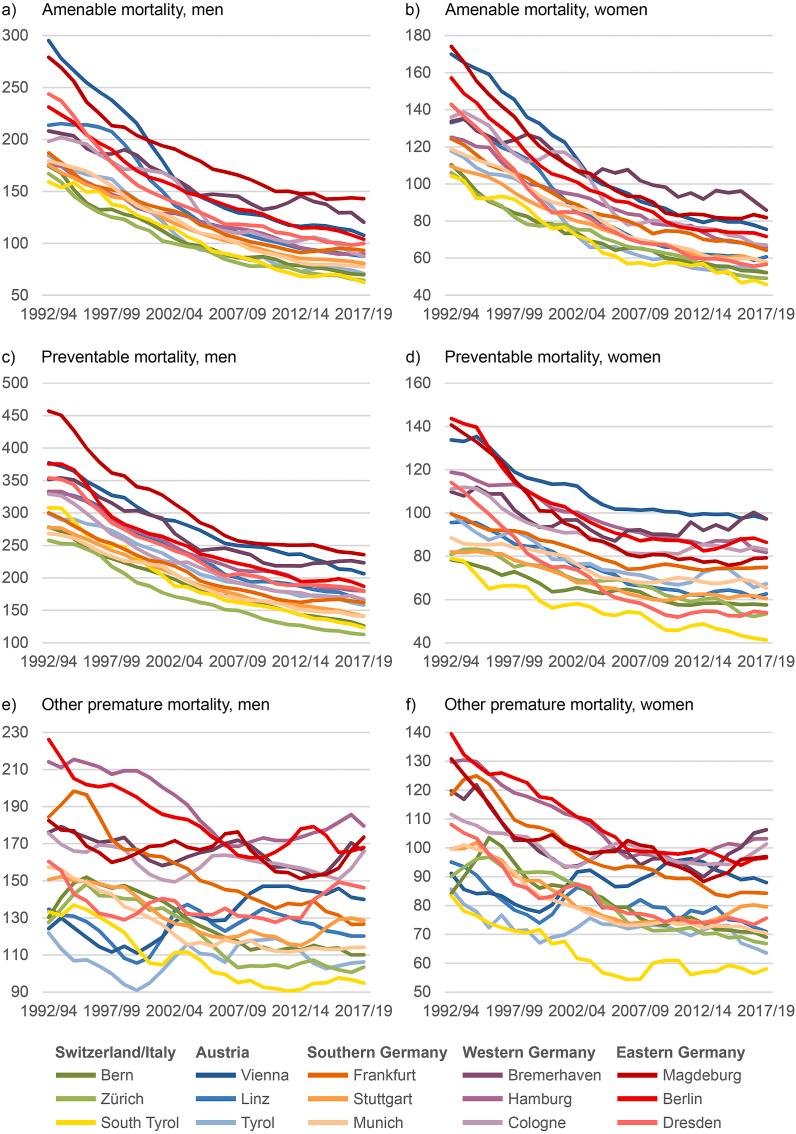
There are strong north-south and east-west gradients in amenable and preventable mortality across the studied regions to the advantage of the southwest. However, the Swiss regions still show significantly lower mortality levels than the neighbouring regions in southern Germany. Eliminating avoidable deaths from the life tables reduces spatial inequality in life expectancy in 2017/2019 by 30% for men and 28% for women.
CONCLUSIONS
The efficiency of health policies in assuring timely and adequate health care and in preventing risk-relevant behaviour has room for improvement in all German regions, especially in the north, west and east, and in eastern Austria as well.
背景
评估卫生系统对不同国家过早死亡率的影响是一项极具挑战性的任务,因为几乎不可能将其与文化差异等背景因素的影响区分开来。在这方面,中欧德语区(奥地利、德国、南蒂罗尔和瑞士的大部分地区)代表了一个独特的“自然实验”环境:尽管面临着不同的卫生政策,但它们具有相似的文化和语言。
方法
为了评估不同卫生系统对德语区死亡率差异的影响,我们依赖于可避免死亡率的概念。根据官方死亡率统计数据,我们将 75 岁以下的死因分为两类:1)可通过医疗保健治疗的,或 2)可通过初级预防避免的。我们计算了标准死亡率,并根据当前的领土边界,为 1992 年至 2019 年的 9 个奥地利、96 个德国、1 个意大利和 5 个瑞士地区构建了归因于死亡原因的生命表。
结果
在所研究的地区,可避免和可预防死亡率存在明显的南北和东西梯度,有利于西南部。然而,瑞士地区的死亡率水平仍明显低于德国南部的相邻地区。从生命表中消除可避免的死亡将 2017/2019 年男性预期寿命的空间不平等降低了 30%,女性降低了 28%。
结论
所有德国地区,尤其是北部、西部和东部地区,以及奥地利东部地区,在确保及时和充分的医疗保健以及预防与风险相关行为方面,卫生政策的效率还有待提高。


 Zotero 插件