Zhang Jing, Waldron Scott, Langford Zannie, Julianto Boedi, Komarek Adam Martin
School of Agriculture and Food Sciences, University of Queensland, Brisbane, Australia.
The Australia-Indonesia Centre, Universitas Hasanuddin, Makassar, Indonesia.
J Appl Phycol. 2023 Jun 8:1-22. doi: 10.1007/s10811-023-03004-0.
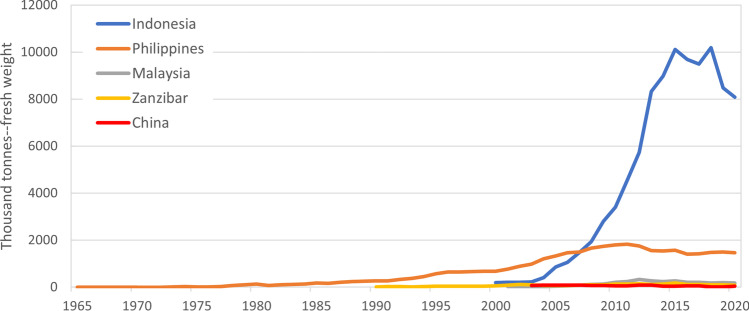
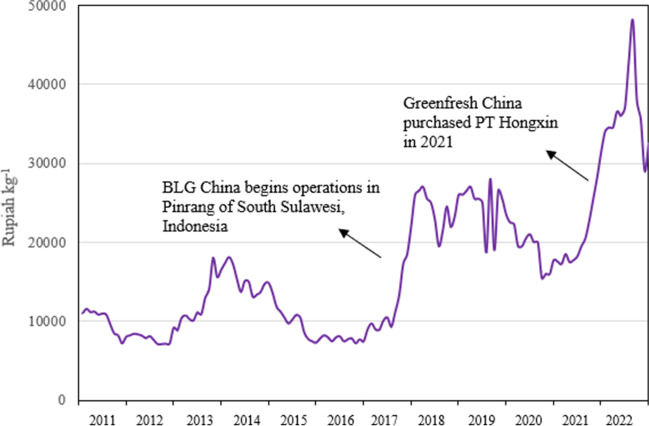
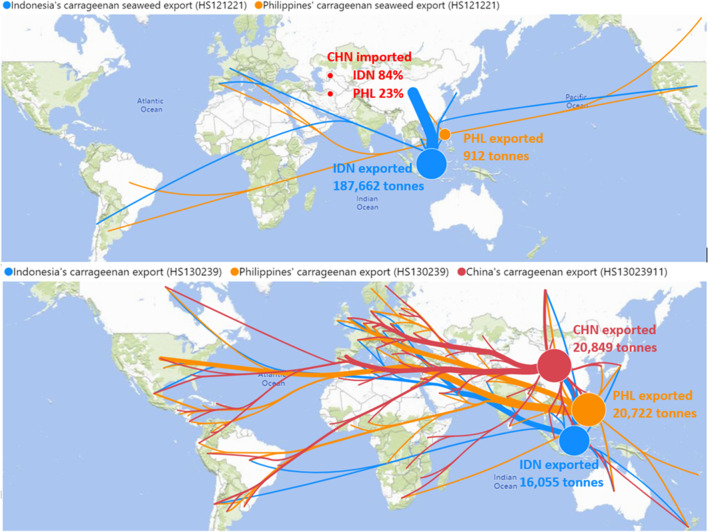
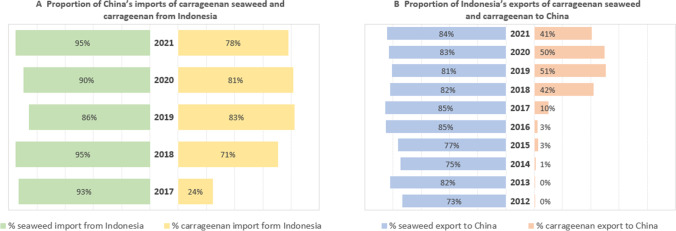
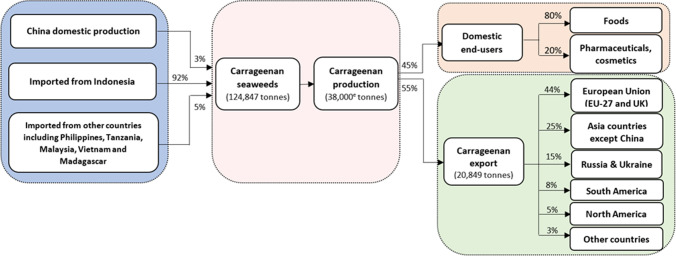
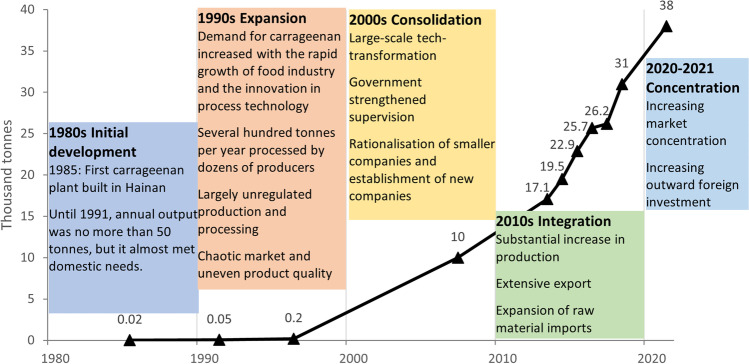
China has reconfigured the global value chains of a wide range of commodities. This includes carrageenan, a polysaccharide extracted from specific types of red seaweeds used as a gelling and thickening agent in a wide range of applications. In the past 20 years, China has moved to centre stage in the global carrageenan processing sector, with wide-ranging implications for seaweed producing nations and farmers. This is especially the case for Indonesia, a pivotal carrageenan seaweeds producer that exports almost all seaweed to China, cemented by large Chinese investments in processing in Indonesia. Despite the importance, there is a dearth of studies on the Chinese domestic industry and associated trade and investment flows. This study fills the gap by triangulating a range of detailed industry, statistical and interview data, in multiple language sources. It finds that Chinese trade and investment linkages is of net benefit to Indonesia but that Indonesian government agencies at both central and local levels can begin to introduce terms in their favour.
中国已经重新配置了多种商品的全球价值链。这其中包括卡拉胶,一种从特定种类的红海藻中提取的多糖,在广泛的应用中用作胶凝剂和增稠剂。在过去20年里,中国已在全球卡拉胶加工领域占据中心地位,这对海藻生产国和农民产生了广泛影响。印度尼西亚的情况尤其如此,它是关键的卡拉胶海藻生产国,几乎所有海藻都出口到中国,这得益于中国在印度尼西亚加工领域的大量投资。尽管其重要性不言而喻,但关于中国国内产业以及相关贸易和投资流动的研究却很匮乏。本研究通过整合多种语言来源的一系列详细行业、统计和访谈数据填补了这一空白。研究发现,中国的贸易和投资联系对印度尼西亚有净收益,但印度尼西亚中央和地方各级政府机构可以开始引入有利于自身的条款。