Peng Ciyuan, Xia Feng, Naseriparsa Mehdi, Osborne Francesco
Institute of Innovation, Science and Sustainability, Federation University Australia, Ballarat, 3353 VIC Australia.
School of Computing Technologies, RMIT University, Melbourne, 3000 VIC Australia.
Artif Intell Rev. 2023 Apr 3:1-32. doi: 10.1007/s10462-023-10465-9.
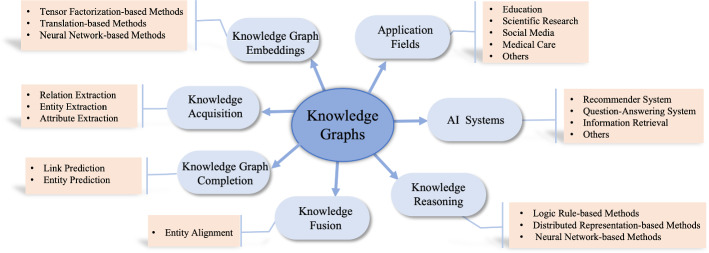
With the explosive growth of artificial intelligence (AI) and big data, it has become vitally important to organize and represent the enormous volume of knowledge appropriately. As graph data, knowledge graphs accumulate and convey knowledge of the real world. It has been well-recognized that knowledge graphs effectively represent complex information; hence, they rapidly gain the attention of academia and industry in recent years. Thus to develop a deeper understanding of knowledge graphs, this paper presents a systematic overview of this field. Specifically, we focus on the opportunities and challenges of knowledge graphs. We first review the opportunities of knowledge graphs in terms of two aspects: (1) AI systems built upon knowledge graphs; (2) potential application fields of knowledge graphs. Then, we thoroughly discuss severe technical challenges in this field, such as knowledge graph embeddings, knowledge acquisition, knowledge graph completion, knowledge fusion, and knowledge reasoning. We expect that this survey will shed new light on future research and the development of knowledge graphs.
随着人工智能(AI)和大数据的爆炸式增长,以适当方式组织和表示海量知识变得至关重要。作为图数据,知识图谱积累并传递现实世界的知识。人们已经充分认识到,知识图谱能有效地表示复杂信息;因此,近年来它们迅速获得了学术界和工业界的关注。为了更深入地理解知识图谱,本文对该领域进行了系统概述。具体而言,我们关注知识图谱的机遇与挑战。我们首先从两个方面回顾知识图谱的机遇:(1)基于知识图谱构建的人工智能系统;(2)知识图谱的潜在应用领域。然后,我们深入讨论该领域面临的严峻技术挑战,如知识图谱嵌入、知识获取、知识图谱补全、知识融合和知识推理。我们期望这项综述能为知识图谱的未来研究和发展提供新的思路。