Research Team for Social Participation and Community Health, Tokyo Metropolitan Institute for Geriatrics and Gerontology, 35-2 Sakae-cho, Itabashi-ku, Tokyo, 173-0015, Japan.
Department of Preventive Medicine and Public Health, Keio University School of Medicine, 35 Shinanomachi, Shinjuku-ku, Tokyo, 160-8582, Japan.
BMC Public Health. 2023 Jun 26;23(1):1230. doi: 10.1186/s12889-023-16131-7.
Research has suggested an association between lower socioeconomic status (SES) and unhealthy dietary habits. However, differences in the effects of different SES indicators and age remain unclear. The current study addressed this research gap by investigating the relationship between SES and unhealthy dietary habits, specifically focusing on educational attainment and subjective financial status (SFS) among varied age groups.
Data were derived from a mail survey of 8,464 people living in a suburb of Tokyo, Japan. Participants were classified into three age groups (20-39 years: young adults; 40-64 years: middle-aged adults; and 65-97 years: older adults). SES was assessed based on individual educational attainment and SFS. Unhealthy dietary habits were defined as skipping breakfast and a low frequency of balanced meal consumption. Participants were asked how often they ate breakfast, and those who did not respond "every day" were categorized as "breakfast skippers." Low frequency of balanced meal consumption was defined as eating a meal that included a staple meal, main dish, and side dishes at least twice a day for less than five days per week. Poisson regression analyses with robust variance adjusted for potential covariates were used to determine the interactive effects of educational attainment and SFS on unhealthy dietary habits.
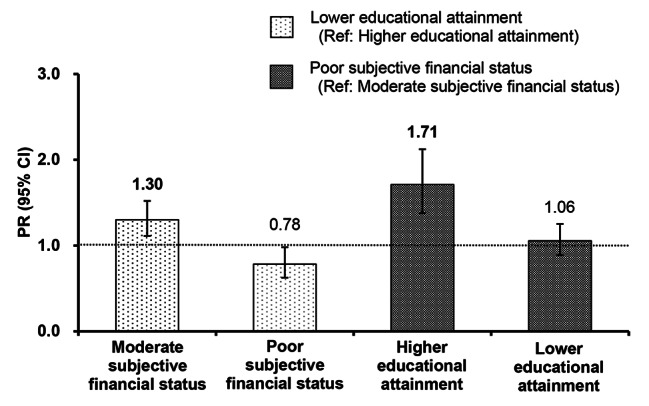
Individuals with lower educational attainment across all age groups skipped breakfast more frequently compared to those with higher educational attainment. For older adults, poor SFS was associated with skipping breakfast. Young adults with poor SFS and middle-aged adults with lower educational attainment tended to eat less balanced meals. In addition, an interaction effect was found in older adults, where those with lower education despite good SFS and those with poor SFS despite higher education were at a greater risk of falling into unhealthy diet.
The findings suggested that different SES indicators affect healthy dietary habits in different generations, and therefore, health policies should consider the potential influence of different SES on promoting healthier dietary habits.
研究表明,社会经济地位(SES)较低与不健康的饮食习惯之间存在关联。然而,不同 SES 指标和年龄的影响差异仍不清楚。本研究通过调查 SES 与不健康饮食习惯之间的关系,特别是关注不同年龄组的教育程度和主观财务状况(SFS),解决了这一研究空白。
数据来自对日本东京郊区 8464 人的邮件调查。参与者被分为三个年龄组(20-39 岁:年轻人;40-64 岁:中年人;65-97 岁:老年人)。SES 基于个人教育程度和 SFS 进行评估。不健康的饮食习惯定义为不吃早餐和均衡饮食频率低。参与者被问及他们吃早餐的频率,未回答“每天”的人被归类为“不吃早餐者”。均衡饮食频率低定义为每周少于五天,每天至少两次食用主食、主菜和配菜。使用具有稳健方差调整的泊松回归分析来确定教育程度和 SFS 对不健康饮食习惯的交互作用。
所有年龄组中教育程度较低的个体比教育程度较高的个体更频繁地不吃早餐。对于老年人,较差的 SFS 与不吃早餐有关。经济状况较差的年轻成年人和教育程度较低的中年成年人往往饮食不均衡。此外,在老年人中发现了一种交互作用,即尽管 SES 较高但教育程度较低的人和尽管 SES 较低但教育程度较高的人更容易陷入不健康的饮食。
研究结果表明,不同的 SES 指标对不同代际的健康饮食习惯有影响,因此,健康政策应考虑不同 SES 对促进更健康饮食习惯的潜在影响。