Unit of Nutrition and Cancer, Catalan Institute of Oncology-ICO, L'Hospitalet de Llobregat, Barcelona, Spain.
Nutrition and Cancer Group, Epidemiology, Public Health, Cancer Prevention and Palliative Care Program, Bellvitge Biomedical Research Institute-IDIBELL, L'Hospitalet de Llobregat, Barcelona, Spain.
BMC Med. 2023 Jun 26;21(1):225. doi: 10.1186/s12916-023-02934-3.
The Mediterranean diet has been associated with lower risk of breast cancer (BC) but evidence from prospective studies on the role of Mediterranean diet on BC survival remains sparse and conflicting. We aimed to investigate whether adherence to Mediterranean diet prior to diagnosis is associated with overall and BC-specific mortality.
A total of 13,270 incident breast cancer cases were identified from an initial sample of 318,686 women in 9 countries from the European Prospective Investigation into Cancer and Nutrition (EPIC) study. Adherence to Mediterranean diet was estimated through the adapted relative Mediterranean diet (arMED), a 16-point score that includes 8 key components of the Mediterranean diet and excludes alcohol. The degree of adherence to arMED was classified as low (score 0-5), medium (score 6-8), and high (score 9-16). Multivariable Cox proportional hazards models were used to analyze the association between the arMED score and overall mortality, and Fine-Gray competing risks models were applied for BC-specific mortality.
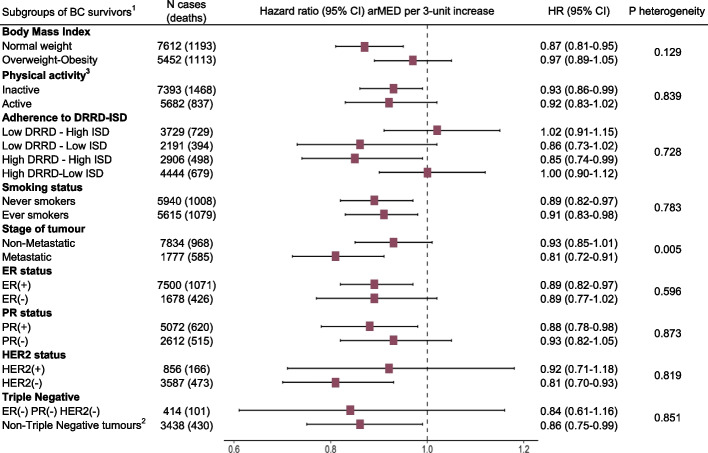
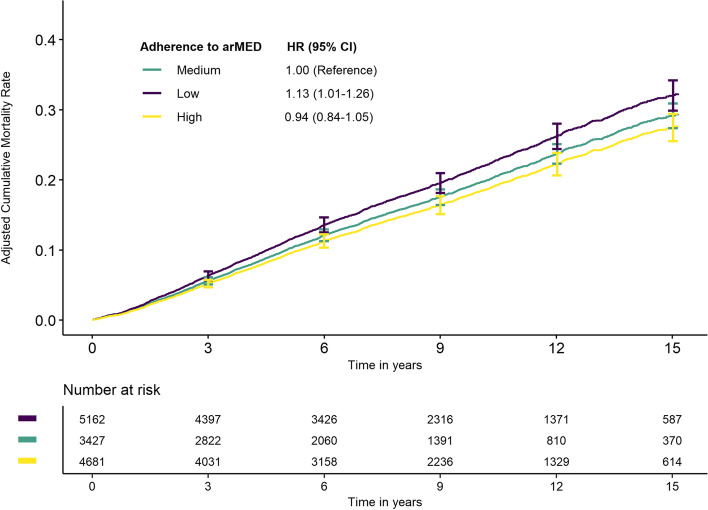
After a mean follow-up of 8.6 years from diagnosis, 2340 women died, including 1475 from breast cancer. Among all BC survivors, low compared to medium adherence to arMED score was associated with a 13% higher risk of all-cause mortality (HR 1.13, 95%CI 1.01-1.26). High compared to medium adherence to arMED showed a non-statistically significant association (HR 0.94; 95% CI 0.84-1.05). With no statistically significant departures from linearity, on a continuous scale, a 3-unit increase in the arMED score was associated with an 8% reduced risk of overall mortality (HR 0.92, 95% CI: 0.87-0.97). This result sustained when restricted to postmenopausal women and was stronger among metastatic BC cases (HR 0.81, 95% CI: 0.72-0.91).
Consuming a Mediterranean diet before BC diagnosis may improve long-term prognosis, particularly after menopause and in cases of metastatic breast cancer. Well-designed dietary interventions are needed to confirm these findings and define specific dietary recommendations.
地中海饮食与较低的乳腺癌(BC)风险相关,但来自前瞻性研究的关于地中海饮食对 BC 生存影响的证据仍然稀少且存在冲突。我们旨在调查诊断前是否遵循地中海饮食与整体和 BC 特异性死亡率之间的关系。
共纳入来自欧洲癌症与营养前瞻性调查(EPIC)研究中 9 个国家的 318686 名女性的初始样本中 13270 例乳腺癌新发病例。通过调整后的相对地中海饮食(arMED)评估地中海饮食的依从性,arMED 是一个 16 分的评分,包括地中海饮食的 8 个关键组成部分且不包括酒精。arMED 的依从性程度分为低(评分 0-5)、中(评分 6-8)和高(评分 9-16)。多变量 Cox 比例风险模型用于分析 arMED 评分与整体死亡率之间的关系,Fine-Gray 竞争风险模型用于分析 BC 特异性死亡率。
诊断后平均随访 8.6 年后,有 2340 名女性死亡,其中 1475 名死于乳腺癌。在所有 BC 幸存者中,与中等 arMED 评分相比,低 arMED 评分与全因死亡率增加 13%相关(HR 1.13,95%CI 1.01-1.26)。高 arMED 评分与中等 arMED 评分相比,相关性无统计学意义(HR 0.94;95%CI 0.84-1.05)。在连续评分中,arMED 评分每增加 3 个单位,整体死亡率降低 8%(HR 0.92,95%CI:0.87-0.97),且不存在线性偏离的统计学意义。当仅限于绝经后女性或转移性 BC 病例时,该结果仍然成立(HR 0.81,95%CI:0.72-0.91)。
诊断前食用地中海饮食可能会改善长期预后,尤其是在绝经后和转移性乳腺癌病例中。需要进行精心设计的饮食干预来证实这些发现并确定具体的饮食建议。