Unit of Dietetic and Clinical Nutrition, University Hospital "Maggiore della Carità", Corso Mazzini 18, 28100 Novara, Italy.
SCDU Endocrinology, Department of Translational Medicine, University of Eastern Piedmont, Via Solaroli 17, 28100 Novara, Italy.
Nutrients. 2022 Jan 21;14(3):476. doi: 10.3390/nu14030476.
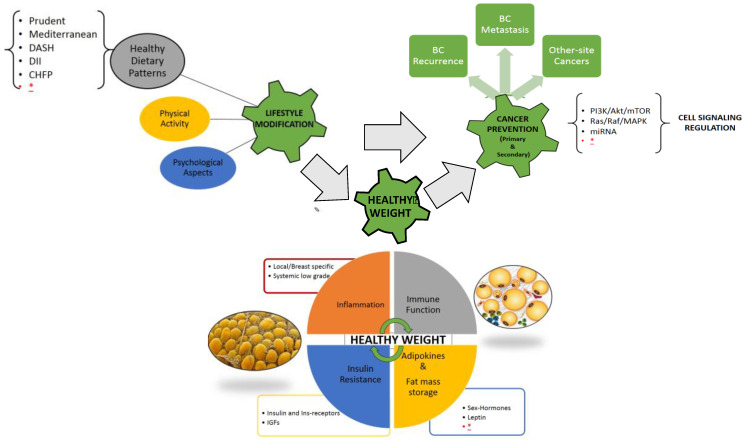
Breast cancer (BC) represents the most common cancer in women, while overweight and obesity are the second preventable cause of cancer. Weight gain and fat accumulation are common after BC diagnosis; moreover, weight gain during the treatment decreases the survival rate and increases the risk of recurrence in breast cancer survivors (BCS). To reduce the risk of second primary cancer or BC recurrence, and all-cause mortality in BCS, multiple interventions have been investigated to obtain reduction in weight, BMI and/or waist circumference. The aim of this narrative review is to analyze evidence on BCS for their risk of recurrence or mortality related to increased weight or fat deposition, and the effects of interventions with healthy dietary patterns to achieve a proper weight and to reduce fat-related risk. The primary focus was on dietary patterns instead of single nutrients and supplements, as the purpose was to investigate on secondary prevention in women free from disease at the end of their cancer treatment. In addition, BC relation with insulin resistance, dietary carbohydrate, and glycemic index/glycemic load is discussed. In conclusion, obesity and overweight, low rates of physical activity, and hormone receptor-status are associated with poorer BC-treatment outcomes. To date, there is a lack of evidence to suggest which dietary pattern is the best approach for weight management in BCS. In the future, multimodal lifestyle interventions with dietary, physical activity and psychological support after BC diagnosis should be studied with the aim of reducing the risk of BC recurrence or mortality.
乳腺癌(BC)是女性最常见的癌症,而超重和肥胖是癌症的第二大可预防原因。BC 诊断后体重增加和脂肪堆积很常见;此外,治疗期间的体重增加会降低乳腺癌幸存者(BCS)的生存率并增加复发风险。为了降低 BCS 发生第二原发癌或 BC 复发以及全因死亡率的风险,已经研究了多种干预措施来减轻体重、BMI 和/或腰围。本叙述性综述的目的是分析与体重增加或脂肪沉积相关的 BCS 复发或死亡率的证据,以及健康饮食模式干预的效果,以达到适当的体重并降低与脂肪相关的风险。主要重点是饮食模式而不是单一营养素和补充剂,因为目的是调查癌症治疗结束后无疾病的女性的二级预防。此外,还讨论了 BC 与胰岛素抵抗、膳食碳水化合物和血糖指数/血糖负荷的关系。总之,肥胖和超重、低体力活动水平和激素受体状态与较差的 BC 治疗结果相关。迄今为止,尚无证据表明哪种饮食模式最适合 BCS 的体重管理。将来,应该研究 BC 诊断后具有饮食、体力活动和心理支持的多模式生活方式干预,以降低 BC 复发或死亡的风险。