Parodi Ilaria, Di Lisa Donatella, Pastorino Laura, Scaglione Silvia, Fato Marco Massimo
Department of Computer Science, Bioengineering, Robotics and Systems Engineering, University of Genoa, 16126 Genoa, Italy.
National Research Council of Italy, Institute of Electronic, Computer and Telecommunications Engineering (IEIIT), 16149 Genoa, Italy.
Gels. 2023 Jun 12;9(6):482. doi: 10.3390/gels9060482.
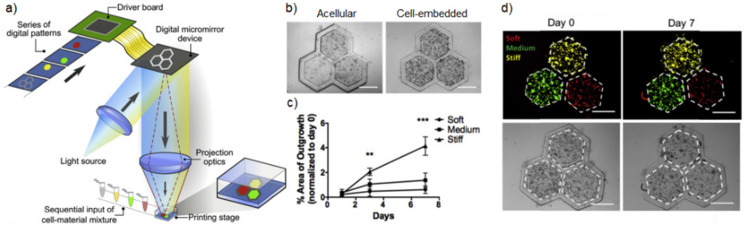
In vitro three-dimensional models aim to reduce and replace animal testing and establish new tools for oncology research and the development and testing of new anticancer therapies. Among the various techniques to produce more complex and realistic cancer models is bioprinting, which allows the realization of spatially controlled hydrogel-based scaffolds, easily incorporating different types of cells in order to recreate the crosstalk between cancer and stromal components. Bioprinting exhibits other advantages, such as the production of large constructs, the repeatability and high resolution of the process, as well as the possibility of vascularization of the models through different approaches. Moreover, bioprinting allows the incorporation of multiple biomaterials and the creation of gradient structures to mimic the heterogeneity of the tumor microenvironment. The aim of this review is to report the main strategies and biomaterials used in cancer bioprinting. Moreover, the review discusses several bioprinted models of the most diffused and/or malignant tumors, highlighting the importance of this technique in establishing reliable biomimetic tissues aimed at improving disease biology understanding and high-throughput drug screening.
体外三维模型旨在减少和替代动物实验,并建立用于肿瘤学研究以及新抗癌疗法研发与测试的新工具。在各种用于构建更复杂、更逼真癌症模型的技术中,生物打印技术脱颖而出,它能够制造出空间可控的水凝胶基支架,便于轻松整合不同类型的细胞,从而重现癌症与基质成分之间的相互作用。生物打印还具有其他优势,比如能够制造大型构建体、过程具有可重复性和高分辨率,以及通过不同方法实现模型血管化的可能性。此外,生物打印允许整合多种生物材料并创建梯度结构,以模拟肿瘤微环境的异质性。本综述的目的是报告癌症生物打印中使用的主要策略和生物材料。此外,该综述还讨论了几种最常见和/或恶性肿瘤的生物打印模型,强调了这项技术在建立可靠的仿生组织以增进对疾病生物学的理解和进行高通量药物筛选方面的重要性。