Bojanović Mila, Stalević Marko, Arsić-Arsenijević Valentina, Ignjatović Aleksandra, Ranđelović Marina, Golubović Milan, Živković-Marinkov Emilija, Koraćević Goran, Stamenković Bojana, Otašević Suzana
Medical Faculty, University of Niš, 18000 Niš, Serbia.
University Clinical Center Niš, 18000 Niš, Serbia.
J Fungi (Basel). 2023 Jun 13;9(6):662. doi: 10.3390/jof9060662.
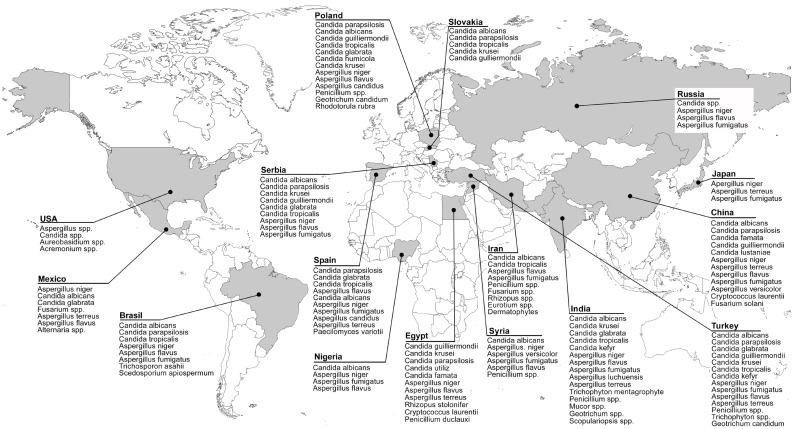
Otomycosis (OM) is a superficial fungal infection of the external auditory canal (EAC) with a worldwide prevalence ranging from 9% to 30%. Commonly, otomycoses are caused by complex and spp. Other causative agents are yeasts of the genera spp., spp., , dermatophytes (), and non-dermatophytes molds ( spp., spp., fungi). The widest range of different species causing OM are found in the territories of Iran, India, China, Egypt, Mexico, and Brazil. Fungal infection of the EAC varies from mild to severe forms. It can be acute, subacute, or chronic, and is often unilateral, while the bilateral form is more common in immunocompromised patients. From an epidemiological point of view, tropical and subtropical climates are the most significant risk factor for the development of otomycosis. Other predisposing conditions include clothing habits, EAC hygiene practices, long-term antibiotic therapy, diabetes, and immunodeficiency. Since it is often difficult to distinguish otomycosis from an infection of a different origin, laboratory-based evidence, including standard procedures (microscopy and cultivation), is essential for diagnosis. For the treatment of this superficial fungal infection, there are no official therapeutic guidelines and protocols. However, many antifungals for local application, such as polyene, imidazoles, and allylamines, can be applied, as well as systemic antimycotics (triazoles) in severe forms of infection.
外耳道真菌病(OM)是外耳道(EAC)的一种浅表真菌感染,在全球范围内的患病率为9%至30%。通常,外耳道真菌病由 复合体和 菌属引起。其他病原体包括 菌属、 菌属、 属的酵母菌、皮肤癣菌( )以及非皮肤癣菌霉菌( 菌属、 菌属、 真菌)。在伊朗、印度、中国、埃及、墨西哥和巴西等地发现了导致外耳道真菌病的种类最为繁多的不同物种。外耳道的真菌感染程度从轻度到重度不等。它可以是急性、亚急性或慢性的,且通常为单侧感染,而双侧感染在免疫功能低下的患者中更为常见。从流行病学角度来看,热带和亚热带气候是外耳道真菌病发生的最重要风险因素。其他诱发因素包括着装习惯、外耳道卫生习惯、长期抗生素治疗、糖尿病和免疫缺陷。由于常常难以将外耳道真菌病与其他来源的感染区分开来,基于实验室的证据,包括标准程序(显微镜检查和培养),对于诊断至关重要。对于这种浅表真菌感染的治疗,尚无官方的治疗指南和方案。然而,许多局部应用的抗真菌药物,如多烯类、咪唑类和烯丙胺类药物,以及在严重感染形式下的全身性抗真菌药物(三唑类)都可以使用。