Department of Periodontology, Krishnadevaraya College of Dental Sciences, Rajiv Gandhi University of Health Sciences, Bangalore 562157, India.
Department of Prosthodontics, College of Dentistry, King Khalid University, Abha 62529, Saudi Arabia.
Medicina (Kaunas). 2023 Jun 20;59(6):1178. doi: 10.3390/medicina59061178.
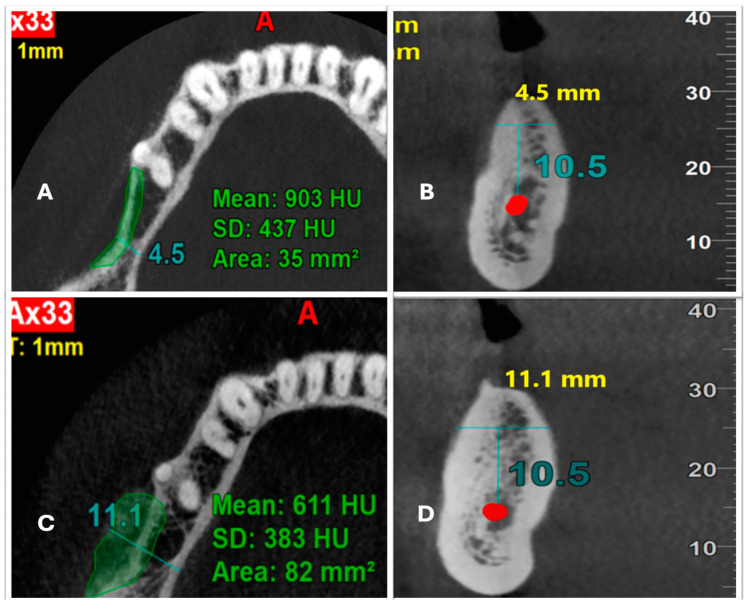
: A narrow alveolar ridge is an obstacle to optimal rehabilitation of the dentition. There are several complex and invasive techniques to counter the ridge augmentation dilemma, with most of them exhibiting low feasibility. Hence, this randomized clinical trial aims to evaluate the effectiveness of a Minimalistic Ridge Augmentation (MRA) technique, in conjunction with low-level laser therapy (LLLT). : A total of 20 patients ( = 20) were selected, with 10 assigned to the test group (MRA+LLLT) and the other 10 to the control group (MRA). A vertical incision of approximately 10 mm was placed mesial to the defect and tunneled to create a subperiosteal pouch across the entire width of the defect. At the test sites, a diode laser (AnARC Fox Surgical Laser 810 nm) was used to deliver LLLT (parameters: 100 mW, with a maximum energy distribution of 6 J/cm in the continuous wave mode for 60 s per point) to the exposed bone surface inside the pouch, followed by graft (G-Graft, Surgiwear, Shahjahanpur, India) deposition with a bone graft carrier. The control sites were not irradiated with a laser. : A horizontal ridge width gain of >2 mm was observed in both groups. The changes in bone density for the test and control groups were -136 ± 236.08 HU and -44.30 ± 180.89 HU, respectively. Furthermore, there was no statistically significant difference between the test and control groups in these parameters. : The study findings reveal that the MRA technique is relatively simple and feasible for alveolar ridge augmentation. The role of LLLT in the process requires further elucidation.
牙槽嵴狭窄是影响牙列最佳修复的障碍。有几种复杂且具侵袭性的技术可用于解决牙槽嵴增量难题,但大多数技术的可行性较低。因此,本随机临床试验旨在评估微创牙槽嵴增量(MRA)技术联合低水平激光疗法(LLLT)的有效性。
共选择了 20 名患者(n=20),其中 10 名患者被分配到实验组(MRA+LLLT),另外 10 名患者被分配到对照组(MRA)。在缺损的近中侧做一个约 10mm 的垂直切口,然后向牙槽嵴方向做隧道,在整个缺损宽度上形成一个骨膜下袋。在实验组中,使用二极管激光(AnARC Fox 外科激光 810nm)对暴露在袋内的骨表面进行 LLLT(参数:100mW,连续波模式下最大能量分布为 6J/cm,每个点照射 60s),然后用骨移植载体将移植物(G-Graft,Surgiwear,Shahjahanpur,印度)填入。对照组不进行激光照射。
两组均观察到水平牙槽嵴宽度增加>2mm。实验组和对照组的骨密度变化分别为-136±236.08HU 和-44.30±180.89HU。此外,两组间这些参数无统计学差异。
研究结果表明,MRA 技术对于牙槽嵴增量相对简单且可行。LLLT 在该过程中的作用需要进一步阐明。