
通过福斯特共振能量转移荧光进行活细胞成像以研究聚乳酸-羟基乙酸共聚物纳米颗粒在树突状细胞中的转运及负载肽的释放
Live Cell Imaging by Förster Resonance Energy Transfer Fluorescence to Study Trafficking of PLGA Nanoparticles and the Release of a Loaded Peptide in Dendritic Cells.
作者信息
Liu Mengshan, Lau Chun Yin Jerry, Cabello Irene Trillo, Garssen Johan, Willemsen Linette E M, Hennink Wim E, van Nostrum Cornelus F
机构信息
Department of Pharmaceutics, Utrecht Institute for Pharmaceutical Sciences, Utrecht University, 3584 CG Utrecht, The Netherlands.
Department of Pharmacology, Utrecht Institute for Pharmaceutical Sciences, Utrecht University, 3584 CG Utrecht, The Netherlands.
出版信息
Pharmaceuticals (Basel). 2023 May 31;16(6):818. doi: 10.3390/ph16060818.
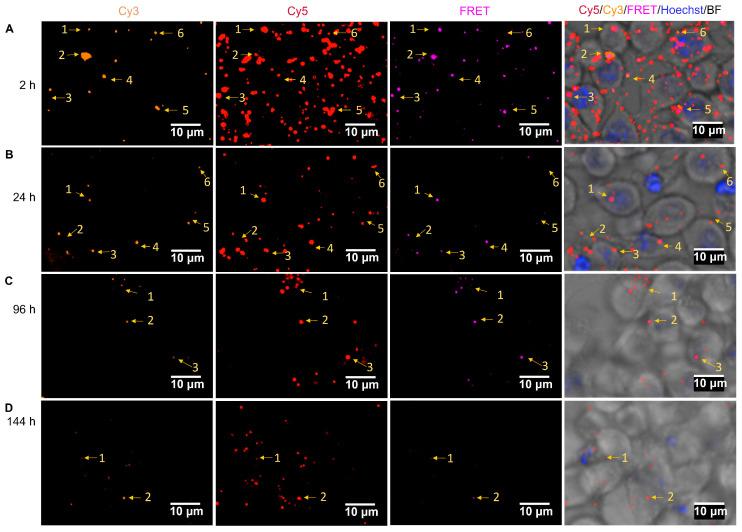
Our previous study demonstrated that a selected β-lactoglobulin-derived peptide (BLG-Pep) loaded in poly(lactic--glycolic acid) (PLGA) nanoparticles protected mice against cow's milk allergy development. However, the mechanism(s) responsible for the interaction of the peptide-loaded PLGA nanoparticles with dendritic cells (DCs) and their intracellular fate was/were elusive. Förster resonance energy transfer (FRET), a distance-dependent non-radioactive energy transfer process mediated from a donor to an acceptor fluorochrome, was used to investigate these processes. The ratio of the donor (Cyanine-3)-conjugated peptide and acceptor (Cyanine-5) labeled PLGA nanocarrier was fine-tuned for optimal (87%) FRET efficiency. The colloidal stability and FRET emission of prepared NPs were maintained upon 144 h incubation in PBS buffer and 6 h incubation in biorelevant simulated gastric fluid at 37 °C. A total of 73% of Pep-Cy3 NP was internalized by DCs as quantified using flow cytometry and confirmed using confocal fluorescence microscopy. By real-time monitoring of the change in the FRET signal of the internalized peptide-loaded nanoparticles, we observed prolonged retention (for 96 h) of the nanoparticles-encapsulated peptide as compared to 24 h retention of the free peptide in the DCs. The prolonged retention and intracellular antigen release of the BLG-Pep loaded in PLGA nanoparticles in murine DCs might facilitate antigen-specific tolerance induction.
我们之前的研究表明,负载于聚乳酸-乙醇酸共聚物(PLGA)纳米颗粒中的一种选定的β-乳球蛋白衍生肽(BLG-Pep)可保护小鼠不发生牛奶过敏。然而,负载肽的PLGA纳米颗粒与树突状细胞(DCs)相互作用及其细胞内命运的机制尚不清楚。荧光共振能量转移(FRET)是一种从供体荧光染料到受体荧光染料介导的依赖距离的非放射性能量转移过程,用于研究这些过程。对供体(花青素-3)缀合肽与受体(花青素-5)标记的PLGA纳米载体的比例进行了微调,以实现最佳(87%)的FRET效率。在PBS缓冲液中孵育144小时以及在37°C的生物相关模拟胃液中孵育6小时后,制备的纳米颗粒的胶体稳定性和FRET发射得以维持。使用流式细胞术定量并通过共聚焦荧光显微镜确认,总共73%的Pep-Cy3纳米颗粒被DCs内化。通过实时监测内化的负载肽纳米颗粒的FRET信号变化,我们观察到与游离肽在DCs中24小时的保留时间相比,纳米颗粒包裹的肽保留时间延长(96小时)。PLGA纳米颗粒中负载的BLG-Pep在小鼠DCs中的延长保留和细胞内抗原释放可能有助于诱导抗原特异性耐受。


 Zotero 插件