Umar Huzaifa, Rizaner Nahit, Usman Abdullahi Garba, Aliyu Maryam Rabiu, Adun Humphrey, Ghali Umar Muhammad, Uzun Ozsahin Dilber, Abba Sani Isah
Operational Research Centre in Healthcare, Near East University, TRNC Mersin 10, Nicosia 99138, Turkey.
Biotechnology Research Centre, Cyprus International University, TRNC Mersin 10, Nicosia 99258, Turkey.
Pharmaceuticals (Basel). 2023 Jun 8;16(6):858. doi: 10.3390/ph16060858.
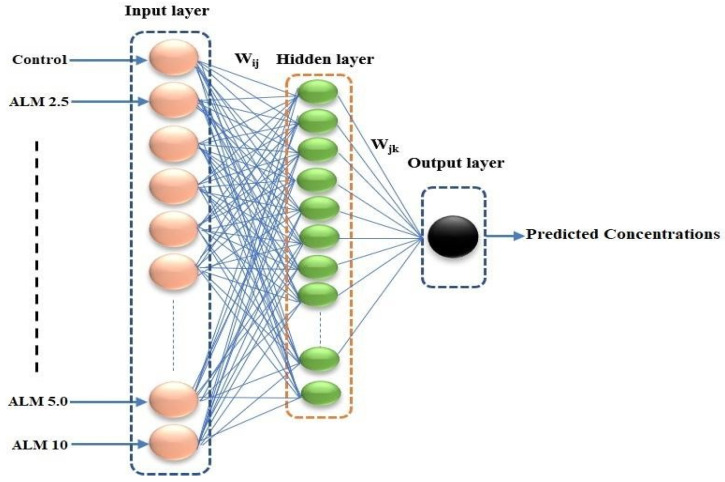
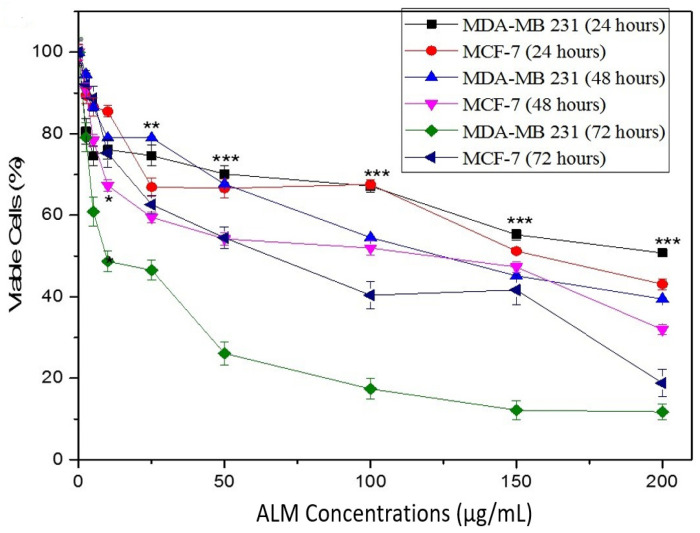
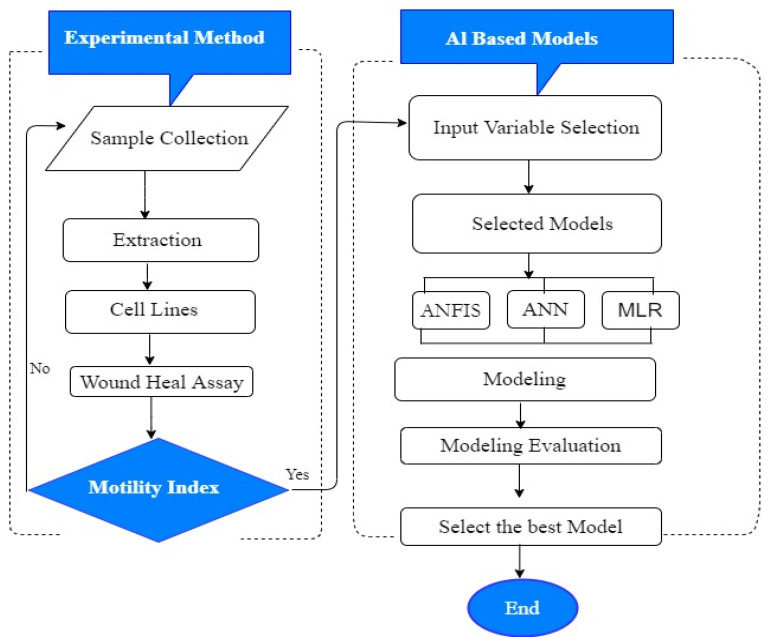
Breast cancer is a common cancer affecting women worldwide, and it progresses from breast tissue to other parts of the body through a process called metastasis. is a valuable plant with medicinal properties due to some active biological macromolecules, and it's cultivated in subtropical and tropical regions of the world. This study reports the phytochemical compositions, the cytotoxic, anti-proliferative and anti-migratory potential of methanolic (ALM) extract on strongly and weakly metastatic MDA-MB 231 and MCF-7 human breast cancer cells, respectively. Furthermore, we employed and compared an artificial neural network (ANN), an adaptive neuro-fuzzy inference system (ANFIS), and multilinear regression analysis (MLR) to predict cell migration on the treated cancer cells with various concentrations of the extract using our experimental data. Lower concentrations of the ALM extract (10, 5 & 2.5 μg/mL) showed no significant effect. Higher concentrations (25, 50, 100 & 200 μg/mL) revealed a significant effect on the cytotoxicity and proliferation of the cells when compared with the untreated group ( < 0.05; ≥ 3). Furthermore, the extract revealed a significant decrease in the motility index of the cells with increased extract concentrations ( < 0.05; ≥ 3). The comparative study of the models observed that both the classical linear MLR and AI-based models could predict metastasis in MDA-MB 231 and MCF-7 cells. Overall, various ALM extract concentrations showed promising an-metastatic potential in both cells, with increased concentration and incubation period. The outcomes of MLR and AI-based models on our data revealed the best performance. They will provide future development in assessing the anti-migratory efficacies of medicinal plants in breast cancer metastasis.
乳腺癌是一种影响全球女性的常见癌症,它通过一种称为转移的过程从乳腺组织扩散到身体的其他部位。[植物名称]是一种具有药用特性的珍贵植物,因其含有一些活性生物大分子,在世界亚热带和热带地区均有种植。本研究报告了[植物名称]甲醇提取物(ALM)对高转移性和低转移性MDA - MB 231及MCF - 7人乳腺癌细胞的植物化学成分、细胞毒性、抗增殖和抗迁移潜力。此外,我们运用并比较了人工神经网络(ANN)、自适应神经模糊推理系统(ANFIS)和多元线性回归分析(MLR),利用我们的实验数据预测不同浓度提取物处理的癌细胞的迁移情况。较低浓度的ALM提取物(10、5和2.5μg/mL)未显示出显著效果。与未处理组相比,较高浓度(25、50、100和200μg/mL)对细胞的细胞毒性和增殖有显著影响(P<0.05;n≥3)。此外,提取物浓度增加时,细胞的运动指数显著降低(P<0.05;n≥3)。对模型的比较研究发现,经典的线性MLR和基于人工智能的模型都可以预测MDA - MB 231和MCF - 7细胞中的转移情况。总体而言,不同浓度的ALM提取物在两种细胞中均显示出有前景的抗转移潜力,且随着浓度和孵育时间的增加而增强。基于我们的数据,MLR和基于人工智能的模型的结果显示出最佳性能。它们将为评估药用植物在乳腺癌转移中的抗迁移功效提供未来的发展方向。