
中国关于流行性出血病的当前知识。
Current Knowledge on Epizootic Haemorrhagic Disease in China.
作者信息
Xin Jige, Dong Jun, Li Jing, Ye Lingling, Zhang Chong, Nie Fuping, Gu Yeqing, Ji Xincheng, Song Zhigang, Luo Qianmin, Ai Jun, Han Diangang
机构信息
College of Veterinary Medicine, Yunnan Agricultural University, Kunming 650201, China.
Animal Quarantine Laboratory, Technology Center of Kunming Customs, Kunming 650200, China.
出版信息
Vaccines (Basel). 2023 Jun 20;11(6):1123. doi: 10.3390/vaccines11061123.
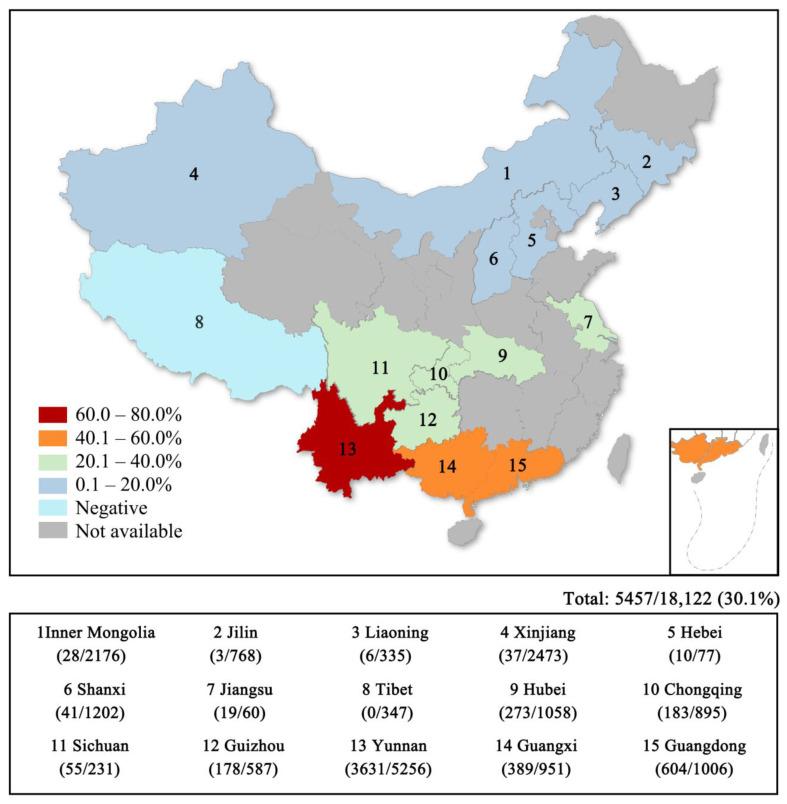
Epizootic haemorrhagic disease (EHD) is an infectious, non-contagious viral disease of ruminants caused by epizootic haemorrhagic disease virus (EHDV) and is transmitted by insects of the genus . In 2008, EHD was listed on the World Organization for Animal Health (WOAH) list of notifiable terrestrial and aquatic animal diseases. This article reviews the distribution of EHD in China and relevant studies and proposes several suggestions for the prevention and control of EHD. There have been reports of positivity for serum antibodies against EHDV-1, EHDV-2, EHDV-5, EHDV-6, EHDV-7, EHDV-8 and EHDV-10 in China. Strains of EHDV-1, -5, -6, -7, -8 and -10 have been isolated, among which the Seg-2, Seg-3 and Seg-6 sequences of serotypes -5, -6, -7 and -10 belong to the eastern topotype. The emergence of western topotype Seg-2 in EHDV-1 strains indicates that EHDV-1 strains in China are reassortant strains of the western and eastern topotypes. A novel serotype strain of EHDV named YNDH/V079/2018 was isolated in 2018. Chinese scholars have successfully expressed the EHDV VP7 protein and developed a variety of ELISA detection methods, including antigen capture ELISA and competitive ELISA. A variety of EHDV nucleic acid detection methods, including RT-PCR and qRT-PCR, have also been developed. LAMP and the liquid chip detection technique are also available. To prevent and control EHD, several suggestions for controlling EHD transmission have been proposed based on the actual situation in China, including controlling the number of , reducing contact between and hosts, continued monitoring of EHDV and in different areas of China and further development and application of basic and pioneering research related to EHD prevention and control.
流行性出血病(EHD)是一种由流行性出血病病毒(EHDV)引起的反刍动物传染性非接触性病毒性疾病,通过 属昆虫传播。2008年,EHD被列入世界动物卫生组织(WOAH)的陆生和水生动物应通报疾病清单。本文综述了EHD在中国的分布及相关研究,并对EHD的防控提出了几点建议。中国已有针对EHDV-1、EHDV-2、EHDV-5、EHDV-6、EHDV-7、EHDV-8和EHDV-10血清抗体阳性的报道。已分离出EHDV-1、-5、-6、-7、-8和-10毒株,其中-5、-6、-7和-10血清型的Seg-2、Seg-3和Seg-6序列属于东部拓扑型。EHDV-1毒株中出现西部拓扑型Seg-2,表明中国的EHDV-1毒株是西部和东部拓扑型的重组毒株。2018年分离出一株名为YNDH/V079/2018的新型EHDV血清型毒株。中国学者已成功表达EHDV VP7蛋白,并开发了多种ELISA检测方法,包括抗原捕获ELISA和竞争ELISA。还开发了多种EHDV核酸检测方法,包括RT-PCR和qRT-PCR。LAMP和液相芯片检测技术也可用。为防控EHD,根据中国实际情况提出了几点控制EHD传播的建议,包括控制 数量、减少 与宿主之间的接触、持续监测中国不同地区的EHDV和 以及进一步开展和应用与EHD防控相关的基础和前沿研究。


 Zotero 插件