Houck Kennedy, Chakhaia Tsira, Gorvetzian Sarah, Critchley Julia A, Schechter Marcos C, Magee Matthew J
Department of Epidemiology, Rollins School of Public Health, Emory University, Atlanta, Georgia, USA.
Department of Population Health Sciences, Georgia State University, Atlanta, Georgia, USA.
Open Forum Infect Dis. 2023 May 10;10(6):ofad255. doi: 10.1093/ofid/ofad255. eCollection 2023 Jun.
Diabetes mellitus and human immunodeficiency virus (HIV) are independent risk factors for poor outcomes among people with tuberculosis (TB). To date, information on the joint impact of diabetes and HIV on TB outcomes is limited. We aimed to estimate (1) the association between hyperglycemia and mortality and (2) the effect of joint exposure to diabetes and HIV on mortality.
We conducted a retrospective cohort study among people with TB in the state of Georgia between 2015 and 2020. Eligible participants were 16 or older, did not have a previous TB diagnosis, and were microbiologically confirmed or clinical cases. Participants were followed during TB treatment. Robust Poisson regression was used to estimate risk ratios for all-cause mortality. Interaction between diabetes and HIV was assessed on the additive scale using the attributable proportion and on the multiplicative scale with product terms in regression models.
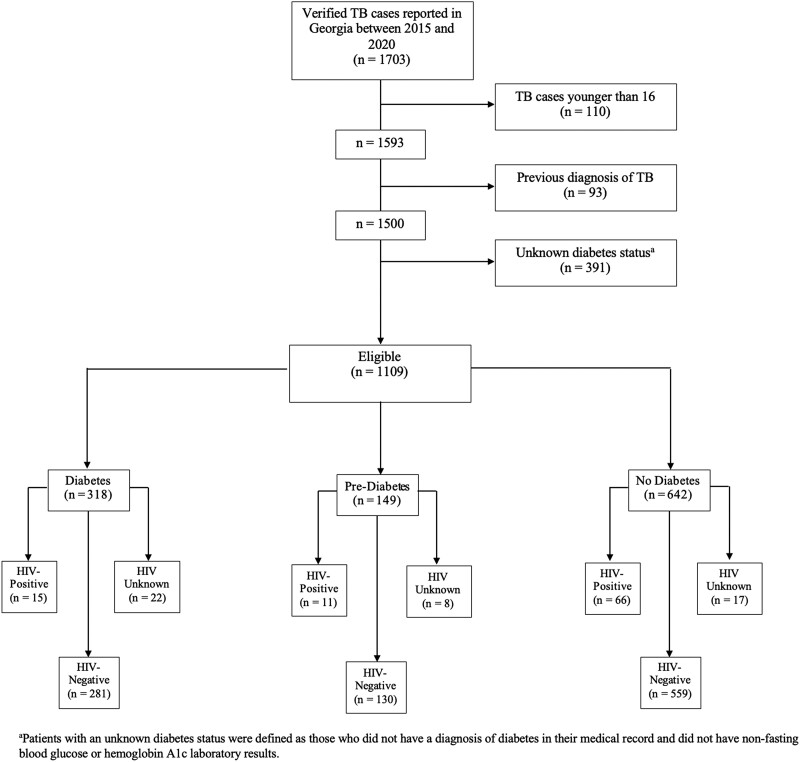
Of 1109 participants, 318 (28.7%) had diabetes, 92 (8.3%) were HIV positive, and 15 (1.4%) had diabetes and HIV. Overall, 9.8% died during TB treatment. Diabetes was associated with an increased risk of death among people with TB (adjusted risk ratio [aRR] = 2.59; 95% confidence interval [CI], 1.62-4.13). We estimated that 26% (95% CI, -43.4% to 95.0%) of deaths among participants with diabetes mellitus and HIV were due to biologic interaction.
Diabetes alone and co-occurring diabetes and HIV were associated with an increased risk of all-cause mortality during TB treatment. These data suggest a potential synergistic effect between diabetes and HIV.
糖尿病和人类免疫缺陷病毒(HIV)是结核病患者预后不良的独立危险因素。迄今为止,关于糖尿病和HIV对结核病预后的联合影响的信息有限。我们旨在估计(1)高血糖与死亡率之间的关联,以及(2)糖尿病和HIV联合暴露对死亡率的影响。
我们在2015年至2020年期间对佐治亚州的结核病患者进行了一项回顾性队列研究。符合条件的参与者年龄在16岁及以上,既往未被诊断为结核病,且为微生物学确诊或临床病例。参与者在结核病治疗期间接受随访。采用稳健泊松回归估计全因死亡率的风险比。使用归因比例在相加尺度上评估糖尿病和HIV之间的相互作用,并在回归模型中使用乘积项在相乘尺度上进行评估。
在1109名参与者中,318人(28.7%)患有糖尿病,92人(8.3%)HIV呈阳性,15人(1.4%)同时患有糖尿病和HIV。总体而言,9.8%的患者在结核病治疗期间死亡。糖尿病与结核病患者死亡风险增加相关(调整后风险比[aRR]=2.59;95%置信区间[CI],1.62 - 4.13)。我们估计,糖尿病合并HIV的参与者中26%(95%CI,-43.4%至95.0%)的死亡归因于生物学相互作用。
单独的糖尿病以及糖尿病与HIV并存均与结核病治疗期间全因死亡率增加相关。这些数据表明糖尿病和HIV之间可能存在协同效应。