Schechter Marcos C, Bizune Destani, Kagei Michelle, Holland David P, Del Rio Carlos, Yamin Aliya, Mohamed Omar, Oladele Alawode, Wang Yun F, Rebolledo Paulina A, Ray Susan M, Kempker Russell R
Department of Medicine, Division of Infectious Diseases, Emory University School of Medicine, Atlanta, Georgia.
Rollins School of Public Health, Emory University, Atlanta, Georgia.
Open Forum Infect Dis. 2018 Mar 21;5(4):ofy063. doi: 10.1093/ofid/ofy063. eCollection 2018 Apr.
Antiretroviral therapy (ART) for persons with HIV infection prevents tuberculosis (TB) disease. Additionally, sequential ART after initiation of TB treatment improves outcomes. We examined ART use, retention in care, and viral suppression (VS) before, during, and 3 years following TB treatment for an inner-city cohort in the United States.
Retrospective cohort study among persons treated for culture-confirmed TB between 2008 and 2015 at an inner-city hospital.
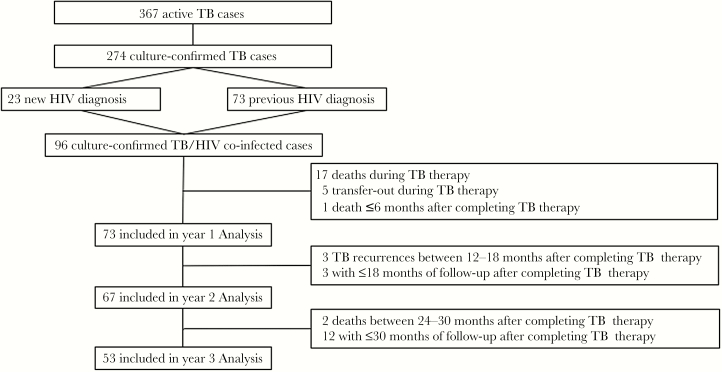
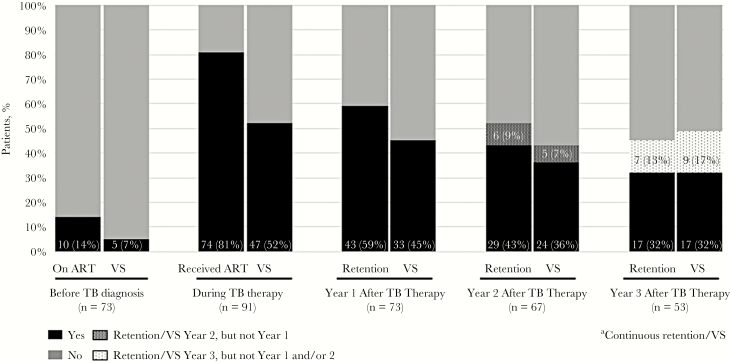
Among 274 persons with culture-confirmed TB, 96 (35%) had HIV co-infection, including 23 (24%) new HIV diagnoses and 73 (76%) previous diagnoses. Among those with known HIV prior to TB, the median time of known HIV was 6 years, and only 10 (14%) were on ART at the time of TB diagnosis. The median CD4 at TB diagnosis was 87 cells/uL. Seventy-four (81%) patients received ART during treatment for TB, and 47 (52%) has VS at the end of TB treatment. Only 32% of patients had continuous VS 3 years after completing TB treatment. There were 3 TB recurrences and 3 deaths post-TB treatment; none of these patients had retention or VS after TB treatment.
Among persons with active TB co-infected with HIV, we found that the majority had known HIV and were not on ART prior to TB diagnosis, and retention in care and VS post-TB treatment were very low. Strengthening the HIV care continuum is needed to improve HIV outcomes and further reduce rates of active TB/HIV co-infection in our and similar settings.
针对艾滋病毒感染者的抗逆转录病毒疗法(ART)可预防结核病(TB)。此外,在开始结核病治疗后序贯使用抗逆转录病毒疗法可改善治疗结果。我们研究了美国一个市中心队列中结核病治疗前、治疗期间及治疗后3年的抗逆转录病毒疗法使用情况、治疗留存率和病毒抑制(VS)情况。
对2008年至2015年在一家市中心医院接受培养确诊结核病治疗的患者进行回顾性队列研究。
在274例培养确诊结核病患者中,96例(35%)合并感染艾滋病毒,其中23例(24%)为新诊断出的艾滋病毒感染,73例(76%)为既往诊断出的感染。在结核病之前已知感染艾滋病毒的患者中,已知感染艾滋病毒的中位时间为6年,结核病诊断时只有10例(14%)正在接受抗逆转录病毒疗法治疗。结核病诊断时的中位CD4细胞计数为87个/微升。74例(81%)患者在结核病治疗期间接受了抗逆转录病毒疗法治疗,47例(52%)在结核病治疗结束时实现了病毒抑制。完成结核病治疗3年后,只有32%的患者实现了持续病毒抑制。结核病治疗后有3例结核病复发和3例死亡;这些患者在结核病治疗后均未实现治疗留存或病毒抑制。
在合并感染艾滋病毒的活动性结核病患者中,我们发现大多数患者已知感染艾滋病毒,但在结核病诊断前未接受抗逆转录病毒疗法治疗,结核病治疗后的治疗留存率和病毒抑制率非常低。需要加强艾滋病毒治疗的连续性,以改善艾滋病毒治疗结果,并在我们及类似环境中进一步降低活动性结核病/艾滋病毒合并感染率。