Physical Activity and Health, Swedish School of Sport and Health Sciences, GIH, Stockholm, Sweden
Physical Activity and Health, Swedish School of Sport and Health Sciences, GIH, Stockholm, Sweden.
BMJ Open. 2022 Aug 2;12(8):e061929. doi: 10.1136/bmjopen-2022-061929.
To investigate the associations between physical activity pattern, sports participation, screen time and mental health in Swedish adolescents.
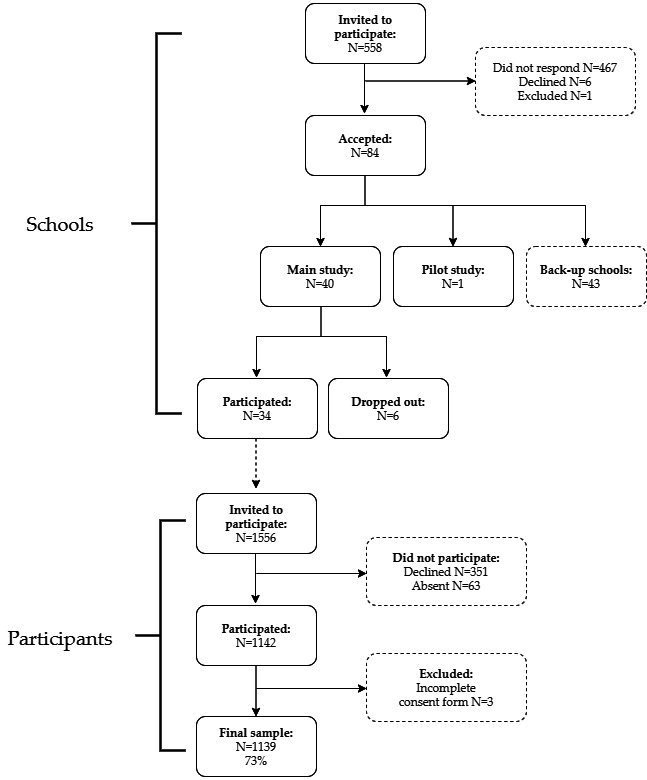
DESIGN, SETTING AND PARTICIPANTS: A total of 1139 Swedish adolescents (mean age 13.4) from 34 schools participated in the cross-sectional study 'Physical Activity for Healthy Brain Functions in School Youth' in 2019.
Time spent sedentary and in moderate-to-vigorous physical activity (MVPA) was measured using accelerometers for seven consecutive days. Screen time and sports participation were self-reported. Anxiety and health-related quality of life (HRQoL) were assessed using a Short version of the Spence Children's Anxiety Scale and Kidscreen-10.
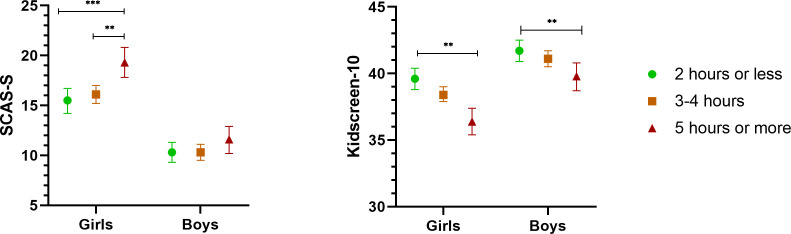
MVPA was positively associated (95% CI 0.01 to 0.05 in girls and 0.02 to 0.07 in boys) whereas screen time on weekdays was inversely associated with HRQoL (-4.79 to -2.22 in girls and -2.66 to -0.41 in boys). The largest effect sizes were observed between the high/low MVPA group in boys (Cohen's d0.51) and screen time groups in girls (Cohen's d0.59 on weekdays). With regards to anxiety, high compared with lower time spent in MVPA during leisure time on weekdays was associated with lower anxiety scores (95% CI -0.13 to -0.05 in girls and -0.07 to -0.01 in boys). Gender differences were observed, boys who participated in organised sports had low anxiety scores (95% CI -3.49 to -0.13) whereas girls who reported 5 hours or more of screen time had high scores (95% CI 1.94 to 6.18 on weekdays and 1.39 to 5.29 on weekend days).
This study showed that MVPA was associated with better mental health, whereas the opposite was seen for screen time. These associations were not consistently significant throughout all time domains, between the genders and mental health outcomes. Our results could create a paradigm for future studies to decide which types of PA patterns and time domains to target in intervention studies with the aim improve mental health among adolescents.
研究瑞典青少年的体力活动模式、运动参与、屏幕时间与心理健康之间的关联。
设计、地点和参与者:本横断面研究于 2019 年在 34 所学校中纳入了 1139 名瑞典青少年(平均年龄 13.4 岁)。
使用加速度计连续 7 天测量久坐时间和中等到剧烈体力活动(MVPA)时间。屏幕时间和运动参与情况由自我报告。使用斯宾塞儿童焦虑量表短版和儿童健康生活质量问卷(Kidscreen-10)评估焦虑和健康相关生活质量(HRQoL)。
MVPA 与 HRQoL 呈正相关(女生为 0.01 至 0.05,男生为 0.02 至 0.07),而工作日的屏幕时间与 HRQoL 呈负相关(女生为-4.79 至-2.22,男生为-2.66 至-0.41)。在男生中,高/低 MVPA 组之间的效应量最大(Cohen's d0.51),而在女生中,高/低屏幕时间组之间的效应量最大(Cohen's d0.59,工作日)。关于焦虑,与较低的工作日闲暇时间 MVPA 相比,较高的闲暇时间 MVPA 与较低的焦虑评分相关(女生为-0.13 至-0.05,男生为-0.07 至-0.01)。存在性别差异,参加有组织运动的男生焦虑评分较低(95%CI-3.49 至-0.13),而报告每周有 5 小时或更长时间屏幕时间的女生焦虑评分较高(95%CI 工作日为 1.94 至 6.18,周末为 1.39 至 5.29)。
本研究表明,MVPA 与更好的心理健康相关,而屏幕时间则相反。这些关联在所有时间域、性别和心理健康结果之间并非始终一致。我们的研究结果可以为未来的研究创造一个范例,以确定在干预研究中针对哪些类型的 PA 模式和时间域,从而改善青少年的心理健康。