Medical-Surgical Department, Nursing School, Aja University of Medical Sciences, Tehran, Iran.
Research and Community Health Departments, Nursing School, Aja University of Medical Sciences, Tehran, Iran.
BMC Nephrol. 2023 Jun 29;24(1):194. doi: 10.1186/s12882-023-03246-7.
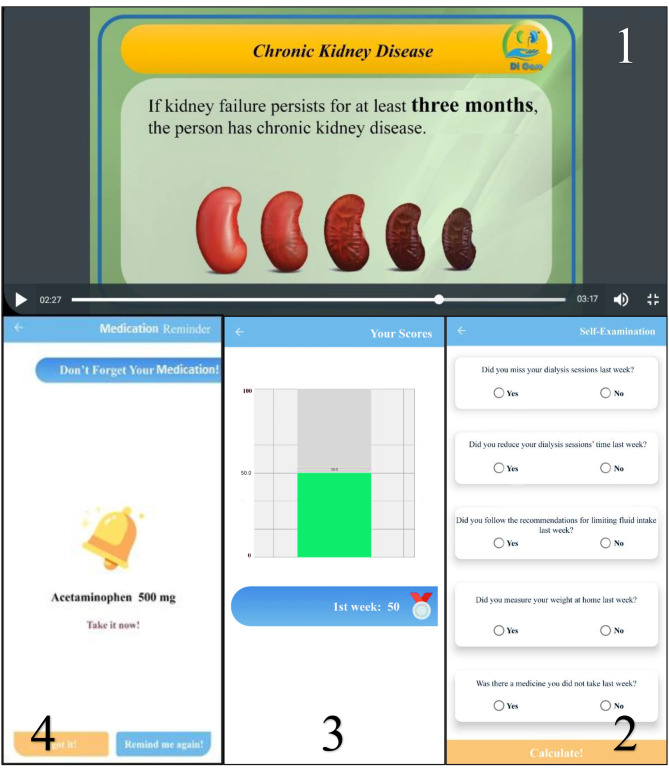
Numerous factors are likely to result in poor treatment adherence, which is one of the important factors contributing to increased complications and the low efficacy of hemodialysis (HD), particularly inadequate knowledge of patients. This study aimed to compare the effects of a mobile health (mHealth) app (the Di Care app) use and face-to-face training on the clinical and laboratory parameters of dietary and fluid intake adherence in patients undergoing HD.
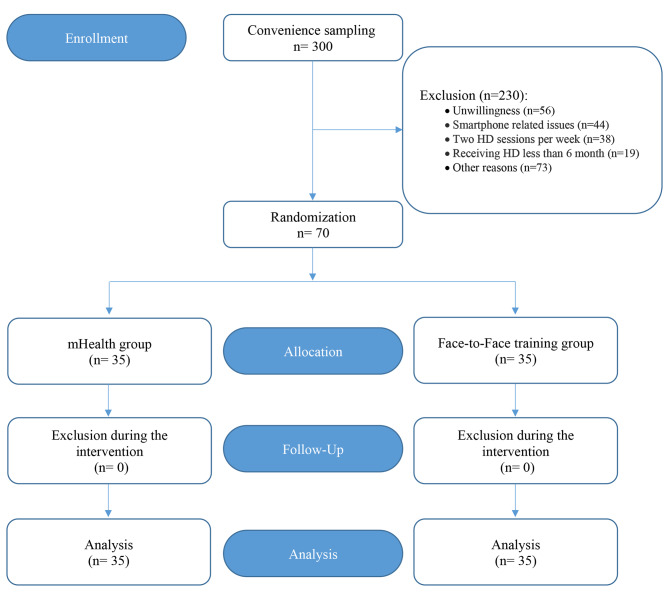
This single-blinded, two-stage/two-group randomized clinical trial was fulfilled in 2021-22 in Iran. Seventy HD patients were recruited, using the convenience sampling method, and were then randomized into two groups: mHealth (n = 35) and face-to-face training (n = 35). The patients in both groups received the same educational materials via the Di Care app and face-to-face training for one month. Before and 12 weeks after the intervention, the mean interdialytic weight gain (IDWG), potassium (K), phosphorus (P), total cholesterol (TC), triglyceride (TG), albumin (AL), and ferritin (FER) levels were measured and compared. The data were analyzed using the SPSS via descriptive statistics (mean, SD, frequency, and percentage) and analytical tests (independent-samples t-test, paired-samples t-test, Wilcoxon signed-rank test, Mann-Whitney U test, Chi-square test, and Fisher's exact test).
Prior to the intervention, the mean IDWG and the K, P, TC, TG, AL, and FER levels, were not significantly different in both groups (p > 0.05). The mean IDWG (p < 0.0001), and the K (p = 0.001), P (p = 0.003), TC/TG (p < 0.0001), and FER (p = 0.038) levels in the HD patients in the mHealth group decreased. As well, the mean IDWG (p < 0.0001), and the K (p < 0.0001) and AL (p < 0.0001) levels showed a descending trend in the face-to-face group. The fall in the mean IDWG (p = 0.001) and the TG level (p = 0.034) in the patients in the mHealth group was significantly greater than that in the face-to-face group.
The Di Care app use and the face-to-face training could improve dietary and fluid intake adherence in patients. However, mHealth could have more effect on the laboratory parameters than face-to-face training, largely reducing the IDWG.
This study was registered in the Iranian Registry of Clinical Trials (No. ID IRCT20171216037895N5).
许多因素可能导致治疗依从性差,这是导致血液透析(HD)并发症增加和疗效降低的重要因素之一,尤其是患者知识不足。本研究旨在比较移动健康(mHealth)应用程序(Di Care 应用程序)使用和面对面培训对 HD 患者饮食和液体摄入依从性的临床和实验室参数的影响。
这是一项于 2021-2022 年在伊朗进行的单盲、两阶段/两组随机临床试验。采用便利抽样法招募了 70 名 HD 患者,然后将他们随机分为两组:mHealth(n=35)和面对面培训(n=35)。两组患者均通过 Di Care 应用程序和面对面培训接受为期一个月的相同教育材料。干预前和干预后 12 周,测量并比较平均透间体重增加(IDWG)、钾(K)、磷(P)、总胆固醇(TC)、甘油三酯(TG)、白蛋白(AL)和铁蛋白(FER)水平。使用 SPSS 通过描述性统计(均值、标准差、频率和百分比)和分析测试(独立样本 t 检验、配对样本 t 检验、Wilcoxon 符号秩检验、Mann-Whitney U 检验、卡方检验和 Fisher 精确检验)对数据进行分析。
干预前,两组间的平均 IDWG 以及 K、P、TC、TG、AL 和 FER 水平无显著差异(p>0.05)。mHealth 组 HD 患者的平均 IDWG(p<0.0001)、K(p=0.001)、P(p=0.003)、TC/TG(p<0.0001)和 FER(p=0.038)水平降低。此外,mHealth 组的平均 IDWG(p<0.0001)、K(p<0.0001)和 AL(p<0.0001)水平呈下降趋势。mHealth 组患者的平均 IDWG(p=0.001)和 TG 水平(p=0.034)下降幅度明显大于面对面组。
Di Care 应用程序使用和面对面培训可以提高患者的饮食和液体摄入依从性。然而,mHealth 可能比面对面培训对实验室参数的影响更大,从而大大降低 IDWG。
本研究在伊朗临床试验注册处注册(注册号:ID IRCT20171216037895N5)。