Melendez-Torres G J, Bonell Chris, Shaw Naomi, Orr Noreen, Chollet Annah, Rizzo Andrew, Rigby Emma, Hagell Ann, Young Honor, Berry Vashti, Humphreys David K, Farmer Caroline
Faculty of Health and Life Sciences, University of Exeter, Exeter, UK.
Department of Public Health Environments and Society, London School of Hygiene and Tropical Medicine, London, UK.
Prev Med Rep. 2023 Jun 8;34:102277. doi: 10.1016/j.pmedr.2023.102277. eCollection 2023 Aug.
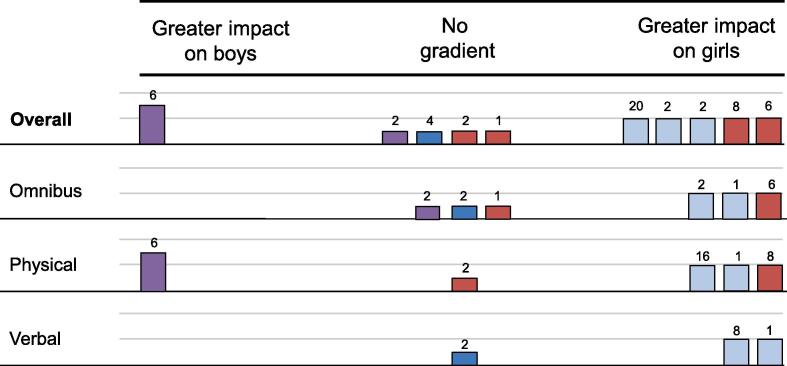
School-based interventions for the prevention of dating and relationship violence (DRV) and gender-based violence (GBV) take advantage of universal opportunities for intervention. Information on differential effectiveness of interventions is important to assess if they ameliorate or worsen social gradients in specific outcomes. This is especially important in DRV and GBV prevention given the gendered context of these behaviours and their common aetiologies in patriarchal gender norms, and social acceptance in school contexts of sexual harassment, such as catcalling or unwanted groping. We undertook a systematic review of moderation analyses in randomised trials of school-based interventions for DRV and GBV prevention. We searched 21 databases and used supplementary search methods without regard to publication type, language or year of publication, and synthesised moderation tests relating to equity-relevant characteristics (principally sex and prior history of the outcome) for DRV and GBV perpetration and victimisation. Across 23 included outcome evaluations, programme effects on DRV victimisation were not moderated by gender or prior experience of DRV victimisation, but DRV perpetration outcomes were greater for boys, particularly for emotional and physical DRV perpetration. Findings for GBV outcomes were counterintuitive. Our findings suggest that practitioners should carefully monitor local intervention effectiveness and equity to ensure that interventions are working as intended. However, one of the most surprising findings from our analysis-with clear relevance for uncertainties in practice-was that differential impacts by sexuality or sexual minority status were not frequently evaluated.
以学校为基础的预防约会和关系暴力(DRV)及性别暴力(GBV)的干预措施利用了普遍的干预机会。了解干预措施的不同效果对于评估它们是否改善或加剧特定结果中的社会梯度很重要。鉴于这些行为的性别背景以及它们在父权制性别规范中的共同病因,以及学校环境中对性骚扰(如吹口哨或不必要的摸索)的社会接受程度,这在预防DRV和GBV方面尤为重要。我们对预防DRV和GBV的以学校为基础的干预措施的随机试验中的调节分析进行了系统评价。我们检索了21个数据库,并使用了补充检索方法,不考虑出版物类型、语言或出版年份,并综合了与DRV和GBV实施及受害情况的公平相关特征(主要是性别和该结果的既往史)相关的调节测试。在纳入的23项结果评估中,干预措施对DRV受害情况的影响不受性别或DRV受害情况既往经历的调节,但男孩的DRV实施结果更大,尤其是在情感和身体DRV实施方面。GBV结果的发现与直觉相反。我们的研究结果表明,从业者应仔细监测当地干预措施的有效性和公平性,以确保干预措施按预期发挥作用。然而,我们分析中最令人惊讶的发现之一——与实践中的不确定性明显相关——是很少评估性取向或性少数群体身份的差异影响。