Department of Psychoeducation, Université de Sherbrooke, Québec, Canada.
Population Research Center, University of Texas at Austin, Austin, Texas.
J Adolesc Health. 2021 Jun;68(6):1155-1161. doi: 10.1016/j.jadohealth.2020.08.034. Epub 2020 Oct 17.
Sexual and gender minority adolescents report higher levels of dating violence compared with their heterosexual and cisgender peers. The objectives of the present study were to (1) identify latent profiles of dating violence; (2) examine if sexual and gender minority adolescents were particularly vulnerable to certain profiles of dating violence; and (3) explore how experiences of peer victimization, discrimination, and parental maltreatment explained this greater vulnerability.
High school students in Grades 9 and 11 from the 2016 Minnesota Student Survey (N = 87,532; mean age = 15.29 years, SD = 1.23) were asked about their sexual and gender identities, their gender nonconformity, their experiences of verbal, physical, and sexual dating violence victimization and perpetration, as well their experiences of childhood maltreatment, peer victimization, and gender-based and sexual minority status-based discrimination.
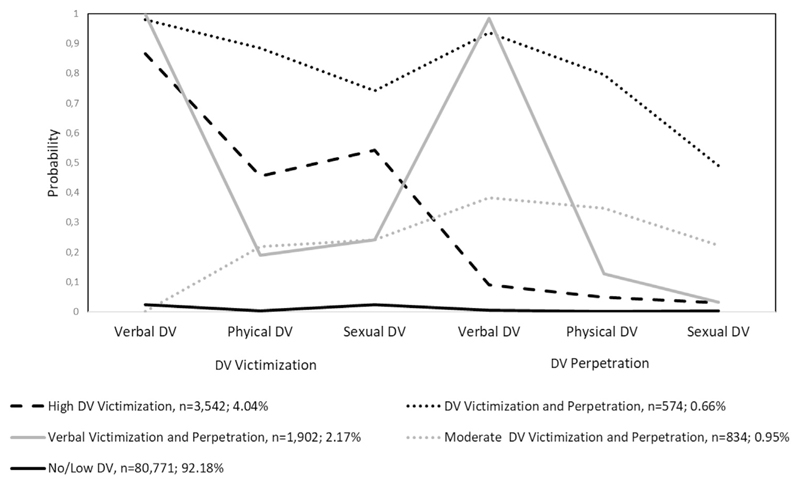
Multinomial logistic regression analysis in a three-step latent class analysis procedure suggested five profiles of dating violence victimization and perpetration across the entire sample. Sexual and gender minority adolescents were generally more likely to be in classes high in dating violence victimization, perpetration, or both, compared with their heterosexual and cisgender peers. Gender nonconformity was also associated with greater risk for being in high dating violence classes. These differences, however, were generally nonsignificant when the social stressors of childhood maltreatment, peer victimization, and experiences of discrimination were accounted for.
Although findings suggested greater vulnerability for dating violence among sexual and gender minority adolescents, they underscore the importance of how minority stressors generally accounted for this greater vulnerability for dating violence.
性少数群体和跨性别青少年报告的约会暴力水平高于其异性恋和顺性别同龄人。本研究的目的是:(1)确定约会暴力的潜在模式;(2)研究性少数群体和跨性别青少年是否特别容易受到某些类型的约会暴力;(3)探讨同伴受害、歧视和父母虐待经历如何解释这种更高的脆弱性。
2016 年明尼苏达州学生调查(N=87532;平均年龄=15.29 岁,SD=1.23)中的 9 年级和 11 年级高中生被问及他们的性和性别认同、他们的性别不一致、他们的言语、身体和性约会暴力受害和施暴经历,以及他们的童年虐待、同伴受害、性别和性少数群体基于身份的歧视经历。
三阶段潜在类别分析程序中的多项逻辑回归分析表明,整个样本中有五种约会暴力受害和施暴的潜在模式。与异性恋和顺性别同龄人相比,性少数群体和跨性别青少年通常更有可能处于约会暴力受害、施暴或两者兼有的高风险类别中。性别不一致也与处于高约会暴力类别相关的风险增加有关。然而,当考虑到童年虐待、同伴受害和歧视经历等社会压力源时,这些差异通常不显著。
尽管研究结果表明性少数群体和跨性别青少年更容易受到约会暴力的影响,但它们强调了少数群体压力源通常如何解释这种更高的约会暴力脆弱性的重要性。