Lam Xin-Jieh, Xu Bingzhe, Yeo Pei-Ling, Cheah Pike-See, Ling King-Hwa
Department of Human Anatomy, Faculty of Medicine and Health Sciences, Unversiti Putra Malaysia, 43400 Serdang, Selangor, Malaysia.
School of Biomedical Engineering, Sun Yat-sen University, 132 Daxuecheng Outer Ring E Rd, Panyu Qu, Guangzhou Shi, Guangdong 511434, People's Republic of China.
IBRO Neurosci Rep. 2023 Apr 11;14:407-418. doi: 10.1016/j.ibneur.2023.04.002. eCollection 2023 Jun.
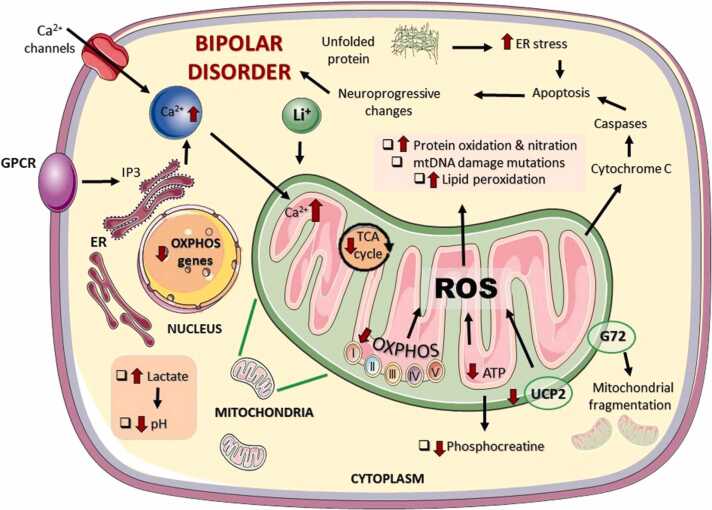
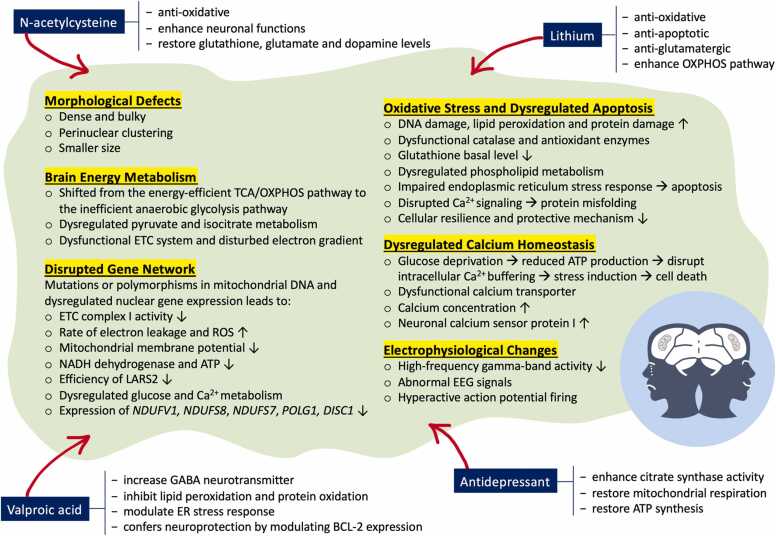
Bipolar disorder (BD) is one of the major psychiatric diseases in which the impairment of mitochondrial functions has been closely connected or associated with the disease pathologies. Different lines of evidence of the close connection between mitochondria dysfunction and BD were discussed with a particular focus on (1) dysregulation of energy metabolism, (2) effect of genetic variants, (3) oxidative stress, cell death and apoptosis, (4) dysregulated calcium homeostasis and electrophysiology, and (5) current as well as potential treatments targeting at restoring mitochondrial functions. Currently, pharmacological interventions generally provide limited efficacy in preventing relapses or recovery from mania or depression episodes. Thus, understanding mitochondrial pathology in BD will lead to novel agents targeting mitochondrial dysfunction and formulating new effective therapy for BD.
双相情感障碍(BD)是主要的精神疾病之一,其中线粒体功能损害与疾病病理密切相关。本文讨论了线粒体功能障碍与双相情感障碍之间密切联系的不同证据线索,特别关注以下方面:(1)能量代谢失调;(2)基因变异的影响;(3)氧化应激、细胞死亡和凋亡;(4)钙稳态和电生理失调;(5)针对恢复线粒体功能的现有及潜在治疗方法。目前,药物干预在预防躁狂或抑郁发作的复发或康复方面通常疗效有限。因此,了解双相情感障碍中的线粒体病理将有助于开发针对线粒体功能障碍的新型药物,并为双相情感障碍制定新的有效治疗方案。