Liu Kathy Y, Villain Nicolas, Ayton Scott, Ackley Sarah F, Planche Vincent, Howard Robert, Thambisetty Madhav
Division of Psychiatry, University College London, London W1T 7NF, UK.
AP-HP.Sorbonne Université, Institut de la Mémoire et de la Maladie d'Alzheimer, Département de Neurologie, Hôpital Pitié-Salpêtrière, 75013 Paris, France.
Brain Commun. 2023 Jun 2;5(3):fcad175. doi: 10.1093/braincomms/fcad175. eCollection 2023.
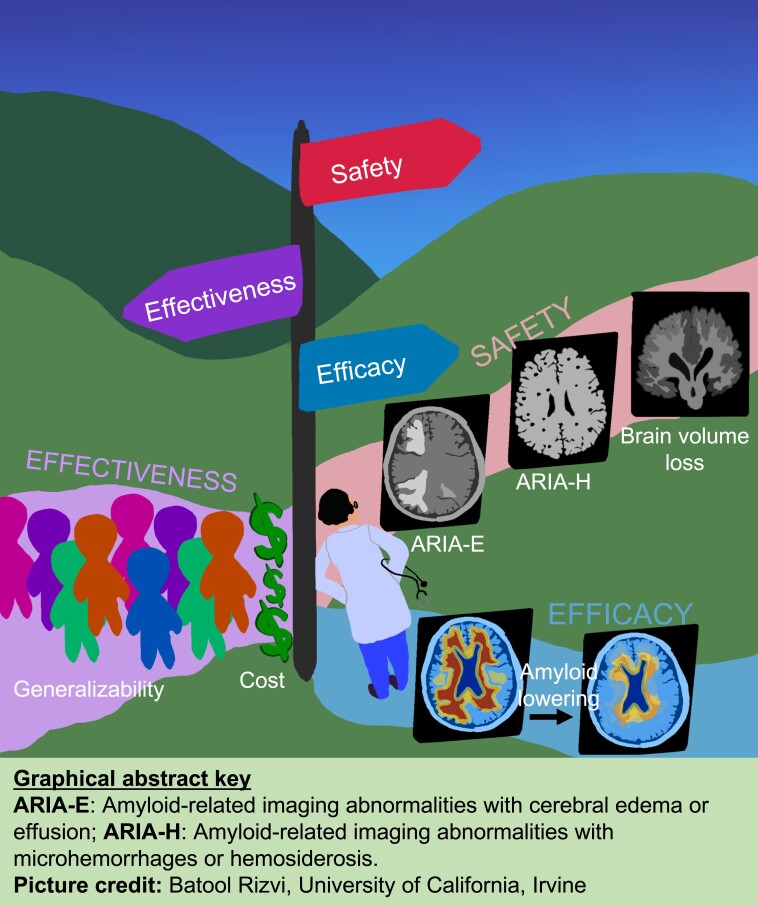
The clinical benefit associated with anti-amyloid immunotherapies, a new class of drugs for the treatment of Alzheimer's disease, is predicated on their ability to modify disease course by lowering brain amyloid levels. At the time of writing, two amyloid-lowering antibodies, aducanumab and lecanemab, have obtained United States Food and Drug Administration accelerated approval, with further agents of this class in the Alzheimer's disease treatment pipeline. Based on limited published clinical trial data to date, regulators, payors and physicians will need to assess their efficacy, clinical effectiveness and safety, as well as cost and accessibility. We propose that attention to three important questions related to treatment efficacy, clinical effectiveness and safety should guide evidence-based consideration of this important class of drugs. These are: (1) Were trial statistical analyses appropriate and did they convincingly support claims of efficacy? (2) Do reported treatment effects outweigh safety concerns and are they generalizable to a representative clinical population of people with Alzheimer's disease? and (3) Do the data convincingly demonstrate disease course modification, suggesting that increasing clinical benefits beyond the duration of the trials are likely? We suggest specific approaches to interpreting trial results for these drugs and highlight important areas of uncertainty where additional data and a cautious interpretation of existing results is warranted. Safe, effective and accessible treatments for Alzheimer's disease are eagerly awaited by millions of patients and their caregivers worldwide. While amyloid-targeting immunotherapies may be promising disease-modifying Alzheimer's disease treatments, rigorous and unbiased assessment of clinical trial data is critical to regulatory decision-making and subsequently determining their provision and utility in routine clinical practice. Our recommendations provide a framework for evidence-based appraisal of these drugs by regulators, payors, physicians and patients.
抗淀粉样蛋白免疫疗法是一类用于治疗阿尔茨海默病的新型药物,其临床益处基于降低脑淀粉样蛋白水平来改变疾病进程的能力。在撰写本文时,两种降低淀粉样蛋白的抗体,即阿杜卡奴单抗和乐卡奈单抗,已获得美国食品药品监督管理局的加速批准,该类别的其他药物也在阿尔茨海默病治疗流程中。基于迄今为止有限的已发表临床试验数据,监管机构、支付方和医生将需要评估其疗效、临床有效性和安全性,以及成本和可及性。我们建议,关注与治疗疗效、临床有效性和安全性相关的三个重要问题,应指导对这类重要药物进行基于证据的考量。这些问题是:(1)试验统计分析是否恰当,是否令人信服地支持了疗效声明?(2)所报告的治疗效果是否超过安全担忧,是否能推广到具有代表性的阿尔茨海默病临床患者群体?以及(3)数据是否令人信服地证明了疾病进程的改变,这表明在试验期之后增加临床益处是可能的?我们提出了解释这些药物试验结果的具体方法,并强调了重要的不确定性领域,在这些领域需要更多数据并对现有结果进行谨慎解读。全球数百万患者及其护理人员急切期待着安全、有效且可及的阿尔茨海默病治疗方法。虽然靶向淀粉样蛋白的免疫疗法可能是有前景的阿尔茨海默病疾病修饰治疗方法,但对临床试验数据进行严格且无偏倚的评估对于监管决策以及随后确定其在常规临床实践中的提供和效用至关重要。我们的建议为监管机构、支付方、医生和患者对这些药物进行基于证据的评估提供了一个框架。