Friedrich Loeffler-Institute of Medical Microbiology, University Medicine Greifswald, Greifswald, Germany.
Institute of Medical Microbiology, University Hospital Münster, Münster, Germany.
Microbiol Spectr. 2023 Aug 17;11(4):e0067323. doi: 10.1128/spectrum.00673-23. Epub 2023 Jul 3.
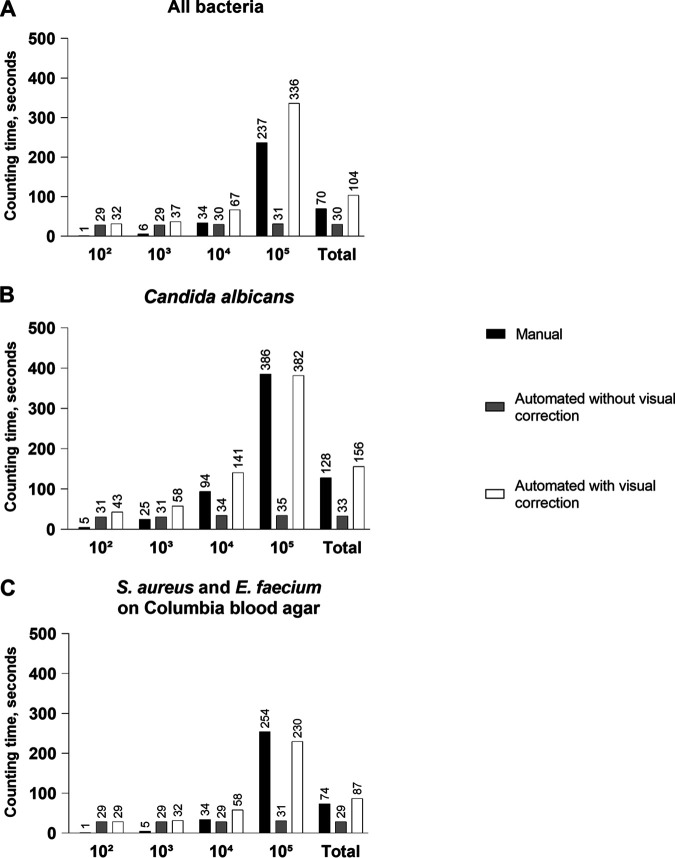
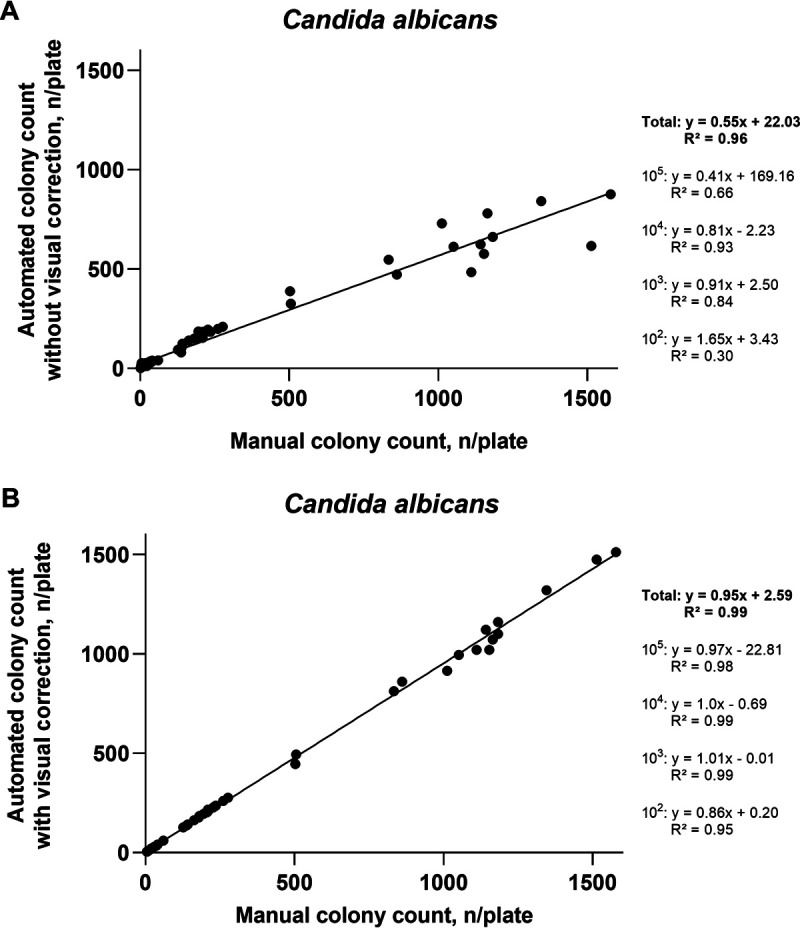
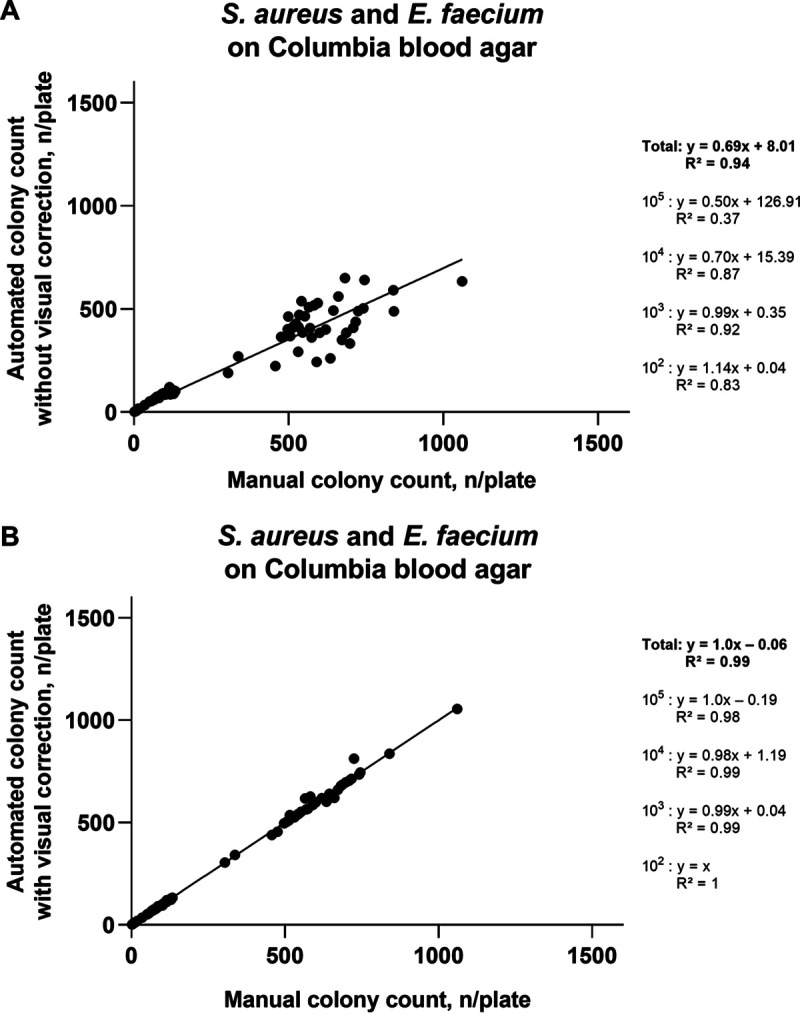
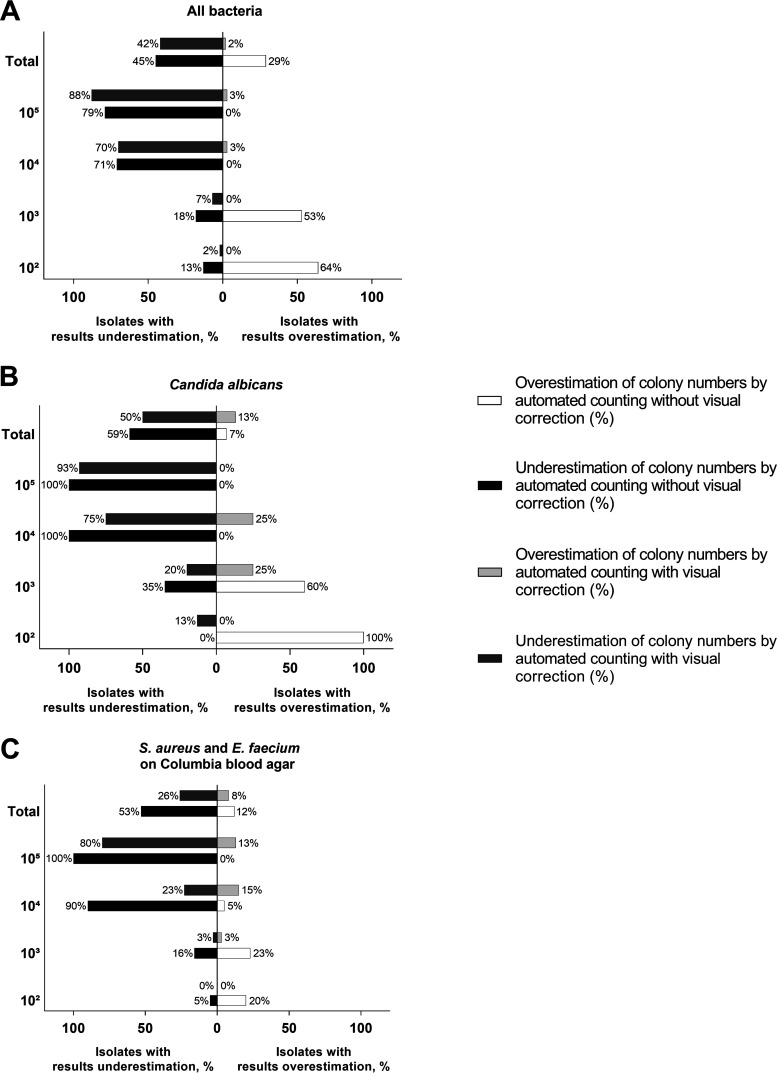
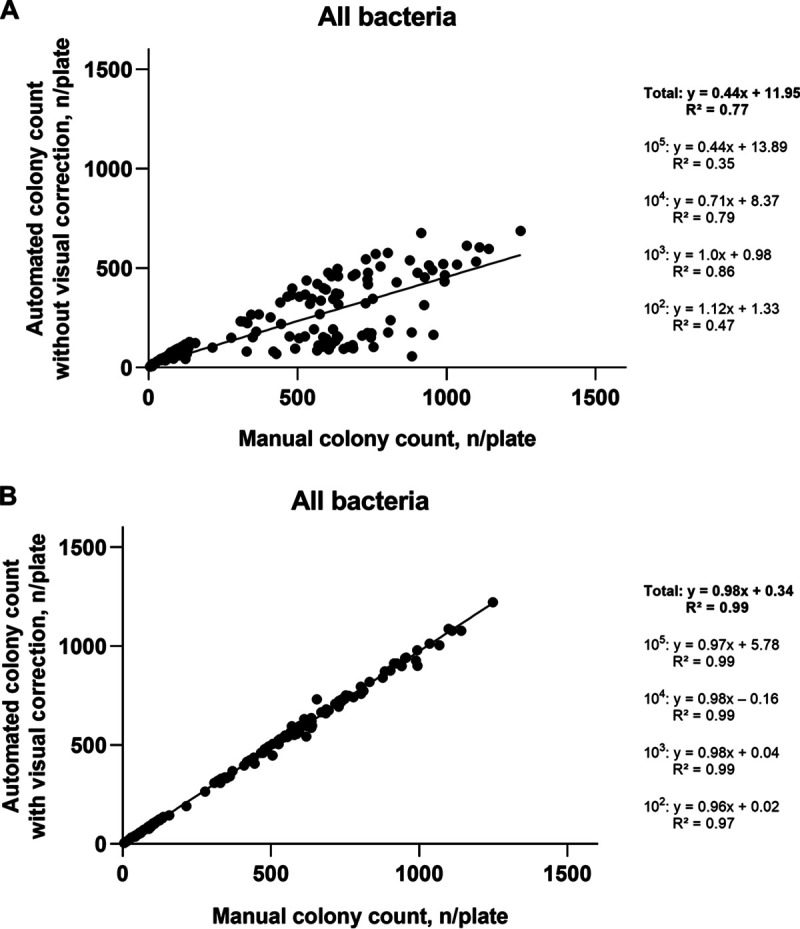
Counting of microbial colonies is a common technique employed in research and diagnostics. To simplify this tedious and time-consuming process, automated systems have been proposed. This study aimed to elucidate the reliability of automated colony counting. We evaluated a commercially available instrument (UVP ColonyDoc-It Imaging Station) in regard to its accuracy and potential time savings. Suspensions of Staphylococcus aureus, Escherichia coli, Pseudomonas aeruginosa, Klebsiella pneumoniae, Enterococcus faecium, and Candida albicans ( = 20 each) were adjusted to achieve growth of approximately 1,000, 100, 10, and 1 colony per plate, respectively, after overnight incubation on different solid media. Compared with manual counting, each plate was automatically counted by the UVP ColonyDoc-It with and without visual adjustment on a computer display. For all bacterial species and concentrations automatically counted without visual correction, an overall mean difference from manual counts of 59.7%, a proportion of isolates with overestimation/underestimation of colony numbers of 29%/45%, respectively, and only a moderate relationship ( = 0.77) with the manual counting were shown. Applying visual correction, the overall mean difference from manual counts was 1.8%, the proportion of isolates with overestimation/underestimation of colony numbers amounted to 2%/42%, respectively, and a strong relationship ( = 0.99) with the manual counting was observed. The mean time needed for manual counting compared with automated counting without and with visual correction was 70 s, 30 s, and 104 s, respectively, for bacterial colonies through all concentrations tested. Generally, similar performance regarding accuracy and counting time was observed with C. albicans. In conclusion, fully automatic counting showed low accuracy, especially for plates with very high or very low colony numbers. After visual correction of the automatically generated results, the concordance with manual counts was high; however, there was no advantage in reading time. Colony counting is a widely utilized technique in the field of microbiology. The accuracy and convenience of automated colony counters are essential for research and diagnostics. However, there is only sparse evidence on performance and usefulness of such instruments. This study examined the current state of reliability and practicality of the automated colony counting with an advanced modern system. For this, we thoroughly evaluated a commercially available instrument in terms of its accuracy and counting time required. Our findings indicate that fully automatic counting resulted in low accuracy, particularly for plates with very high or very low colony numbers. Visual correction of the automated results on a computer screen improved concordance with manual counts, but there was no benefit in counting time.
微生物菌落计数是研究和诊断中常用的技术。为了简化这个繁琐且耗时的过程,已经提出了自动化系统。本研究旨在阐明自动化菌落计数的可靠性。我们评估了一种市售仪器(UVP ColonyDoc-It 成像站)在准确性和潜在时间节省方面的性能。金黄色葡萄球菌、大肠杆菌、铜绿假单胞菌、肺炎克雷伯菌、屎肠球菌和白色念珠菌的悬浮液( = 每个 20 个)分别调整为在不同固体培养基上孵育过夜后,每平板分别生长约 1,000、100、10 和 1 个菌落。与手动计数相比,UVP ColonyDoc-It 在不进行视觉调整和在计算机显示器上进行视觉调整的情况下,对每个平板进行自动计数。对于所有细菌物种和浓度,不进行视觉校正自动计数,与手动计数相比的总体平均差异为 59.7%,分别有 29%和 45%的分离物存在菌落数量高估/低估,并且仅具有中度相关性( = 0.77)。应用视觉校正后,与手动计数相比的总体平均差异为 1.8%,高估/低估菌落数量的分离物比例分别为 2%和 42%,并且与手动计数具有很强的相关性( = 0.99)。手动计数与自动计数(不进行视觉校正和进行视觉校正)相比,所有测试浓度的细菌菌落的平均时间分别为 70 秒、30 秒和 104 秒。总体而言,对于白色念珠菌,在准确性和计数时间方面观察到类似的性能。因此,完全自动计数的准确性较低,尤其是对于菌落数量非常高或非常低的平板。对自动生成的结果进行视觉校正后,与手动计数的一致性很高;然而,在阅读时间方面没有优势。 菌落计数是微生物学领域广泛使用的技术。自动化菌落计数器的准确性和便利性对于研究和诊断至关重要。然而,关于此类仪器的性能和实用性的证据很少。本研究使用先进的现代系统检查了自动化菌落计数的可靠性和实用性的现状。为此,我们在准确性和所需计数时间方面对市售仪器进行了全面评估。我们的研究结果表明,完全自动计数的准确性较低,尤其是对于菌落数量非常高或非常低的平板。在计算机屏幕上对自动结果进行视觉校正可以提高与手动计数的一致性,但在计数时间方面没有优势。