Department of Endocrinology, Metabolism and Internal Medicine, Poznan University of Medical Sciences, Poznan, Poland.
Department of Physical Pharmacy and Pharmacokinetics, Poznan University of Medical Sciences, Poznan, Poland.
Front Endocrinol (Lausanne). 2023 Jun 16;14:1068418. doi: 10.3389/fendo.2023.1068418. eCollection 2023.
Iodine is a pivotal component of thyroid hormones, and its deficiency leads to negative pregnancy outcomes. Therefore, during gestation, additional iodine supplementation is recommended.
By evaluating a group of women from western Poland, the study updated on iodine status during pregnancy and the effectiveness of iodine supplementation in relation to the maternal and neonatal thyroid function.
A total of 91 women were recruited before the delivery between 2019 and 2021. During the medical interview, the patients declared their dietary supplements intake. Thyroid parameters (TSH, ft3, ft4, a-TPO, a-Tg, and TRAb) were measured in the serum of mothers and in the cord blood of newborns after birth. Urinary iodine concentration (UIC) and urine/creatinine (UIC/crea) ratio were assessed in single urine samples using a validated high-performance liquid chromatography with ultraviolet detection (HPLC-UV). Neonatal TSH screening from dried blood spot was analyzed.
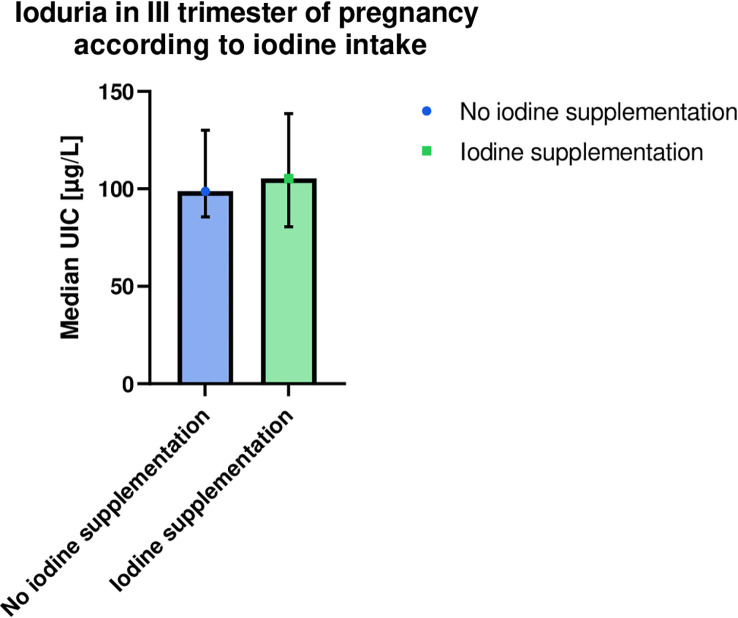
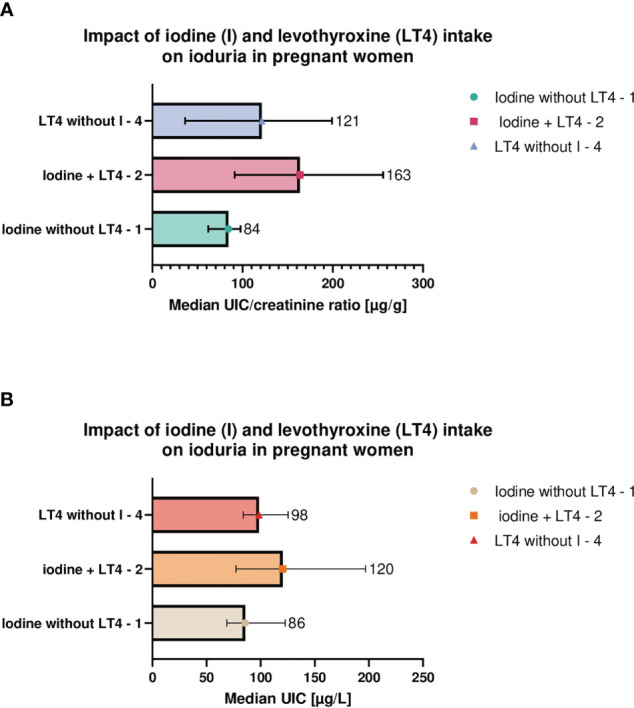
Pregnant women showed a median (interquartile range) UIC of 106 (69-156) µg/liter and UIC/crea ratio of 104 (62-221) µg/g, whereas approximately 20% had UIC/crea below 50 µg/g, indicating iodine deficiency. The iodine supplementation ratio was 68%. No significant differences in UIC, UIC/crea and thyroid parameters were found between iodine supplemented and non-supplemented groups; however, the highest ioduria was detected when iodine was supplemented in addition to levothyroxine in comparison with both substances administered separately. Patients with UIC/crea within 150-249 µg/g demonstrated the lowest TSH and a-TPO levels. Screening TSH was above 5 mIU/liter in 6% of children.
Despite the national salt iodization and the recommendation to supplement iodine during gestation, the status of the abovementioned microelement and real-life intake revealed the ineffectiveness of the current iodine-deficiency prophylaxis model in pregnancy.
碘是甲状腺激素的关键组成部分,其缺乏会导致不良的妊娠结局。因此,建议在妊娠期间额外补充碘。
通过评估来自波兰西部的一组女性,本研究更新了妊娠期间碘的状态,以及补充碘对产妇和新生儿甲状腺功能的有效性。
共招募了 91 名女性,她们于 2019 年至 2021 年期间分娩前入组。在医疗访谈中,患者报告了他们的膳食补充剂摄入情况。在母亲的血清和新生儿出生后的脐带血中测量了甲状腺参数(TSH、ft3、ft4、a-TPO、a-Tg 和 TRAb)。使用经验证的高效液相色谱法(HPLC-UV)对单次尿液样本中的尿碘浓度(UIC)和尿/肌酐(UIC/crea)比值进行了评估。对来自干血斑的新生儿 TSH 筛查进行了分析。
孕妇的 UIC(中位数[四分位距])为 106(69-156)µg/L,UIC/crea 比值为 104(62-221)µg/g,而约 20%的孕妇 UIC/crea 低于 50µg/g,表明存在碘缺乏。碘补充的比例为 68%。在碘补充组和非补充组之间,UIC、UIC/crea 和甲状腺参数没有显著差异;然而,与单独使用左甲状腺素相比,当同时补充碘和左甲状腺素时,尿碘排泄量最高。UIC/crea 在 150-249µg/g 之间的患者 TSH 和 a-TPO 水平最低。儿童 TSH 筛查结果超过 5mIU/L 的比例为 6%。
尽管国家食盐碘化和建议在妊娠期间补充碘,但上述微量元素的状况和实际摄入量表明,目前的妊娠碘缺乏预防模式无效。