Gavilán Ana M, van de Nes-Reijnen Linda, Castellanos Ana, Woudenberg Tom, López-Perea Noemí, Masa-Calles Josefa, Echevarría Juan E, Fernández-García Aurora, Bodewes Rogier
Centro Nacional de Microbiología (CNM), Instituto de Salud Carlos III (ISCIII), Madrid, Spain.
CIBER de Epidemiología y Salud Pública (CIBERESP), ISCIII, Madrid, Spain.
Front Microbiol. 2023 Jun 16;14:1207500. doi: 10.3389/fmicb.2023.1207500. eCollection 2023.
Mumps is a viral infection mainly characterized by inflammation of the parotid glands. Despite of vaccination programs, infections among fully vaccinated populations were reported. The World Health Organization (WHO) recommends molecular surveillance of mumps based on sequencing of the small hydrophobic (SH) gene. The use of hypervariable non-coding regions (NCR) as additional molecular markers was proposed in multiple studies. Circulation of mumps virus (MuV) genotypes and variants in different European countries were described in the literature. From 2010 to 2020, mumps outbreaks caused by genotype G were described. However, this issue has not been analyzed from a wider geographical perspective. In the present study, sequence data from MuV detected in Spain and in The Netherlands during a period of 5 years (2015- March 2020) were analyzed to gain insights in the spatiotemporal spread of MuV at a larger geographical scale than in previous local studies.
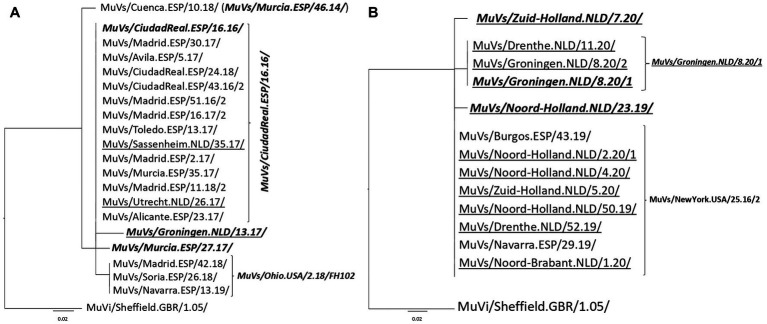
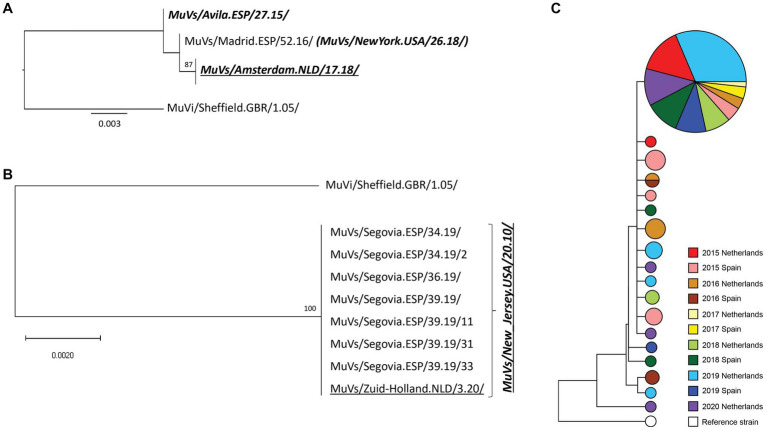
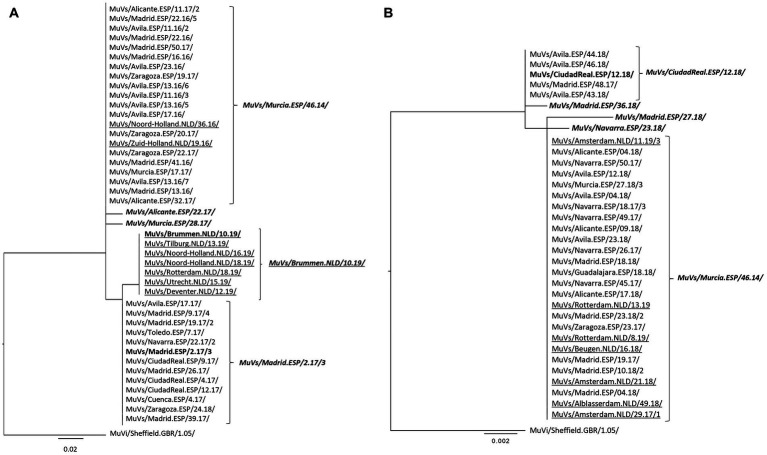
A total of 1,121 SH and 262 NCR between the Matrix and Fusion protein genes (MF-NCR) sequences from both countries were included in this study. Analysis of SH revealed 106 different haplotypes (set of identical sequences).
Of them, seven showing extensive circulation were considered variants. All seven were detected in both countries in coincident temporal periods. A single MF-NCR haplotype was detected in 156 sequences (59.3% of total), and was shared by five of the seven SH variants, as well as three minor MF-NCR haplotypes. All SH variants and MF-NCR haplotypes shared by both countries were detected first in Spain.
Our results suggest a transmission way from south to north Europe. The higher incidence rate of mumps in Spain in spite of similar immunization coverage in both countries, could be associated with higher risk of MuV exportation. In conclusion, the present study provided novel insights into the circulation of MuV variants and haplotypes beyond the borders of single countries. In fact, the use of MF-NCR molecular tool allowed to reveal MuV transmission flows between The Netherlands and Spain. Similar studies including other (European) countries are needed to provide a broader view of the data presented in this study.
腮腺炎是一种病毒感染,主要特征是腮腺炎症。尽管有疫苗接种计划,但仍有关于完全接种疫苗人群感染的报道。世界卫生组织(WHO)建议基于小疏水(SH)基因测序对腮腺炎进行分子监测。多项研究提出将高变非编码区(NCR)用作额外的分子标记。文献中描述了不同欧洲国家腮腺炎病毒(MuV)基因型和变异株的传播情况。2010年至2020年期间,描述了由G基因型引起的腮腺炎疫情。然而,尚未从更广泛的地理角度对该问题进行分析。在本研究中,分析了西班牙和荷兰在5年期间(2015年至2020年3月)检测到的MuV序列数据,以在比以往局部研究更大的地理尺度上深入了解MuV的时空传播情况。
本研究纳入了来自两国的总共1121个SH序列以及基质蛋白和融合蛋白基因之间的262个NCR(MF-NCR)序列。对SH的分析揭示了106种不同的单倍型(相同序列的集合)。
其中,七种显示广泛传播的被视为变异株。所有七种变异株在两国的同一时间段均被检测到。在156个序列(占总数的59.3%)中检测到单一的MF-NCR单倍型,并且七种SH变异株中的五种以及三种次要的MF-NCR单倍型共享该单倍型。两国共享的所有SH变异株和MF-NCR单倍型均首先在西班牙被检测到。
我们的结果表明存在从南欧向北欧的传播途径。尽管两国的免疫覆盖率相似,但西班牙腮腺炎发病率较高,这可能与MuV输出的风险较高有关。总之,本研究为MuV变异株和单倍型在单个国家边界之外的传播提供了新的见解。事实上,使用MF-NCR分子工具能够揭示荷兰和西班牙之间的MuV传播流。需要开展包括其他(欧洲)国家的类似研究,以更全面地了解本研究中呈现的数据。