Centre for Infectious Disease Control, National Institute for Public Health and the Environment (RIVM), Bilthoven, The Netherlands.
PLoS One. 2020 Sep 14;15(9):e0233143. doi: 10.1371/journal.pone.0233143. eCollection 2020.
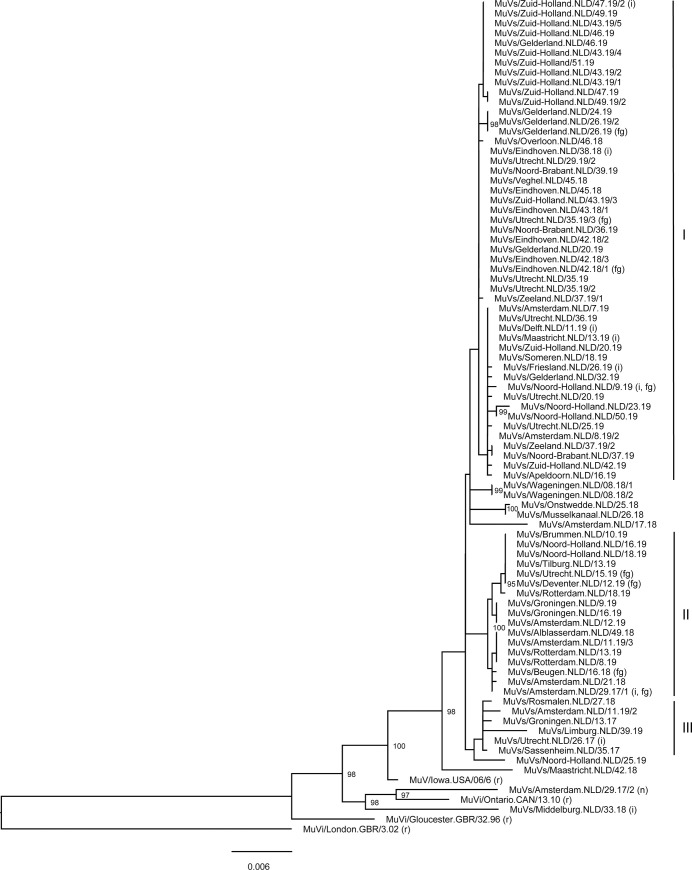
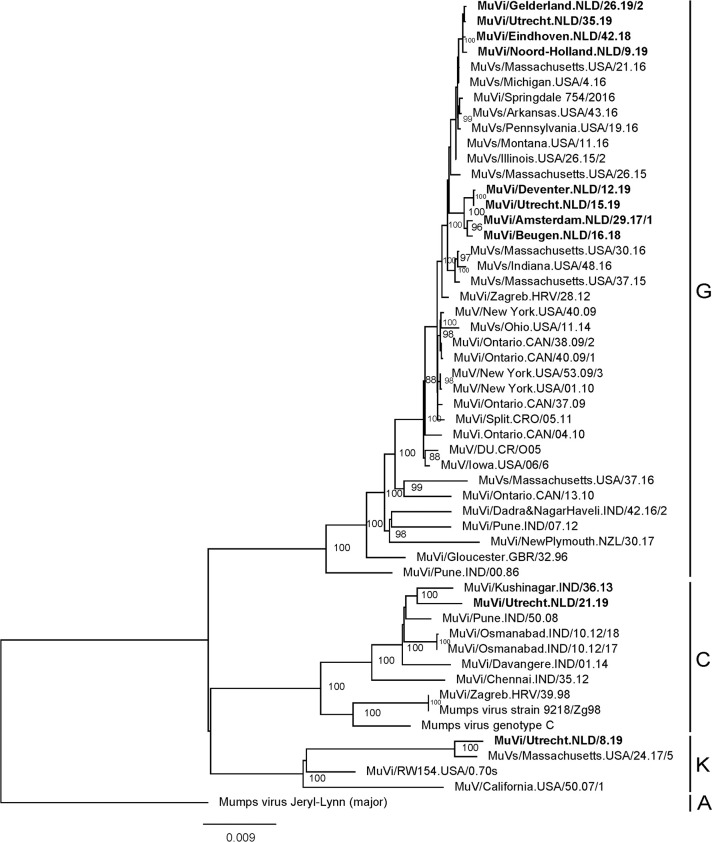
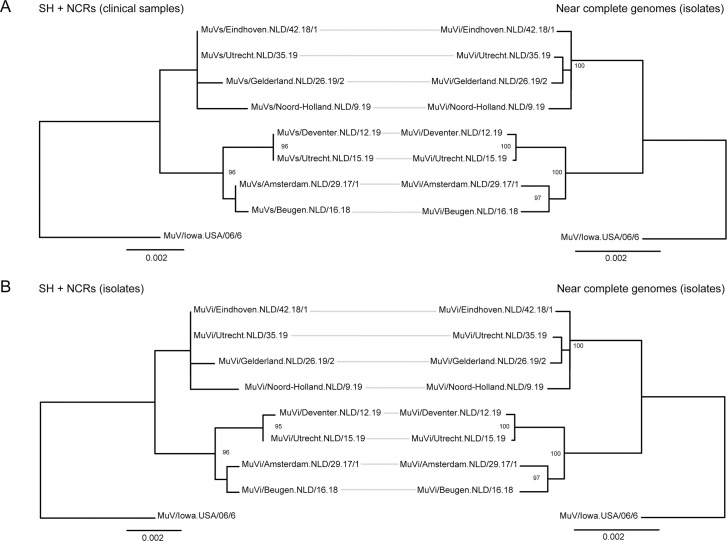
Mumps cases continue to occur, also in countries with a relatively high vaccination rate. The last major outbreaks of mumps in the Netherlands were in 2009-2012 and thereafter, only small clusters and single cases were reported. Molecular epidemiology can provide insights in the circulation of mumps viruses. The aims of the present study were to analyze the molecular epidemiology of mumps viruses in the Netherlands in 2017-2019 and to compare the phylogenetic trees built from sequence data of near complete mumps virus genomes or from the SH gene and non-coding regions (SH+NCRs). To this end, Sanger sequence data from SH+NCRs were analyzed from 82 mumps genotype G viruses. In addition, near complete genomes were obtained from 10 mumps virus isolates using next-generation sequencing. Analysis of SH+NCRs sequences of mumps genotype G viruses revealed the presence of two major genetic lineages in the Netherlands, which was confirmed by analysis of near complete genomes. Comparison of phylogenetic trees built with SH+NCRs or near complete genomes indicated that the topology was similar, while somewhat longer branches were present in the phylogenetic tree with near complete genomes. These results confirm that analysis of SH + NCRs sequence data is a useful approach for molecular surveillance. Furthermore, data from recent mumps genotype G viruses might indicate (intermittent) circulation of mumps genotype G viruses in the Netherlands in 2017-2019.
流行性腮腺炎病例仍在发生,即使在疫苗接种率相对较高的国家也是如此。荷兰最近一次大规模流行性腮腺炎暴发发生在 2009-2012 年,此后,仅报告了一些小的聚集性病例和单个病例。分子流行病学可以提供关于腮腺炎病毒传播的见解。本研究的目的是分析 2017-2019 年荷兰流行性腮腺炎病毒的分子流行病学,并比较从接近完整的腮腺炎病毒基因组序列或 SH 基因和非编码区(SH+NCRs)构建的系统发育树。为此,对 82 株基因型 G 的腮腺炎病毒的 SH+NCRs 进行了 Sanger 序列分析。此外,使用下一代测序从 10 株腮腺炎病毒分离株中获得了接近完整的基因组。对基因型 G 的腮腺炎病毒的 SH+NCRs 序列分析表明,荷兰存在两个主要的遗传谱系,这一点通过对接近完整的基因组的分析得到了证实。使用 SH+NCRs 或接近完整的基因组构建的系统发育树的比较表明,拓扑结构相似,而在接近完整的基因组的系统发育树中存在更长的分支。这些结果证实了分析 SH+NCRs 序列数据是一种用于分子监测的有效方法。此外,来自最近的基因型 G 腮腺炎病毒的数据可能表明 2017-2019 年在荷兰有间歇性的基因型 G 腮腺炎病毒循环。